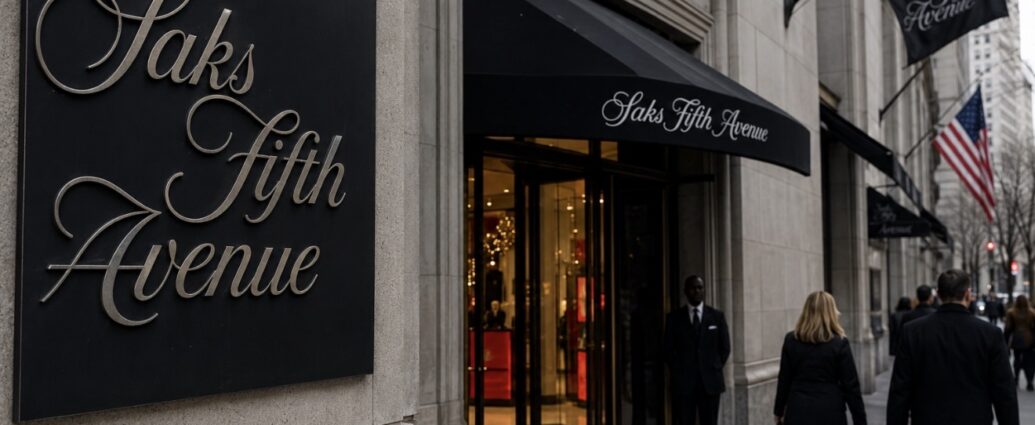
A U.S. Bankruptcy Court judge approved Saks Global’s Chapter 11 reorganization plan on June 5, 2026, clearing the luxury retail company to emerge from bankruptcy with significantly less debt, fewer stores, and a smaller workforce. The ruling marks the latest chapter in the restructuring of the company created by the merger of Saks Fifth Avenue, Neiman Marcus, and Bergdorf Goodman, a deal that was once expected to reshape the luxury department store industry.
In a hearing before the U.S. Bankruptcy Court for the Southern District of Texas in Houston, Judge Alfredo Perez approved the company’s plan to cut its debt burden by nearly 75%, reducing total debt to approximately $1.2 billion while transferring ownership to senior lenders. During the hearing, Perez praised management’s efforts to stabilize operations following what he described as a difficult start to the bankruptcy process.
The approval concludes a restructuring that dramatically altered the company’s footprint. When Saks Global filed for Chapter 11 protection on January 13, 2026, it carried approximately $3.4 billion in debt and employed roughly 17,000 workers. Since then, management has closed stores, reduced staff, and worked to restore relationships with luxury brands and vendors that had been strained during the company’s financial struggles.
The workforce reductions occurred in two separate phases.
Earlier in the restructuring process, the company eliminated more than 1,200 store and distribution center positions tied to a series of store closures across multiple states. Later, in April 2026, Saks Global announced approximately 640 corporate layoffs, representing about 16% of its headquarters workforce but less than 4% of total company employment.
Company executives said the corporate cuts were designed to eliminate duplicate administrative functions created after the merger and streamline operations for a smaller organization.
The store portfolio has also been significantly reduced.
Under the approved restructuring plan, Saks Global will continue operating 49 luxury retail locations, consisting of 33 Neiman Marcus stores, 15 Saks Fifth Avenue stores, and Bergdorf Goodman in New York City. To reach that level, the company closed more than half of its Saks Fifth Avenue locations and exited the Saks Off 5th off-price business.
Saks Global was formed following Hudson’s Bay Company’s $2.7 billion acquisition of Neiman Marcus Group in 2024. Executives envisioned creating a dominant luxury retail platform capable of competing with global luxury brands and online retailers.
Instead, the combined company struggled under the weight of acquisition-related debt, vendor payment issues, inventory shortages, and weakening sales trends. Those pressures ultimately pushed the retailer into bankruptcy protection at the beginning of 2026.
Chief Executive Officer Geoffroy van Raemdonck said the restructuring reflects the company’s transition to a smaller and more focused operating model. He noted that recent sales and inventory performance have exceeded internal expectations, suggesting the business is beginning to stabilize.
Under the court-approved plan, senior lenders will assume control of the company after providing $1 billion in bankruptcy financing and committing an additional $500 million in funding once Saks Global exits Chapter 11.
Junior creditors, who are owed approximately $1.5 billion, supported the restructuring after the creation of a $20 million litigation trust designed to pursue potential claims and recover additional funds on their behalf.
Looking ahead, management has set ambitious long-term goals, including generating $9 billion in gross merchandise value and achieving double-digit adjusted EBITDA margins by fiscal 2030.
The company’s challenges reflect broader pressures facing the luxury retail industry.
According to the Business of Fashion–McKinsey State of Fashion 2026 report, 46% of fashion executives expect industry conditions to worsen in 2026, up from 39% a year earlier. Executives cited tariffs as the industry’s leading concern, while rising borrowing costs, expensive retail leases, and the growing trend of consumers purchasing directly from luxury brands continue to pressure traditional department stores.
Additional workforce reductions are still ahead.
In a filing submitted to the Texas Workforce Commission on June 12, 2026, under the Worker Adjustment and Retraining Notification (WARN) Act, Saks Global disclosed plans to lay off 67 employees when it permanently closes the historic Neiman Marcus flagship store in downtown Dallas on September 30, 2026.
The location has served as a landmark in downtown Dallas since opening in 1907.
According to the filing, submitted by Janet Lee, associate general counsel for Saks Global, all employees at the store will be separated from employment when the location closes. The filing also noted that the workers are not represented by a union.
The company said it expects many affected employees will receive transfer opportunities at the Neiman Marcus NorthPark Center location in Dallas, while those who are not offered transfers will receive severance packages.
Dallas city officials, who spent months attempting to preserve the flagship location, expressed disappointment over the closure and noted the store’s long-standing importance to the city’s central business district.
For the luxury retail sector, Saks Global’s emergence from bankruptcy represents both an ending and a new test. The company has reduced its debt burden and repaired key vendor relationships. Whether a leaner chain of 49 stores can successfully compete in a market where luxury shoppers increasingly buy directly from brands remains one of the industry’s biggest questions.
JBizNews Desk | Dallas
© JBizNews.com All Rights Reserved. Reproduction or distribution without written permission is prohibited.