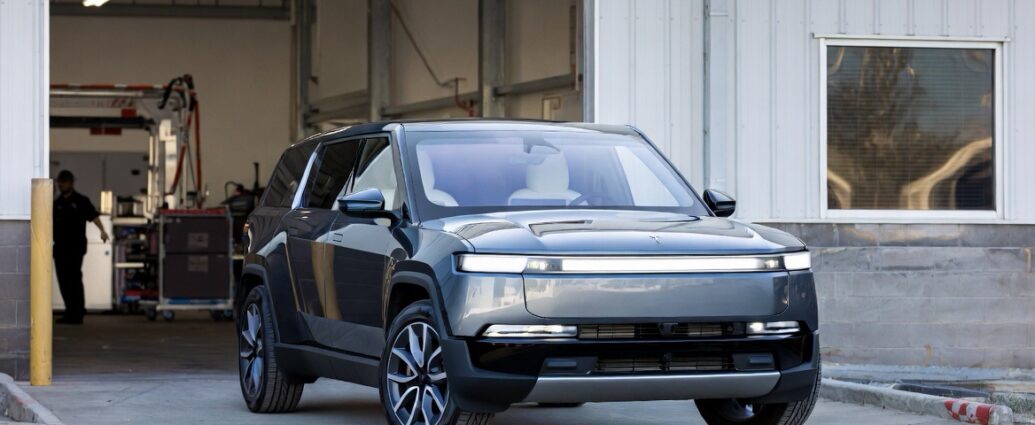
Electric-vehicle maker Rivian is laying off hundreds of workers just one week after it began delivering its most important new vehicle, the R2 SUV — a jarring sequence for a company trying to convince the public, and investors, that it is finally turning a corner. Rivian said Tuesday, June 16, that it was cutting less than 2% of its workforce as the EV maker aims to narrow losses, with the layoffs affecting some teams in its service and customer segments. The Wall Street Journal first reported the cuts.
In a statement, the company framed the move as part of its push toward profitability. “We recently restructured a handful of teams within Rivian as we work to profitably scale our business,” the company said. Rivian employed roughly 15,200 people across North America and Europe at the end of last year, putting the cuts at up to around 300 positions, concentrated in customer-facing roles rather than R2 production. Affected employees were given severance and encouraged to apply for other open roles.
The timing is striking because the R2 is the vehicle Rivian’s entire financial story rests on. It officially launched customer deliveries of the R2 on June 9, positioning the SUV as a serious U.S.-built competitor to the Tesla Model Y and the cheaper, higher-volume model meant to carry the company from a niche premium player burning cash to a mainstream automaker with the scale to make money.
So far, the market reaction has been cool. Investors reacted with disappointment to the first deliveries on June 9, with shares falling 7% that day, and analysts noted that the version now on sale is still out of reach for many buyers. The R2 Performance with the Launch Package opened at $57,990, with a Premium trim at $53,990 and a Standard version at $48,490 due in 2027, and a roughly $45,000 base model slated to follow.
This is not a one-off. It is at least the fourth round of cuts Rivian has made since the start of 2024. The move follows roughly 600 layoffs in October 2025, about 4.5% of the workforce at the time, which CEO RJ Scaringe tied to slowing EV demand after the federal tax credit expired and to leaning down ahead of the R2 launch.
Industry analysts cautioned against reading the cuts purely as a reaction to the R2. Auto analyst Brian Moody said the layoffs are likely not directly tied to the R2’s reception, pointing instead to declining interest in new electric cars and in expensive things generally, and noting the process likely began long before the launch. The backdrop is a broad cooling of the EV market after years of rapid growth.
The financial pressure is real. Rivian lost $3.6 billion last year and recently said it no longer expects to meet its 2027 adjusted core profit target. The company is also spending heavily on autonomous-driving efforts, including a robotaxi partnership with Uber, even as it tries to cut costs elsewhere.
That tension — pouring money into the future while squeezing the present — is what these layoffs are really about. Ivan Drury, director of insights at Edmunds, said Rivian may be trying to reach profitability by saving on labor, and wondered aloud to what degree the company plans to replace those people with AI and automation.
For the workers affected, the cuts land in a tough stretch for the broader tech and auto sectors, where companies are trimming headcount and steering savings toward automation and capital projects. For Rivian, the message to Wall Street is that it is willing to keep cutting even at an awkward moment to prove it can scale the R2 without scaling its losses.
The broader EV industry is facing a similar challenge. Growth has slowed from the explosive pace seen earlier in the decade, financing costs remain elevated, and consumers have become more selective about high-priced vehicle purchases. Automakers across the industry are balancing aggressive investment in new technology with pressure from investors to show a path toward profitability.
Rivian still has significant long-term ambitions. Beyond the R2, the company is developing the smaller R3 platform and continuing work on software, autonomous driving, and commercial-vehicle initiatives. Management believes those programs can eventually broaden the company’s customer base and improve margins, but they require substantial capital today.
The bigger question is whether the R2 can deliver the volume the company needs. Rivian is targeting 20,000 to 25,000 R2 deliveries in 2026 within total guidance of 62,000 to 67,000 vehicles, and it is building additional capacity, including a new factory near Atlanta. The R2 was supposed to be the moment Rivian broadened its customer base beyond its $70,000-plus R1 trucks and SUVs. Cutting hundreds of jobs in the same week it went on sale shows how narrow the company’s path to profitability has become — and how little room it has left to get the launch right.
JBizNews Desk | Irvine, Calif.
© JBizNews.com All Rights Reserved. Reproduction or distribution without written permission is prohibited.