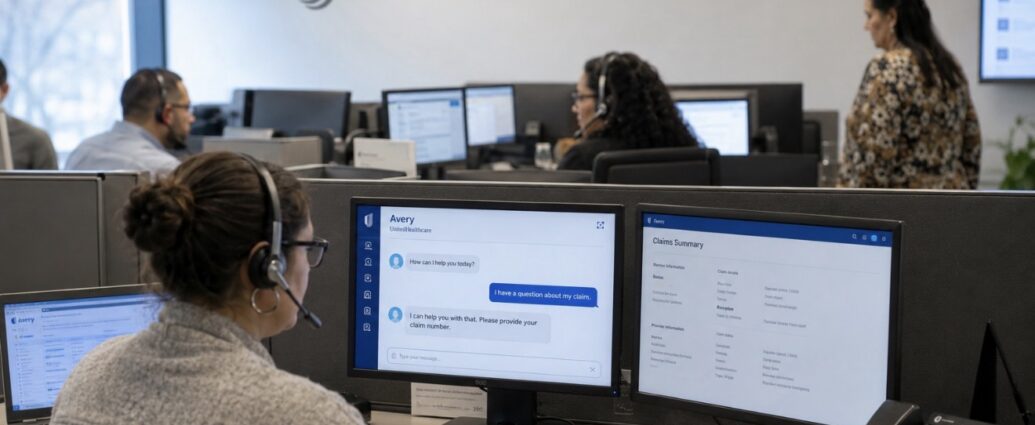
The largest health insurer in the country is spending $3 billion to wire artificial intelligence into nearly every corner of its business — and in one early trial, the software is picking up the phone to call doctors’ offices and book appointments for patients. UnitedHealth Group executives, describing the effort in remarks reported Friday, said the company plans to spend the money across 2026 and 2027 and is already seeing about $2 back for every $1 invested, as the technology automates manual work and makes staff more efficient.
The examples are striking. At UnitedHealth, AI reads summaries of medical charts aloud to nurses as they drive to patients’ homes, and it listens to millions of recorded customer calls to figure out what is driving complaints. The company has also rolled out a member chatbot named Avery that interacts with more than 20 million members. The appointment-scheduling test, in which AI agents call physicians’ offices on a patient’s behalf, is one of the newest experiments.
The scale of the buildout is hard to overstate. UnitedHealth now employs about 22,000 software engineers worldwide, and more than 80% of them use AI to write code or build new digital agents — programs designed to carry out tasks on their own. The company says it has already put more than 1,000 AI applications into production. In 2024, its chatbots handled more than 65 million customer calls, and in early 2025, members performed roughly 18 million AI-assisted searches to find doctors and healthcare providers.
The reason is money and speed. Sandeep Dadlani, who oversees technology operations at Optum Insight, has said the goal is to cut through healthcare’s notoriously slow and expensive administrative systems. AI is being deployed to automate fraud detection, generate clinical notes, review medical documentation, assist customer-service representatives, and help select billing codes that determine how much a medical visit costs and who ultimately pays for it.
The push comes at a critical time for the company. UnitedHealth has been grappling with rising medical costs while continuing to recover from the massive 2024 Change Healthcare cyberattack, one of the largest healthcare data breaches in American history. Executives believe automation can help offset those pressures while improving service for members and providers.
For a company of UnitedHealth’s size, even small productivity gains can translate into enormous savings. The insurer’s businesses touch tens of millions of Americans through employer-sponsored coverage, Medicare Advantage plans, pharmacy services, and physician networks. Industry analysts have described the initiative as one of the largest corporate AI investments ever made in healthcare.
At the same time, the rapid expansion raises questions about transparency and trust. When artificial intelligence becomes involved in healthcare decisions or communications, patients often have little visibility into how it is being used or whether a human reviewed the recommendation. A recent examination by STAT found that many patients remain unaware when AI systems are helping shape their healthcare experiences.
Healthcare experts have also warned that AI assistants can occasionally produce inaccurate information or incomplete recommendations. Public trust in healthcare chatbots remains mixed, particularly when conversations involve sensitive medical issues.
UnitedHealth says it is drawing clear boundaries around the technology. The company notes that more than 90% of claims are automatically approved, largely using traditional rules-based systems rather than generative AI. Dadlani has repeatedly emphasized that AI is intended to support human decision-making and will not be used to independently deny insurance claims.
That distinction matters because insurers’ use of algorithms in coverage decisions has already generated lawsuits, regulatory scrutiny, and public criticism in recent years. Consumer advocates continue to push for greater transparency whenever automated systems influence healthcare outcomes.
Not all of the results have focused on cost cutting. One AI tool developed by the company reviews patient records to identify conditions that may have gone undiagnosed. Early testing found physicians were approximately twice as effective at identifying certain health problems when supported by the AI system, according to company data.
The broader healthcare industry is watching closely. Rivals including CVS Health, Humana, and Cigna have all increased investments in artificial intelligence, but none has publicly announced a commitment approaching UnitedHealth’s $3 billion plan. The race reflects a growing belief across healthcare that AI could reshape everything from scheduling appointments to processing claims and identifying diseases.
It adds up to one of the largest AI bets any healthcare company has ever made. Whether UnitedHealth’s investment ultimately makes healthcare faster, cheaper, and easier to navigate — or simply inserts more machines between patients and their care — will be determined in real time by the tens of millions of Americans whose healthcare journeys increasingly intersect with artificial intelligence.
JBizNews Desk
Healthcare & Technology Bureau
© JBizNews.com All Rights Reserved. Reproduction or distribution without written permission is prohibited.