Conakry, Guinea — President Mamadi Doumbouya ordered a halt to all exports of raw gold on Sunday, telling the country’s miners and gold-buying houses that the metal must be refined inside Guinea before it can be sold abroad. He announced the ban at a meeting with industrial and artisanal gold producers in the West African nation, casting it as a way to keep more of the country’s mineral wealth at home and grow its economy.
The timing is no accident. Gold is in the middle of one of the strongest price runs in its history. The metal is trading above $4,300 an ounce this week, roughly $1,000 higher than a year ago and up about 40% over the past 12 months. Prices remain near the records set earlier this year, driven by heavy buying from central banks, persistent inflation concerns, and uncertainty surrounding the conflict between the United States and Iran. For a country with substantial gold reserves, watching the metal leave its borders as raw material while much of the profit is captured elsewhere has become increasingly difficult to justify.
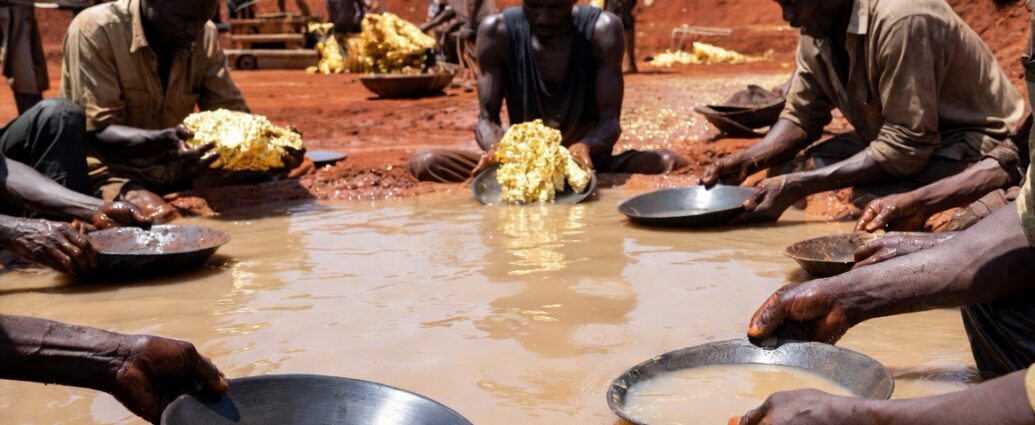
That is the heart of what Doumbouya is trying to do. Today, most of Guinea’s gold is extracted and exported with minimal processing, meaning the refining work, industrial jobs, and much of the value-added revenue are generated overseas. By requiring domestic refining, the government hopes to capture more of that value, build a local precious-metals industry, and transform raw exports into higher-value finished products.
The strategy follows a familiar economic argument. Processing natural resources domestically can significantly increase the amount of revenue a country earns from the same commodity. Guinea has already applied that reasoning to its massive bauxite industry, arguing that refining bauxite into alumina locally could generate substantially greater returns. The new gold policy extends that same approach to another major mineral resource at a time when prices remain exceptionally high.
The move also fits a broader economic agenda that has defined Doumbouya’s leadership. After seizing power in a 2021 military coup, he won a presidential election in December and was inaugurated in January, completing his transition from junta leader to elected president. Throughout that period, he has emphasized greater national control over Guinea’s natural resources.
His administration has rewritten mining regulations to encourage local processing, revoked the license of a unit of Emirates Global Aluminium amid a dispute over refinery construction commitments, and transferred those assets to a state-owned company. During the campaign, government officials repeatedly argued that Guinea’s mineral wealth should generate more benefits for Guineans themselves.
The country possesses the resources to support such ambitions. Guinea holds roughly one-quarter of the world’s known bauxite reserves, ranks among the world’s largest exporters of the ore, and is home to Simandou, one of the largest untapped high-grade iron ore deposits on the planet. Mining dominates the country’s export earnings and contributes roughly one-fifth of its economic output.
Yet despite that mineral wealth, much of the population remains poor. Mining accounts for only a limited share of formal employment, unemployment and underemployment remain widespread, and many citizens have seen little direct benefit from the country’s natural resources. For Doumbouya, the promise is straightforward: keep more of the value chain inside Guinea and convert mineral wealth into broader economic growth.
The policy also reflects a wider trend across parts of Africa. Governments in Mali, Burkina Faso, and Niger have all sought greater state control over mining operations and natural-resource revenues. Those efforts have often been framed as attempts to ensure that more wealth generated from local resources stays within national borders. Doumbouya is now applying a similar philosophy to gold during one of the strongest bullion markets in decades.
Significant challenges remain. Large-scale gold refining requires dependable electricity and industrial infrastructure. Only a portion of Guinea’s population has reliable access to power, and building modern refining facilities can require years of investment and billions of dollars. Foreign mining companies may also push back against stricter processing requirements or perceive increased regulatory risk.
There is also the question of the country’s extensive informal mining sector. Thousands of artisanal miners and small gold-buying businesses now face a sudden change in the rules governing how they sell and export their product. How effectively the government enforces the ban may ultimately determine its success.
For the global gold market, Guinea remains a relatively modest producer compared with some of the world’s largest suppliers, meaning the immediate impact on international prices is likely to be limited. The more important development may be the signal it sends. As gold remains near historic highs, resource-rich countries are increasingly asking why they should export raw commodities while other nations capture much of the downstream value.
In the near term, the burden will fall on miners, exporters, and buyers adjusting to the new requirements. Over the longer term, the success of the policy will depend on whether Guinea can build a competitive domestic refining industry and convert its mineral wealth into lasting economic gains.
JBizNews Desk | New York
© JBizNews.com All Rights Reserved. Reproduction or distribution without written permission is prohibited.