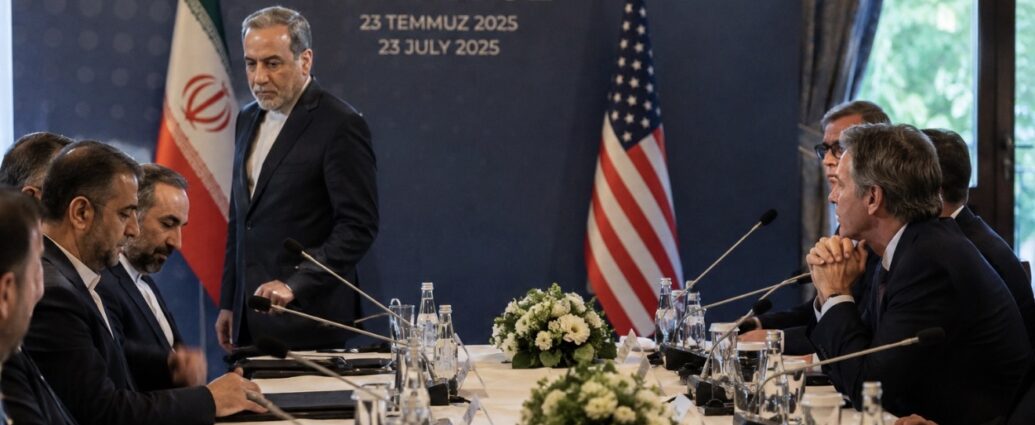
Iran’s negotiating team walked out of peace talks in Switzerland on Sunday after President Trump threatened fresh military strikes, throwing a week-old agreement to end the U.S.-Iran war into doubt. Iranian state media said the delegation left the Bürgenstock Resort near Lucerne and gave no date for returning.
The break followed a post Trump published on social media. He demanded Iran rein in its proxies in Lebanon and warned, “we’ll hit Iran very hard again, just like we did last week, only harder.” In a separate Fox News interview, he said the U.S. could resume bombing and even seize the Strait of Hormuz if no deal is reached.
Tehran’s complaint is that the threat itself broke the rules. The preliminary deal both sides signed on Wednesday bars them from attacking or even threatening each other, and Iranian media called Trump’s words a violation. The president, for his part, says Iran is the one not keeping its word.
For families watching their wallets, the real story sits in a narrow stretch of water. The Strait of Hormuz, between Iran and Oman, carries about a fifth of the world’s oil plus large volumes of natural gas and fertilizer ingredients. Iran announced on Saturday that it had closed the waterway again, blaming continued Israeli strikes in Lebanon. U.S. Central Command said ships were still moving through. Most of that oil heads to Asia, so a prolonged shutdown ripples through global supply long before it fully hits American shores.
That standoff lands at the gas pump. Oil had been falling fast on hopes the war was ending — Brent crude, the global benchmark, closed near $80 a barrel on Friday, down about 8% for the week and back near pre-war levels. A breakdown in Switzerland could reverse that. At the height of the war, average U.S. pump prices jumped more than a dollar a gallon and topped $4 across much of the country, and a Brown University tracker estimates the conflict has already cost the typical household over $250 in added energy bills.
The agreement was meant to wind the war down over 60 days. It reopens the Strait of Hormuz, sets up negotiations on Iran’s nuclear program, and — in a clause Tehran pushed for — calls for an end to the fighting in Lebanon. It was never a full peace treaty, more a roadmap both governments agreed to negotiate inside of. That last piece is what blew up. Rather than discussing the nuclear file the U.S. wanted to tackle, the talks had already been pulled toward the Lebanon flare-up before they stalled.
U.S. officials insisted the deal was not dead. Vice President JD Vance, who arrived in Switzerland early Sunday, told reporters there had been “great progress” and said he felt good about Lebanon. A U.S. official said the two sides expected to work through the night to keep the framework alive. Pakistan and Qatar, the mediators, were again leaning on Iran to return, with Pakistani Prime Minister Shehbaz Sharif and International Atomic Energy Agency chief Rafael Grossi on hand.
Iran’s leaders gave little ground. President Masoud Pezeshkian said his country “will never back down from the right to enrich uranium.” Tehran says its nuclear work is peaceful, though inspectors note it has enriched uranium well past the level needed for civilian use.
The hardest knot remains Lebanon. Israel and Hezbollah announced a ceasefire on Friday but kept trading fire into the weekend, and Israel has said it will keep fighting as long as Hezbollah does. Notably, Trump and Vance spent part of last week venting frustration at Israel, blaming a heavy-handed Israeli strike for nearly wrecking the deal — a rare public split between the two governments.
For businesses and households, it is the same nerve-racking rhythm: a deal that looks finished, a threat that knocks it loose, and an oil market that lurches on every headline. Whether gas stays near current levels or climbs again depends on what happens in a Swiss resort this week — and on whether the guns finally fall silent in Lebanon.
JBizNews Desk | New York
© JBizNews.com All Rights Reserved. Reproduction or distribution without written permission is prohibited.