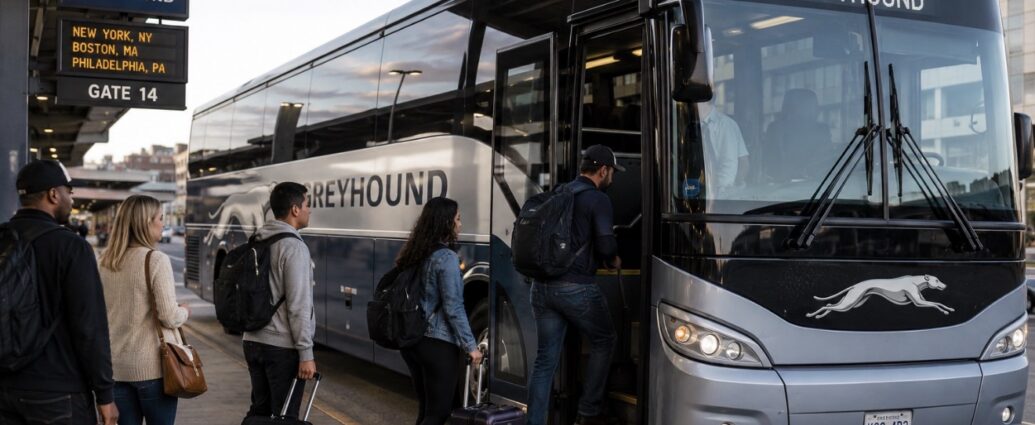
The biggest winner from the collapse of Spirit Airlines is not another airline. It is a 112-year-old bus company. Greyhound, the largest intercity bus operator in North America, is picking up budget travelers who lost their cheapest way to fly — and it is courting them with buses that look nothing like the ones their parents rode. After Spirit shut down on May 2, 2026, Rodney Surber, Greyhound’s chief operating officer, said the company’s upgraded fleet is “setting a new standard” for bus travel in North America.
That standard is a long way from the old image of intercity buses. As part of a multi-year overhaul, Greyhound has been replacing aging coaches with premium Prevost and Van Hool buses. The new vehicles come with ergonomic seats that have lumbar support and footrests, free Wi-Fi, a power outlet at every seat, quieter cabins, and an air system that filters the cabin several times an hour. They also carry modern safety gear, including collision-avoidance technology and onboard cameras. The first 60 of these buses rolled out on high-traffic routes like New York to Boston and Philadelphia, with hundreds more planned.
The timing could not be better for the bus company. Spirit Airlines ceased all operations on May 2, ending 34 years in business and stranding thousands of passengers overnight. It was the first time in 25 years that a major U.S. airline shut down because it ran out of money.
What killed Spirit was fuel. The airline had built its 2026 budget around jet fuel near $2.24 a gallon. By the end of April, the price had climbed to roughly $4.51. In a filing in the U.S. Bankruptcy Court for the Southern District of New York, the company blamed “recent geopolitical events” for a massive, sustained jump in fuel costs. Those events were the war with Iran, which began February 28, and the closure of the Strait of Hormuz, the narrow waterway that carries about a fifth of the world’s oil.
The fuel crisis did not stop at Spirit. Airfares climbed across the board. Domestic round-trip tickets averaged $623 in April, the highest in nearly four years, according to the Airlines Reporting Corporation, which tracks travel agency sales. Gas got expensive too. The national average hit $4.56 a gallon on May 21, according to AAA — painful timing as families started planning summer trips.
For travelers doing the math, the bus suddenly looked smart. A ticket from New York to Washington or Chicago to Detroit can cost a fraction of a plane fare, with no baggage fees and no airport. Joseph Schwieterman, director of DePaul University’s Chaddick Institute for Metropolitan Development, forecast in April that high gas prices and frustration with long flights would push more Americans onto buses by summer. His institute had already projected intercity bus ridership would grow about 4% in 2025, faster than its forecast for air travel or driving.
The company behind the comeback is German. Greyhound is now a brand of Flix North America, owned by Flix SE, which bought the iconic carrier in 2021 and folded it into the same platform as FlixBus. Together they serve roughly 1,800 destinations and carry more than 12 million passengers a year. Kai Boysan, the chief executive of Flix North America, has said the goal is to be “top of mind for anybody considering long-distance travel,” the way the company already is across Europe. For trips of five to seven hours, he argues, a bus can beat a plane once airport waits are counted.
Now comes a twist. The fuel crunch that started all of this is finally easing. On June 18, the national average for regular gas dropped below $4 for the first time since March 30, falling to $3.999, AAA reported. The decline followed a deal between the United States and Iran to reopen the Strait of Hormuz. By that date, 28 states were already under $4 a gallon.
Cheaper gas helps drivers, but it does not bring Spirit back. The discount airline competition it provided is gone, and a missing low-cost rival tends to push average fares up over time, not down. The U.S. Energy Information Administration expects it to take until early 2027 for oil shipments through the Strait of Hormuz to fully return to normal, with jet fuel staying sharply higher through 2026.
That leaves the upgraded bus as the budget option that did not disappear — and the timing is sharp. AAA expects record numbers of Americans to travel over the July 4 holiday. For a lot of them, the cheap seat this summer has wheels, Wi-Fi and a footrest.
JBizNews Desk
© JBizNews.com All Rights Reserved. Reproduction or distribution without written permission is prohibited.