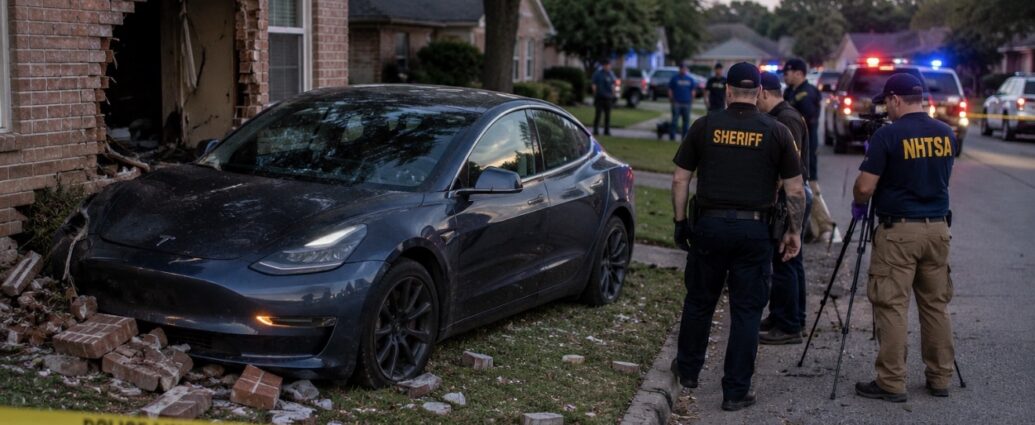
Federal safety regulators have taken over the investigation into a deadly Tesla crash in suburban Houston, escalating a local tragedy into a national test of the company’s driver-assistance technology. On Monday, June 22, the National Highway Traffic Safety Administration said it is launching a special crash investigation into a Tesla Model 3 that left a residential road in Katy, Texas, on Friday evening and slammed into a brick home at high speed, killing a 76-year-old woman inside. The driver told sheriff’s deputies the car was operating with an automated driving assistance system at the moment of impact.
According to the Harris County Sheriff’s Office, the driver, identified as Michael Butler, was traveling around 8 p.m. when his Model 3 failed to stay in its lane, ran off the road, missed a turn and tore through the wall of the house. The victim, Martha Avila, was standing in the front room of the home she shared with her daughter, son-in-law and three young grandchildren. She was pinned in the wreckage, airlifted to a hospital and later died; no one else was hurt. Butler, who was injured, showed no signs of intoxication and is cooperating, and no charges had been filed as of the weekend.
The driver’s claim that a driver-assistance system was engaged has not been independently confirmed. Investigators say they will pull the vehicle’s event data recorder and onboard logs to determine whether a driver-assistance feature was active, how fast the car was going, and what the driver did in the final seconds. A neighbor estimated the Model 3 was moving 60 to 70 miles per hour through the residential street, and a doorbell-camera video captured the car plowing through the home’s front wall.
NHTSA’s involvement federalizes a case that began with the county’s vehicular crimes unit, and it lands on top of mounting scrutiny of Tesla’s technology. In March, the agency upgraded its investigation into Tesla’s Full Self-Driving software to an Engineering Analysis covering roughly 3.2 million vehicles — the last procedural step before regulators can demand a recall — spanning 2017-through-2026 Model 3 sedans, the same model involved in the Katy crash. A separate open review covers about 2.88 million Teslas over reports of the system running red lights and drifting into oncoming lanes, and the company has faced questions about whether it properly reported earlier crashes. In all, NHTSA has opened more than 40 special crash investigations into Tesla incidents tied to its driver-assistance features.
There is a naming wrinkle. Tesla stopped using the “Autopilot” label on new vehicles in January 2026 after a California ruling pushed it to drop the marketing, but millions of older cars still carry the software. Whether the Katy car was running Autopilot or FSD (Supervised) depends on its age. Both are so-called Level 2 systems that require an attentive human driver at all times; neither makes a Tesla autonomous.
The business stakes are substantial. Full Self-Driving is a commercially active product that Tesla sells for $99 a month, and a defect finding could force a costly recall while undercutting the company’s robotaxi ambitions, which hinge on public and regulatory confidence in the same technology. The fatality also arrives at a politically charged moment. Tesla, led by Elon Musk, has been pressing the Trump administration to loosen federal safety rules for automated vehicles, and NHTSA Administrator Jonathan Morrison has signaled that 2026 would be a major year for self-driving rulemaking aimed at clearing regulatory barriers. Musk’s earlier government cost-cutting effort had also trimmed NHTSA staff with expertise in evaluating autonomous-vehicle safety.
For now, the central question is factual: was a driver-assistance system actually engaged, and if so, what did it do? The data recorder is expected to settle it, and NHTSA’s involvement makes that evidence far more likely to become public. Either way, a federal fatality investigation tied to Tesla’s flagship software raises the regulatory and financial pressure on the company at exactly the moment it is trying to convince Washington — and the public — that its cars can be trusted to drive themselves.
JBizNews Desk
© JBizNews.com All Rights Reserved. Reproduction or distribution without written permission is prohibited.