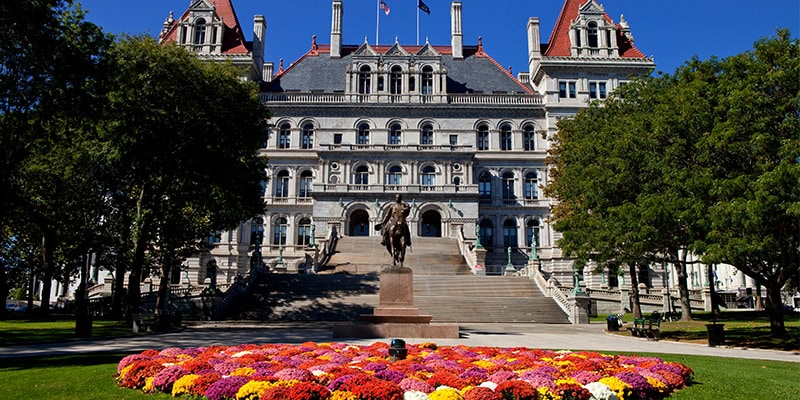
Like other legislatures around the United States, the New York State Legislature spent the first half of this year considering policy on controversial topics that affect commercial real estate development. When both chambers adjourned their 2026 legislative session in early June, two bills they had passed demonstrated the antithetical approaches to development policy that many other states are currently deciding between.
On the one hand, there was the Responsible Data Center Development Act (A.11560/S.106420), a one-year moratorium on data center development that, if signed into law, will become the harshest statewide restriction on data center development in the nation. On the other hand, A.10009-C/S.9009-C, the state’s budget bill for fiscal year 2026-2027, included a significant reform of the State Environmental Quality Review Act (SEQRA) that both NAIOP chapters in New York – NAIOP Upstate New York and NAIOP New York City Metro – supported during their Day at the Capitol in Albany earlier this year. These diverging approaches to development policy within the same state illustrate the crossroads at which many states find themselves while trying to fulfill promises of affordability.
Though data centers have existed for decades, opposition to data center development rapidly became a prominent political issue nationwide starting in 2025 amid the AI boom. Over the past year, dozens of municipalities have placed temporary bans, or moratoriums, on data center development. Though these moratoriums largely started in smaller towns, they have spread to major cities like Denver, Minneapolis and Charlotte by the spring of 2026. No state has yet enacted a data center moratorium, though there has been one close call. Maine passed a one-year moratorium bill through both chambers of its state legislature in April 2026; however, an unexpected veto from Governor Janet Mills killed that effort until at least 2027. Now, New York has become the second state to pass a data center moratorium through its legislature and potentially will become the first to enact it.
New York’s Responsible Data Center Development Act contains multiple provisions affecting development of data centers, which the bill defines as any facility with a peak electrical power demand of at least 1 megawatt that is used for computing or related services. The strictest regulation, of course, is the one-year development moratorium, which will freeze permitting for “large” data center projects with peak loads of at least 20 megawatts. Additionally, these “large” data centers will face a new public utility classification for their electricity and water usage, provide benefits programs for the local community where the data center is located, and host a public hearing on development at least three months before receiving a permit. All data centers with peak loads of 5 megawatts or higher will face strict renewable energy and prevailing wage labor mandates, while data centers of any size will have to comply with energy efficiency requirements. Finally, the bill directs the Department of Environmental Conservation to complete an 18-month study on the environmental impact of data centers to inform future regulations. New York Governor Kathy Hochul has until Dec. 31 to decide whether to sign or veto this bill, meaning it could take quite some time to know if New York will become the first state with a data center moratorium.
In contrast to the anti-development posture of the data center moratorium bill, the state’s budget, signed by Hochul in late May, contained major reforms to New York’s State Environmental Quality Review Act (SEQRA). Modeled off the federal National Environmental Policy Act, SEQRA is an environmental review law that requires the completion of a lengthy environmental impact assessment prior to any discretionary government decision regarding development, such as a zoning change or special permit.
Including New York, 15 states and Washington, D.C., have a NEPA-like environmental review law, often making development much harder. The recent political debate over “affordability” has generated momentum to reform these laws; in June 2025, California majorly reformed the California Environmental Quality Act (CEQA), the strictest environmental review law in the nation, as part of an effort to address a housing shortage.
In 2026, Hochul began promoting her “Let Them Build” agenda, which included a request that the New York legislature include reforms to SEQRA in its annual budget. When NAIOP Upstate New York and NAIOP New York City Metro sent representatives to Albany earlier this year, they urged state legislators to support Hochul’s proposal. In a huge win for NAIOP and the broader development community, these reforms successfully passed as part of the budget. Now, residential developments of up to 500 units in New York City and 300 units in the rest of the state are exempt from SEQRA reviews if they are built on previously disturbed sites. This exemption also applies to certain water infrastructure projects. Additionally, stricter timelines have been placed on SEQRA review timelines, creating a more consistent environment for developers.
While these two bills only directly affect New York, many other states are currently discussing these same or similar issues right now. And as these bills demonstrate, the relevant policy solutions have the potential to either help or harm the commercial real estate development industry. If NAIOP members ensure to engage with their state and local governments, they can help ensure that more pursue the path of working with, not against, developers.