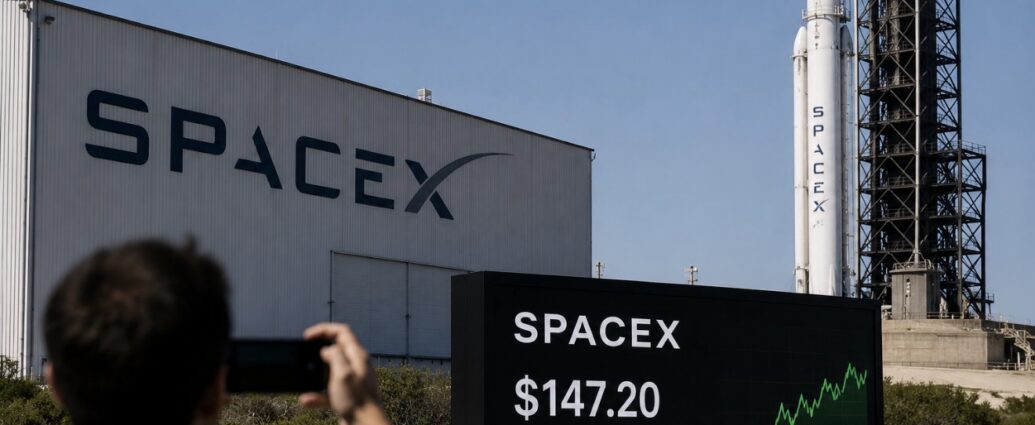
SpaceX shares recovered Tuesday after briefly falling below the stock’s initial trading price for the first time since the company’s highly anticipated public debut earlier this month.
The stock dropped as low as $146.88 during morning trading, slipping below the company’s first-trade price of $150 and briefly pushing its market valuation below $2 trillion.
By the closing bell, however, buyers returned.
Shares finished the session modestly higher, snapping a three-day slide that had erased nearly a quarter of the company’s market value.
The rebound followed one of the most dramatic stretches since the company’s June 12 initial public offering.
After pricing its IPO at $135 per share, SpaceX surged more than 50% in its first days of trading, briefly becoming one of the most valuable companies in the world and adding hundreds of billions of dollars to founder Elon Musk’s net worth.
The enthusiasm cooled quickly.
Investors began reassessing the company’s valuation after SpaceX disclosed plans Monday to enter the public bond market for the first time.
The company announced a senior unsecured notes offering expected to raise at least $20 billion, while also revealing that it held approximately $100.8 billion in cash and equivalents as of June 19.
For some investors, the combination raised questions.
If the company already holds more than $100 billion in cash, why raise billions more through debt?
Supporters argue the answer lies in the scale of SpaceX’s ambitions.
The company continues investing heavily in Starship, satellite infrastructure, artificial intelligence, data centers, and other long-term growth initiatives that require enormous amounts of capital.
Critics counter that the fundraising highlights just how expensive those ambitions may ultimately become.
Despite the recent volatility, SpaceX remains significantly above its IPO price.
Even after the pullback, shares continue trading roughly 10% above the offering price that investors paid less than two weeks ago.
Part of the stock’s volatility stems from its unusually small public float.
Only about 4.2% of outstanding shares were made available to public investors during the IPO. With relatively few shares actively trading, both rallies and selloffs can become amplified as investors rush to buy or sell.
The market is also continuing to evaluate the company’s financial performance.
SpaceX generated approximately $18.7 billion in revenue during 2025, but reported a net loss of roughly $4.9 billion as spending accelerated across major projects.
The company also continued reporting substantial investment-related losses during the first quarter of 2026 as it expanded operations and pursued new growth initiatives.
Bulls argue those losses reflect strategic investment rather than financial weakness.
Recent agreements tied to artificial intelligence infrastructure and high-performance computing have strengthened revenue expectations, with analysts citing several large commercial contracts that could generate billions in future revenue.
Wall Street remains divided.
Some analysts believe SpaceX’s dominance in commercial launch services, satellite communications, and emerging AI infrastructure justifies a substantially higher valuation.
Others caution that investors may have become overly optimistic following the IPO and that the company still faces significant execution risks.
Another major test is approaching.
Several insider lock-up periods begin expiring later this year, allowing early investors and company insiders to sell portions of their holdings for the first time.
The first significant unlock is expected following the company’s next earnings report, currently scheduled for August 6.
Investors will be watching closely.
The earnings release will provide the market’s first comprehensive look at SpaceX as a public company and may help determine whether the stock’s early valuation can be supported by operating performance.
For now, Tuesday’s rebound suggests many investors still view the recent pullback as a buying opportunity.
But the sharp swings also serve as a reminder that even industry-leading companies can experience significant volatility when expectations, valuations, and growth ambitions collide.
JBizNews Desk | New York
© JBizNews.com All Rights Reserved. Reproduction or distribution without written permission is prohibited.