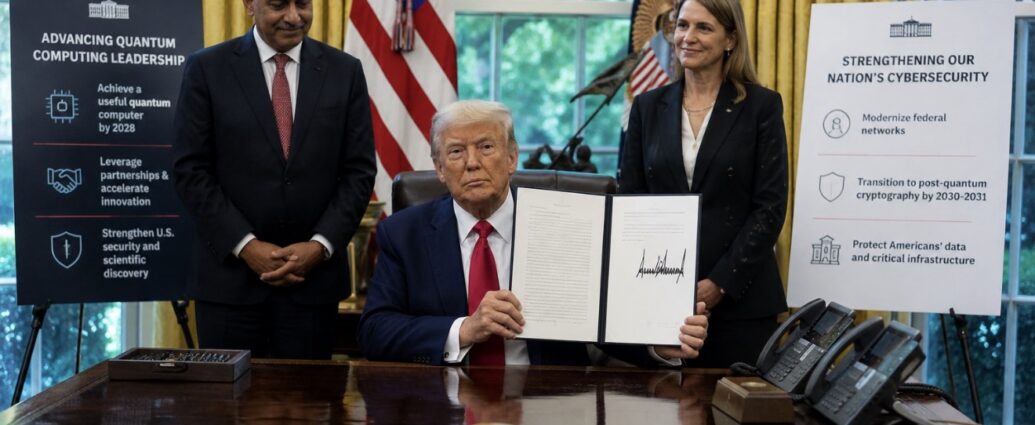
President Donald Trump signed two executive orders Monday designed to accelerate America’s quantum-computing capabilities while preparing federal agencies for the cybersecurity challenges the technology could eventually create.
The orders place quantum technology among the administration’s top national-security and economic priorities, reflecting growing competition with China and increasing concern that future quantum computers could undermine today’s digital security systems.
Speaking during the signing ceremony, administration officials described the initiative as a major step toward securing U.S. leadership in one of the world’s most strategically important technologies.
At the center of the first order is an ambitious goal.
The administration is directing federal agencies to pursue development of a next-generation quantum computer capable of supporting advanced scientific research by 2028.
The Department of Energy has been instructed to establish technical requirements for the system and explore partnerships with private-sector companies capable of helping build the technology.
The computer is expected to be housed within the national laboratory system.
Quantum computing differs fundamentally from traditional computing.
While conventional computers process information using bits that exist as either zeros or ones, quantum computers utilize quantum mechanical properties that allow them to perform certain calculations exponentially faster than today’s most advanced supercomputers.
Researchers believe the technology could eventually transform fields including drug development, advanced materials, artificial intelligence, energy production, logistics, and national defense.
The executive order also directs the Department of Defense to accelerate deployment of quantum-sensing technologies by September 2028.
These systems could help military aircraft navigate in environments where GPS signals are unavailable or disrupted and may eventually assist in detecting underground facilities, hidden infrastructure, and other difficult-to-observe targets.
The second executive order focuses on cybersecurity.
Federal officials increasingly worry that sufficiently powerful quantum computers could eventually break many of the encryption systems currently protecting financial transactions, government communications, healthcare records, critical infrastructure, and other sensitive data.
To address that risk, the administration ordered agencies to accelerate migration toward so-called post-quantum cryptography, a new generation of encryption designed to withstand attacks from future quantum computers.
Federal agencies will now be expected to transition their most sensitive systems by approximately 2030–2031, significantly ahead of previous timelines.
Each agency must designate a migration leader within 30 days and develop implementation plans designed to protect government networks before large-scale quantum systems become operational.
The urgency stems from growing concerns surrounding what technology experts often call “Q-Day” — the moment when quantum computers become powerful enough to break widely used encryption standards.
While experts disagree on exactly when that threshold may arrive, many believe the timeline is shortening.
Several major technology companies and research organizations have recently warned that practical quantum breakthroughs could emerge sooner than previously expected.
The executive orders do not include new funding appropriations.
Instead, agencies have been directed to utilize existing resources while coordinating with industry partners, research institutions, and national laboratories.
The orders follow recent federal efforts to expand investment in emerging technologies tied to artificial intelligence, semiconductors, advanced manufacturing, and national security.
The business implications could be substantial.
The move provides additional momentum for companies operating in the quantum-computing sector, including technology giants such as IBM, Microsoft, and Alphabet, as well as a growing number of specialized quantum firms focused on hardware, networking, sensing, and cybersecurity.
Investors responded positively, with several publicly traded quantum-related companies posting significant gains following news of the initiative.
Still, many industry experts caution that the timeline remains aggressive.
Developing a large-scale fault-tolerant quantum computer remains one of the most difficult engineering challenges in modern science. Several leading companies have previously suggested that fully operational systems may not arrive until the end of the decade or later.
Government targets alone cannot overcome the underlying scientific obstacles.
Even so, the message from Washington is unmistakable.
The United States is treating quantum technology not merely as a research project, but as a strategic national priority with major implications for economic competitiveness, technological leadership, cybersecurity, and national defense.
For businesses and consumers alike, the most important impact may ultimately be invisible: a race to strengthen the digital locks protecting financial data, communications, and critical infrastructure before future quantum machines become powerful enough to break them.
JBizNews Desk | New York
© JBizNews.com All Rights Reserved. Reproduction or distribution without written permission is prohibited.