Before Tesla became a $1.3 trillion company and one of the most influential businesses in the world, its future rested on a simple but controversial belief: batteries—not engines—would transform transportation. The engineer who championed that idea, JB Straubel, is now reflecting on the gamble that helped reshape the auto industry.
Speaking at Fortune’s Brainstorm Tech Conference in Aspen, Straubel recalled that his first meeting with Elon Musk in 2003 was not about building electric cars at all. Yet Musk was convinced enough by the young Stanford engineer’s vision to write a check, launching a partnership that would eventually change the automotive world.
Straubel is one of Tesla’s five co-founders and served as the company’s Chief Technology Officer until 2019. While Musk became the public face of Tesla, Straubel was widely regarded as the architect of the company’s battery strategy—the technology that made long-range electric vehicles commercially viable.
At a time when electric cars were widely dismissed as impractical, Straubel focused on developing battery systems that could deliver both performance and scale. He also helped pioneer Tesla’s Gigafactory model, designed to manufacture batteries in massive volumes while driving down costs.
Years before Tesla’s rise, Straubel spent his spare time building solar-powered vehicles as a hobby. That passion eventually led him to electric transportation and the conviction that batteries would become the foundation of a new energy economy.
Looking back, Straubel said entrepreneurs must be willing to pursue ideas that many people believe will fail.
“You have to be willing to dive into something,” he said, noting that innovators should expect critics and skeptics along the way.
That conviction has proven valuable. Tesla’s energy-storage division has become one of its fastest-growing businesses. During the third quarter of 2025, Tesla’s energy segment generated more than $3.4 billion in revenue, representing over 12% of company sales and highlighting Tesla’s evolution from an automaker into a broader energy company.
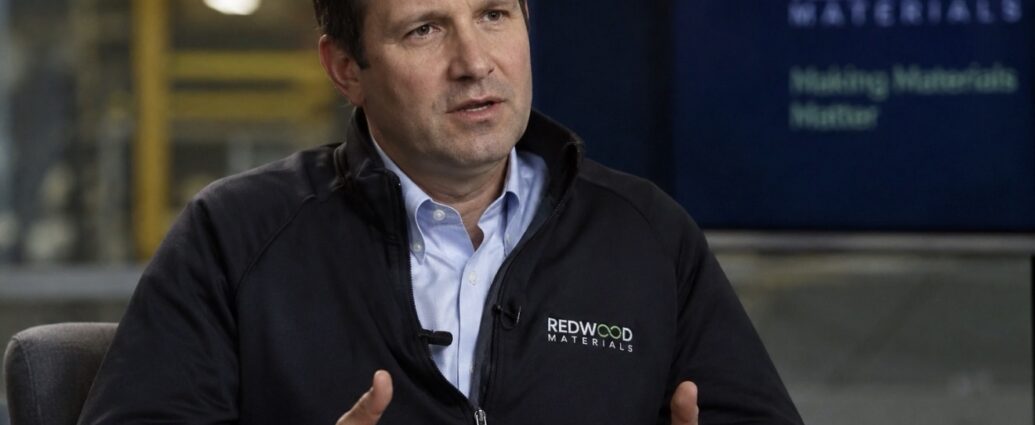
Straubel stepped away from day-to-day operations at Tesla in 2019 but remains on the company’s board. His attention is now focused on Redwood Materials, the battery recycling and materials company he founded in 2017.
Based in Nevada, Redwood seeks to create a closed-loop battery ecosystem by recovering lithium, cobalt, nickel, and other valuable materials from used batteries and turning them back into new battery components. The strategy is aimed at reducing America’s dependence on foreign supply chains while supporting the rapid growth of electric vehicles, renewable energy, and AI-driven power demand.
Investors have embraced the vision.
Redwood raised more than $1 billion in a funding round co-led by Goldman Sachs Asset Management and funds advised by T. Rowe Price, followed by another $350 million investment round backed by Nvidia. The company also secured a conditional $2 billion Department of Energy loan to support expansion near Reno, Nevada.
Major industry partners include Panasonic, Ford, General Motors, and BMW, underscoring the growing importance of battery supply chains across the automotive sector.
The company is also positioning itself for a future where batteries are needed far beyond electric vehicles. The rise of artificial intelligence, data centers, and grid-scale energy storage is creating enormous demand for battery infrastructure capable of supporting increasingly power-hungry technologies.
That opportunity comes amid a changing political landscape. The expiration of the federal $7,500 electric vehicle tax credit and broader reductions in clean-energy incentives have slowed parts of the EV market. Yet demand for energy storage continues to rise as utilities, technology companies, and data-center operators seek reliable power solutions.
The common thread between Tesla and Redwood is the same belief Straubel held more than two decades ago: batteries are becoming the foundation of modern transportation and energy systems.
From a lunch meeting in 2003 to helping build one of the world’s most valuable companies, Straubel’s early bet on batteries continues to shape industries worth trillions of dollars—and may prove just as important in the decades ahead.
JBizNews Desk | New York
© JBizNews.com All Rights Reserved. Reproduction or distribution without written permission is prohibited.