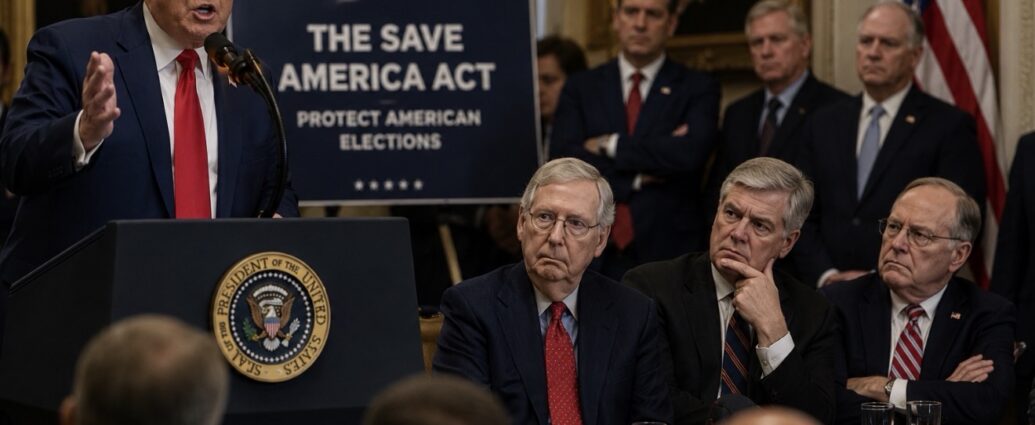
President Donald Trump abruptly called off a planned signing ceremony for a bipartisan housing-affordability bill on Wednesday, announcing the cancellation in a social-media post hours before he was set to appear at the Capitol — and triggering one of the sharpest public breaks with his own party in months. “Today’s Housing News Conference and Signing is hereby cancelled,” Trump wrote, saying he would not sign until Congress passes his elections-overhaul measure, the Save America Act, which he called a national emergency.
The move blindsided Senate Republicans, who had hoped to showcase the housing bill as a concrete win on affordability heading into November’s midterm elections. Instead, the day descended into open friction. According to Bloomberg and multiple lawmakers present, tensions flared at a closed-door GOP luncheon, where senators pressed the president over his handling of the war in Iran.
The most heated exchange came between Trump and Louisiana Senator Bill Cassidy, whose Senate career effectively ended after Trump backed a primary challenger. Cassidy, who one day earlier had voted to formally rebuke the president’s war powers, said he stood up and demanded answers: the conflict was supposed to last four weeks, he noted, and had stretched to four months without meeting its original aims. By his own account, Cassidy raised his voice and called Trump “brother.” Trump shot back that he was not his brother, according to a person in the room, before colleagues urged Cassidy to sit down.
The substance underneath the drama is what makes this a business story. The housing bill Trump declined to sign was aimed squarely at affordability — the cost-of-living issue voters consistently rank near the top of their concerns. By walking away from a public signing, Trump signaled he is willing to hold a popular economic measure hostage to an unrelated elections fight, even as home prices and rents strain household budgets nationwide.
The standoff also reflects a deeper rift over priorities. Senate Majority Leader John Thune has repeatedly said the path to keeping the GOP majority runs through “kitchen table” pocketbook issues. Trump, by contrast, has pushed senators to prioritize his proof-of-citizenship voting bill, which currently lacks the votes to pass. He has also blocked confirmation of one of his own nominees and pressed lawmakers to help fund a White House ballroom project over their objections.
Markets, meanwhile, found something to like in the day’s other headline. Emerging from the lunch, Trump pointed reporters to oil prices, noting crude had just broken below $70 a barrel — a level not seen since before the Iran conflict began on February 28. He framed falling energy costs and factory construction as evidence of a strong economy, calling the U.S. “the hottest country in the world.”
The Iran war remains the fault line. Four Senate Republicans joined Democrats this week to advance a war-powers resolution directing Trump to pull back forces — the first time the Senate has approved such a measure. Though largely symbolic, the vote underscored growing unease among Republicans about both the war and the interim deal Trump struck to wind it down. For days, top lawmakers complained they were kept in the dark about the terms of the U.S.-Iran memorandum of understanding.
There were signs of de-escalation abroad even as Washington squabbled. The State Department said the U.S. Embassy in Kuwait resumed operations at midnight Wednesday, more than three months after Iranian attacks forced its closure. And the head of the U.N. nuclear agency, Rafael Grossi, signaled that inspectors would be allowed to visit Iranian enrichment sites — a key piece of the interim agreement.
For business and markets, the takeaway is the uncertainty itself. A president openly feuding with his own Senate majority complicates the path for any legislation that touches the economy, from housing to government funding. Trump tried to paper over the discord, insisting afterward that Republicans are a “really well-unified party,” even as he conceded he didn’t like a few people in the room. Outgoing Senator John Cornyn, another Trump-backed primary casualty, summed up the mood drily on his way out: “Quite the unity message.”
Whether Trump ultimately signs the housing bill — and when — now hangs on a voting fight that has nothing to do with housing at all.
JBizNews Desk | New York
© JBizNews.com All Rights Reserved. Reproduction or distribution without written permission is prohibited.