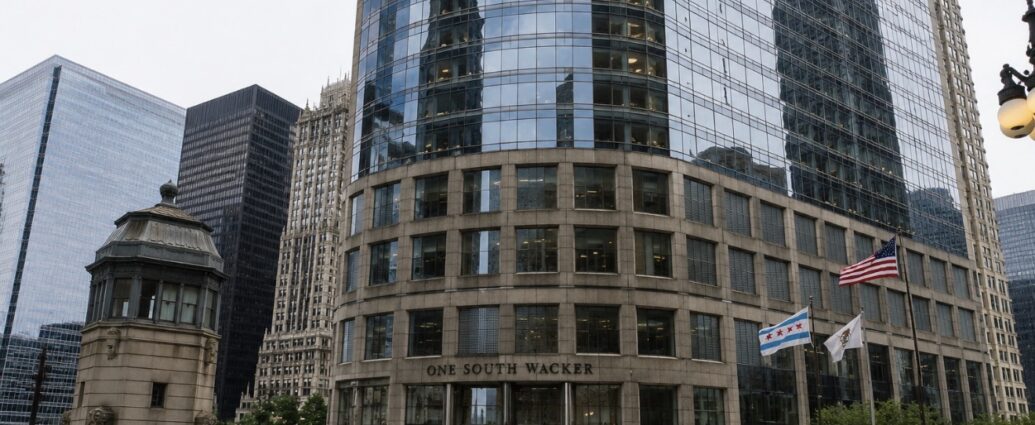
A mortgage filing made public this week shows that 601W Companies, the New York real estate firm that owns the 40-story office tower at One South Wacker Drive in downtown Chicago, defaulted on a $343 million loan on June 9. The default is the latest sign that Chicago’s office market continues to struggle years after the pandemic reshaped how and where people work.
The default occurred when the loan reached its maturity date and the outstanding balance was not repaid. In commercial real estate, failing to pay off a loan when it comes due typically triggers a default, even if the borrower has remained current on interest payments. According to the filing, that is what happened at One South Wacker Drive.
The debt was originally provided by Blackstone Mortgage Trust, the commercial real estate lending arm of private-equity giant Blackstone. The company originated the $343 million loan in late 2018, the same year 601W acquired the building for approximately $310 million. Loan records indicate the financing carried an origination loan-to-value ratio of roughly 78%, meaning the debt represented a significant portion of the property’s value at the time.
Like many large commercial real estate loans, part of the financing was packaged into a commercial mortgage-backed security (CMBS). Roughly $159 million of the debt was bundled with other loans and sold to bond investors. While common in commercial real estate, that structure means financial stress at a single office building can affect a broad range of institutional investors beyond the original lender.
The property itself remains one of Chicago’s better-known office towers. The 1.2 million-square-foot building was designed by renowned architect Helmut Jahn and underwent a major renovation shortly before the COVID-19 pandemic disrupted office markets nationwide. Today, however, the tower is approximately 73% occupied, well below the occupancy levels landlords relied on before remote and hybrid work became widespread.
There are signs of progress. Energy developer Invenergy is reportedly negotiating an expansion that could nearly double its footprint in the building. If completed, the deal would meaningfully increase occupancy and strengthen cash flow. But those improvements were not enough to resolve the refinancing challenge before the loan matured.
Blackstone sought to minimize concerns about the default. A spokesperson for Blackstone Mortgage Trust noted that the loan represents less than 2% of the company’s overall portfolio and said the property has been on the lender’s internal watchlist since 2022. The company added that it still views the building’s operating performance as reasonable despite ongoing challenges. Investors appeared to agree, with shares of Blackstone Mortgage Trust slipping only modestly following the news.
For 601W, the situation reflects broader pressures across its portfolio. The company also owns Chicago’s Aon Center, which faces the maturity of a $678 million debt package. Separately, the firm has been involved in a foreclosure dispute tied to the historic Civic Opera Building. At the same time, 601W has continued pursuing acquisitions, purchasing properties at significant discounts as office valuations remain depressed. Recent transactions include the acquisition of 175 West Jackson Boulevard in Chicago and the Wells Fargo Center North Tower in Los Angeles.
The larger story extends far beyond a single office tower.
Across the United States, office values have fallen sharply since 2020 as companies reduced their real-estate footprints and embraced hybrid work arrangements. At the same time, higher interest rates have dramatically increased borrowing costs, making it far more difficult for property owners to refinance loans that were originated when rates were near historic lows.
That combination — lower occupancy and higher financing costs — has created significant pressure throughout the commercial real-estate sector. Owners face declining property values while lenders confront growing risks tied to maturing debt.
The consequences reach beyond landlords and investors. Office towers represent a major source of property-tax revenue for cities. When building values decline, local governments collect less revenue, increasing pressure on municipal budgets. Lower office occupancy also affects restaurants, retailers, transit systems, and other businesses that depend on daily commuter traffic.
Chicago has already seen a growing number of office properties trade at steep discounts compared with pre-pandemic valuations. Some buildings are being converted into apartments or mixed-use developments as owners search for alternative uses.
The default at One South Wacker Drive does not threaten Blackstone or fundamentally alter Chicago’s economy. But it adds another prominent name to the growing list of office buildings struggling to refinance debt in a market that looks dramatically different from the one that existed when those loans were first issued.
For Chicago’s downtown office market, the message remains clear: recovery is happening, but it remains slow, uneven, and far from complete.
JBizNews Desk | New York
© JBizNews.com All Rights Reserved. Reproduction or distribution without written permission is prohibited.