Let me confirm the Apple price-hike consumer angle, which is the everyday-business hook here.
Korean Stocks Plunge Over 8% as Apple Price Hikes Sink Chipmakers, Halt Trading
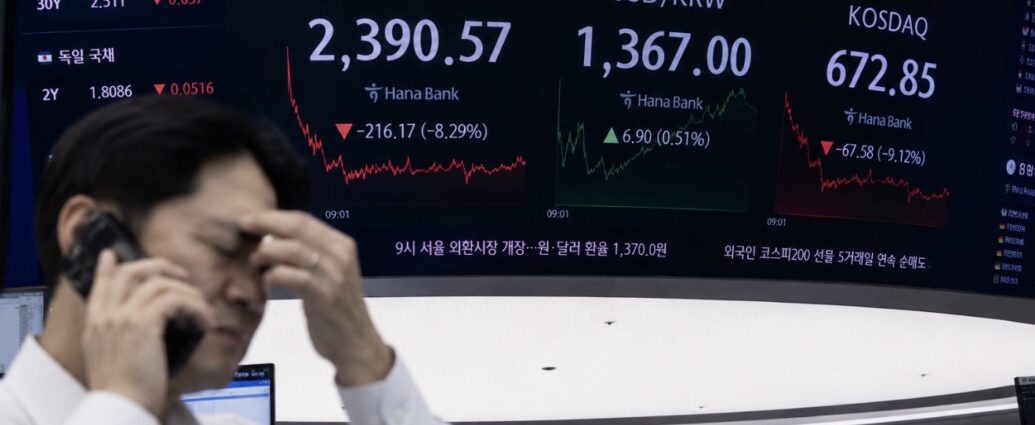
South Korea’s main stock index crashed more than 8 percent on Friday, June 26, forcing the Korea Exchange to slam on a 20-minute trading halt after a wave of selling tore through the country’s largest chipmakers. It was the fifth time the exchange has tripped its circuit breaker this year and the third halt this week alone, a stretch of turbulence that has rattled what had been, until recently, the best-performing stock market on the planet.
The spark came from an unlikely place: a price increase on iPads and laptops. Apple announced Thursday, June 25, that it was raising prices on Macs, iPads, home devices and the Vision Pro headset, its first formal move to pass soaring memory-chip costs on to shoppers. In a statement, the company said the rapid buildout of AI data centers had created an extraordinary surge in demand for memory and storage, adding that it had never seen a component price climb this fast. Apple shares fell about 6 percent, the stock’s worst day since April 2025.
That sounds like an American consumer story, but it landed hardest in Seoul. Samsung Electronics and SK Hynix, the two Korean giants that dominate global memory-chip production, each tumbled more than 9 percent on Friday and dragged the broader market down with them. The benchmark KOSPI slid roughly 8.2 percent, and the selling was severe enough to freeze the entire market mid-session.
Here is the connection. Apple raising prices because memory chips have gotten so expensive should, on its face, be good news for the companies that make those chips. But investors read it the other way. Tim Cook, Apple’s chief executive, had earlier told The Wall Street Journal that the price increases were unavoidable and likened the memory shortage to a hundred-year flood. The fear now is that if devices get more expensive, people buy fewer of them. Research firm IDC estimates the global smartphone market could see its biggest-ever annual decline this year, near 14 percent, with the PC market falling more than 11 percent. Fewer phones and laptops sold eventually means softer demand for the chips inside them, and that threatens the exact growth story that sent Samsung and SK Hynix soaring all year.
A second blow came from across the Pacific. The New York Times reported that OpenAI was weighing a delay of its hotly anticipated stock-market debut to 2027. The artificial-intelligence boom has been the engine behind Korea’s entire rally, and any hint that the marquee names of that boom are cooling sends a chill through the chip trade.
The numbers behind the chip squeeze help explain the panic. Prices for DRAM, the memory used in nearly every modern device, jumped as much as 98 percent in the first quarter of this year and are set to climb another 58 to 63 percent this quarter, according to industry tracker TrendForce. Some in the industry have nicknamed the spike “RAMageddon.” The cause is the same everywhere: AI companies such as Nvidia are signing massive long-term deals with memory makers, who are steering production toward data centers and leaving less supply for ordinary gadgets. Micron said this week it had locked in $22 billion in such long-term commitments. Apple is not alone in passing the cost along. Microsoft said Thursday it would raise Xbox console prices by $100 to $150.
The pain reaches the checkout counter. Apple’s lowest-priced laptop, the MacBook Neo, jumps from $599 to $699 just months after launch, and the company hinted more increases could follow, including, eventually, on the iPhone. For now, the iPhone, Apple Watch and AirPods were spared.
Not every voice on Wall Street is bearish. Dan Ives of Wedbush kept his “outperform” rating and $400 price target on Apple, arguing the company’s premium customers can absorb higher prices without walking away.
Korea’s slide was also partly homegrown. Samsung and SK Hynix had become so dominant that they now drive much of the KOSPI’s value, leaving the whole index exposed when they fall. The head of South Korea’s markets watchdog warned that the government may have moved too quickly in approving leveraged funds tied to the two chipmakers, products that have amplified the market’s swings since launching last month. Even as it fell, Samsung confirmed plans to pour more than 1,000 trillion won, about $646 billion, into chipmaking infrastructure over the next decade.
For all the drama, perspective matters. The KOSPI is on track to lose nearly 10 percent this week, yet it remains up roughly 90 percent for 2026, still the strongest major market in the world. Friday’s crash was less a collapse than a violent reminder of how much of that gain rests on a single bet: that the world’s hunger for AI chips keeps growing. When Apple raised its prices, it quietly asked whether that hunger has a limit.
JBizNews Desk © JBizNews.com All Rights Reserved. Reproduction or distribution without written permission is prohibited.