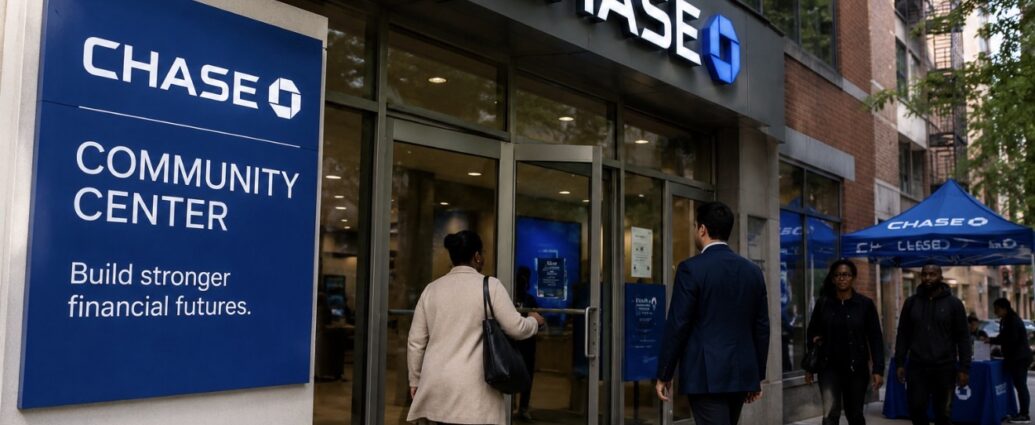
JPMorgan Chase announced Thursday, June 25, that it will significantly expand its national Community Center branch program, doubling the number of these specialized banking locations serving low- and moderate-income neighborhoods across the United States. The announcement came directly from the bank, with Diedra Porché, head of Chase’s Community and Business Development division, saying the company is deepening its commitment to increasing access to financial services in underserved communities.
As part of the expansion, Chase will hire an additional 150 community managers and increase the educational programming offered at the locations. The bank currently operates 19 Community Centers nationwide. The first opened in Harlem in 2019 as a pilot project, and its success has led the bank to steadily expand the concept.
Unlike a traditional bank branch, Community Centers are designed to function as neighborhood financial hubs. While customers can still conduct everyday banking, each location also features meeting space where financial educators, nonprofit organizations, and local community groups host free workshops throughout the year.
The classes cover practical financial topics such as household budgeting, improving credit, homeownership preparation, entrepreneurship, and small-business development. According to Chase, the community managers overseeing these centers are hired locally and are instructed to focus on education and outreach rather than selling banking products. Participants do not need to be Chase customers and are under no obligation to open an account.
The program has already grown into one of the nation’s largest community-based financial education initiatives. JPMorgan Chase estimates it has hosted approximately 14,000 workshops since launching the first Community Center six years ago. Most of the centers are located in neighborhoods where many residents are considered underbanked or unbanked, meaning they have limited or no access to traditional banking services.
The initiative also aligns with the requirements of the Community Reinvestment Act (CRA), the federal law encouraging banks to help meet the credit and banking needs of low- and moderate-income communities. While financial institutions can satisfy many of their CRA obligations through charitable giving and community investments, JPMorgan Chase Chairman and CEO Jamie Dimon has long argued that establishing permanent neighborhood branches provides greater long-term economic benefits by creating local jobs, expanding access to financing, and building lasting relationships within communities.
Dimon has personally attended the opening of nearly every Community Center since the program began, often joined by local elected officials, business leaders, and nonprofit organizations.
Beyond its community mission, Chase acknowledges that the strategy also makes sound business sense.
Although the educational programs are intentionally separated from sales efforts, the bank says Community Centers consistently generate higher rates of new account openings than many traditional branches serving similar neighborhoods. By introducing residents to financial education first, Chase often builds trust that later translates into long-term customer relationships.
For the nation’s largest bank by assets, even modest increases in new customers at each location can produce meaningful growth across a nationwide network. The approach also strengthens the bank’s standing with regulators and community leaders by demonstrating sustained investment in underserved neighborhoods.
The expansion comes at a time when much of the banking industry continues moving in the opposite direction. Thousands of traditional bank branches have closed across the country over the past decade as more customers shift to mobile banking and digital services. Rural communities and lower-income urban neighborhoods have often experienced the greatest losses in physical banking access.
Chase’s decision to expand its brick-and-mortar presence in exactly those communities represents a notable departure from the industry’s broader trend and reflects the bank’s belief that face-to-face relationships remain essential where financial trust has historically been limited.
For consumers, the benefits are immediate. Anyone living near one of these Community Centers can attend free budgeting classes, receive one-on-one financial coaching, participate in small-business workshops, and access educational resources regardless of whether they bank with Chase.
As Diedra Porché explained, the goal is to meet people where they are, provide practical financial knowledge, and help individuals and small businesses build stronger financial futures. Over time, Chase hopes those relationships will also create loyal customers, while the communities themselves benefit from new jobs, expanded financial education, and greater access to mainstream banking services.
JBizNews Desk
© JBizNews.com All Rights Reserved. Reproduction or distribution without written permission is prohibited.