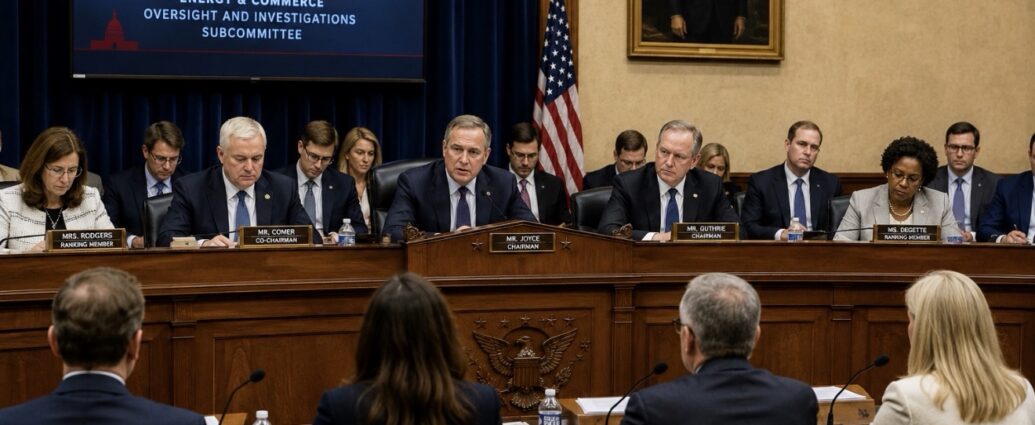
Representative John Joyce of Pennsylvania, chairman of the House Energy and Commerce Oversight and Investigations Subcommittee, led a hearing Thursday in which Medicaid directors from four states defended their fraud-prevention efforts as Democrats accused the Trump administration of unfairly targeting Democratic-led states through funding penalties. The hearing marked the latest stage of a months-long congressional investigation into oversight of the nation’s Medicaid program.
Officials from New York, California, Minnesota, and Ohio testified before lawmakers. Minnesota’s acting Human Services Commissioner John Connolly acknowledged significant fraud involving the state’s autism-services program while outlining reforms that include expanded audits, stricter background checks and a new provider licensing system designed to reduce abuse.
Republican lawmakers argued that stronger oversight remains necessary. Chairman John Joyce and House Energy and Commerce Committee Chairman Brett Guthrie of Kentucky cited several recent enforcement actions, including a $90 million Medicaid fraud case in Minnesota, a $270 million prescription-drug fraud guilty plea in California, and $226 million in alleged adult day-care fraud uncovered in New York this year.
Democrats countered that while fraud investigations are appropriate, the administration has disproportionately targeted Democratic-led states by delaying or withholding federal Medicaid funding. They argued that enforcement actions risk becoming political tools against governors who oppose White House policies rather than neutral oversight efforts.
The financial stakes are substantial. The Centers for Medicare & Medicaid Services (CMS) deferred approximately $1.3 billion in federal Medicaid funding to California in May, describing it as the largest payment deferral in the agency’s history. Earlier this year, CMS also paused approximately $350 million in federal Medicaid payments to Minnesota while reviewing program compliance.
Unlike a permanent funding cut, a payment deferral temporarily suspends federal reimbursement until states can demonstrate that claims comply with Medicaid requirements. During that period, state governments must either finance the programs themselves or reduce expenditures while the review remains underway. Approximately $1.1 billion of California’s deferred funding involved home-care services for elderly individuals and people living with disabilities.
The dispute carries significant economic consequences beyond government budgets. Home-health agencies, nursing providers, hospitals and healthcare workers depend heavily on consistent Medicaid reimbursement. Delayed federal payments can affect payrolls, cash flow and patient services, forcing states to redirect money from other priorities to keep healthcare programs operating.
The Trump administration maintains that the effort represents a nationwide campaign against Medicaid fraud rather than a politically motivated initiative. CMS has instructed every state to rapidly revalidate higher-risk providers, launched reviews of state Medicaid Fraud Control Units and established a specialized task force focused on reducing improper payments throughout the system.
Committee leaders also emphasized that Medicaid fraud is not limited to any particular political party or region. Chairman Joyce noted during the hearing that fraud has occurred in both Republican-led and Democratic-led states for decades, costing taxpayers billions of dollars and underscoring the need for stronger accountability nationwide.
The hearing concluded a lengthy congressional review that included two previous oversight sessions, formal inquiries sent to 11 states, and examination of more than 90,000 pages of government records. As part of its response, Minnesota has accepted a corrective-action plan requiring 17 separate reforms, including a temporary pause on new providers operating in higher-risk service categories and revalidation of more than 5,500 existing providers.
For the tens of millions of Americans who depend on Medicaid for healthcare coverage, the debate extends well beyond Washington politics. The outcome will determine how federal oversight is conducted, whether reimbursement dollars continue flowing smoothly to healthcare providers and how much financial uncertainty states and medical organizations must navigate while fraud investigations continue.
JBizNews Desk
© JBizNews.com All Rights Reserved. Reproduction or distribution without written permission is prohibited.