A five-justice High Court of Justice panel on Sunday pressed Knesset representatives on whether a ballot can remain meaningfully secret if lawmakers are permitted or expected to document their votes behind a curtain.
The hearing came after Knesset Speaker Amir Ohana rejected the court’s proposal to hold a new vote for state comptroller, following allegations that coalition MKs photographed or filmed themselves during the decisive second round of the June 3 election.
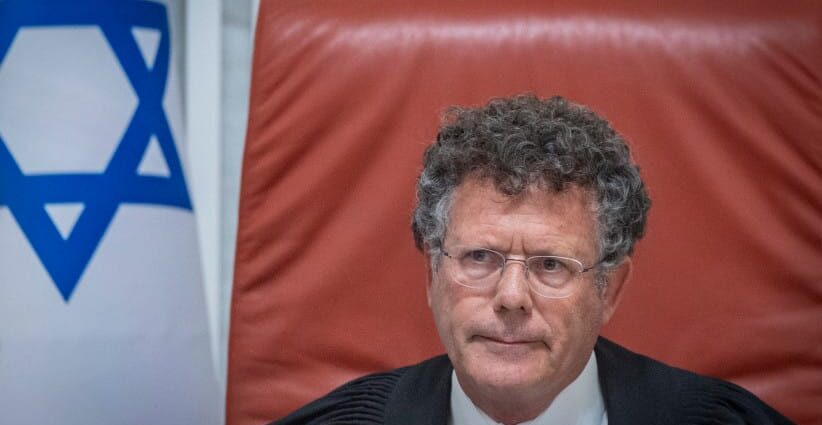
The bench consisted of Supreme Court President Isaac Amit, Deputy President Noam Sohlberg, and Justices Dafna Barak-Erez, Gila Canfy-Steinitz, and Ruth Ronnen.
The court is considering whether to cancel the election of attorney Michael Rabello, Prime Minister Benjamin Netanyahu’s longtime lawyer, after issuing a conditional order requiring the respondents to explain why the vote should not be annulled over an alleged breach of ballot secrecy.
At the opening of the hearing, Amit recounted the procedural history of the case, noting that the earlier panel had found an “undesirable cloud” over the election process, issued a conditional order, and proposed a repeat vote that the Knesset ultimately rejected.
The court’s order is focused on the secrecy of the ballot. It does not, at this stage, require the respondents to show why Rabello should not be disqualified because of his professional ties to Netanyahu, Likud, the Prime Minister’s Office, and government ministers.
Attorney Yitzhak Bart, representing the Knesset’s legal adviser, argued that there was no proof of an explicit instruction directing MKs to document their ballots.
Bart: No prohibition on filming voting
“There is no explicit prohibition on filming in the ballot box,” Bart said, arguing that, as a legal matter, an instruction could not be inferred without evidence of a direct order.
Ronnen questioned whether pressure could nevertheless arise without a formal directive.
She asked whether an expectation to document votes could be created through what she described as a social atmosphere within a political group, in which lawmakers understand that those who do not record their ballots may be viewed with suspicion.
Barak-Erez similarly challenged the argument that the absence of an explicit prohibition resolved the issue.
“What is the meaning of that?” she asked. “What is the norm? Maybe things done in the past were not correct.”
Bart argued that even if the court were to rule that photographing a ballot is prohibited, it should not invalidate Rabello’s election retroactively.
“Even if you decide that it is forbidden to photograph, that is a new rule that was not known,” he said. “Changing the rules of the game during the game is serious, but changing them after the election and then canceling it is much more serious.”
Sohlberg appeared skeptical of the suggestion that allowing an MK to document a ballot was a meaningful matter of freedom of expression.
Lawmakers may speak freely before and after a vote, he said, but the brief period behind the curtain carries a different purpose.
Sohlberg: Vote secrecy ‘common sense’
“The common sense is that the vote should be secret and there is a curtain,” Sohlberg said.
Bart maintained that the law does not explicitly prohibit a voter from filming himself behind the curtain. He also cited comparative material that he said found no parliament with a specific prohibition on self-documentation in a secret vote.
Barak-Erez pushed back on reliance on the United States as a comparison, saying its approach to the limits of freedom of speech differs fundamentally from Israel’s.
Ronnen later asked whether the Knesset had any explanation for why lawmakers documented themselves during the second round of voting. Bart replied that it did not.
Sohlberg responded to the argument that MKs are free to publicly disclose their votes after leaving the ballot area by asking whether the legal requirement of secrecy should simply be removed.
“Ultimately, the test is inside the ballot box,” he said.
The hearing was briefly interrupted by Likud MK Tally Gotliv, who shouted toward the bench. Amit asked court security to remove her after what he said were several prior interruptions, before allowing her to leave the courtroom on her own.
Rabello was elected in a two-round Knesset vote on June 3. Retired Supreme Court justice Yosef Elron received 60 votes in the first round, compared with Rabello’s 57, leaving both candidates short of the required 61-vote majority.
In the second round, opposition MKs alleged that coalition lawmakers had been asked to photograph or film their ballots behind the curtain. The vote was halted and restarted before Rabello won 61 votes to Elron’s 57.
The petitioners argue that the documentation transformed a secret election into a loyalty test, potentially preventing MKs from voting freely.
The Knesset, Rabello, Likud, and Netanyahu have denied that any instruction to document votes was proven. They argue that the court should not infer coercion from the fact that some lawmakers photographed themselves.