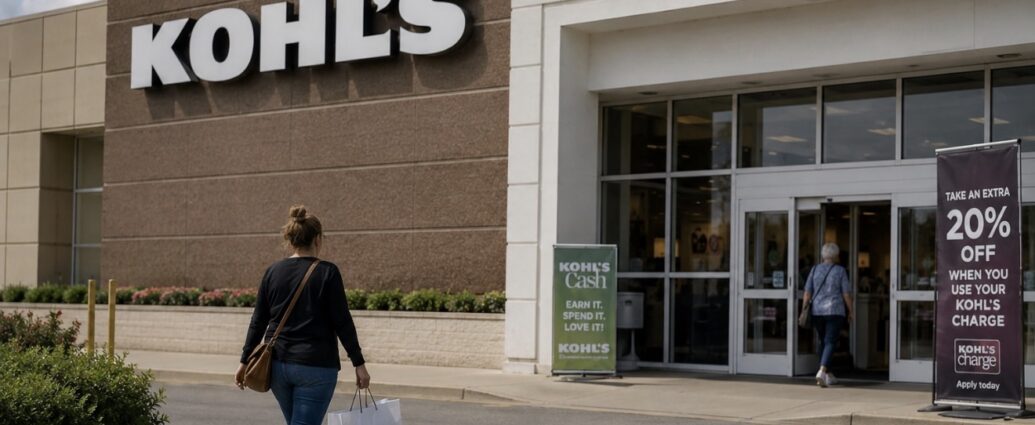
Kohl’s, once one of America’s most successful department-store chains, is trying to revive its business by returning to the discount-driven strategy that originally made it popular. Chief Executive Michael Bender, who took over the company in late 2025, says Kohl’s lost touch with its core customer and is now rebuilding around the proprietary brands, coupons and Kohl’s Cash rewards program that helped make the retailer a household name.
“We stopped listening to our best customers for a while,” Bender told analysts, describing the turnaround as an effort to restore the shopping experience longtime customers expected.
The retailer’s decline has been dramatic.
After going public in 1992, Kohl’s became one of the country’s fastest-growing department-store chains, with annual revenue topping $20 billion in fiscal 2019. Its stock reached more than $80 per share in 2018.
Over the following five years, however, the company lost nearly 70% of its market value as sales declined, customer traffic weakened and competition from online retailers and discount chains intensified.
Retail analysts believe many of those problems were self-inflicted.
Chuck Grom, an analyst with Gordon Haskett, said Kohl’s gradually abandoned many of the products and promotions that attracted its loyal customer base. The retailer reduced coupon offerings, eliminated popular categories including petites and fine jewelry, and shifted toward an off-price retail strategy that made it resemble competitors instead of emphasizing what made Kohl’s unique.
According to Bender, those strategic decisions ultimately weakened customer loyalty and contributed to years of sluggish sales.
The company’s recovery plan focuses on returning to the basics.
Kohl’s has restored petites to stores, repositioned its juniors apparel department closer to Sephora beauty locations, and introduced “deal bars” near store entrances featuring seasonal merchandise and everyday essentials priced below $10.
Bender has described the strategy as identifying exactly who Kohl’s serves rather than attempting to compete with every retailer across every customer segment.
Early results have shown encouraging signs.
During its most recent quarter, Kohl’s generated approximately $3 billion in revenue while posting its strongest comparable-store sales growth in four years.
Following the earnings report, the company’s stock rose roughly 20%, and shares have climbed more than 130% over the past year.
Despite that improvement, management continues projecting full-year sales ranging from flat to down about 2%, underscoring that the turnaround remains in its early stages.
Wall Street remains cautiously optimistic.
Analysts at TD Cowen said Kohl’s appears to be making sound strategic decisions but maintained a neutral rating, citing continued weakness in apparel and footwear sales while describing the retailer as a “show-me story” that still needs to demonstrate sustained improvement.
One area that continues to face challenges is the chain’s Sephora partnership.
Although Sephora beauty shops remain central to Kohl’s long-term strategy of attracting younger shoppers, sales in those departments declined during the latest quarter.
Even Bender has emphasized patience, telling investors the company has “not arrived yet” and remains in the early stages of rebuilding the business.
The outcome extends beyond Kohl’s itself.
The retailer operates squarely within the middle of the American retail market, a segment that has steadily lost ground as consumers increasingly gravitate either toward luxury retailers or low-cost discount chains.
Today, Kohl’s competes with companies including Walmart, Target, Amazon, T.J. Maxx and numerous off-price retailers, while traditional department-store rivals such as Macy’s increasingly target more upscale customers.
Whether Kohl’s can successfully rebuild a profitable national retailer serving value-conscious middle-income shoppers has become one of the more closely watched turnaround stories in the retail industry.
For now, the company has paused widespread store closures that have affected much of the department-store sector.
Kohl’s continues operating approximately 1,150 stores nationwide while experimenting with smaller-format urban locations.
Management says the overwhelming majority of existing stores remain profitable.
The company’s long-term success will ultimately depend on whether former customers decide to return.
After years of declining sales and shrinking market share, Kohl’s believes its renewed focus on value, familiar brands and aggressive promotions can restore the retailer’s position in American shopping.
JBizNews Desk
© JBizNews.com All Rights Reserved. Reproduction or distribution without written permission is prohibited.