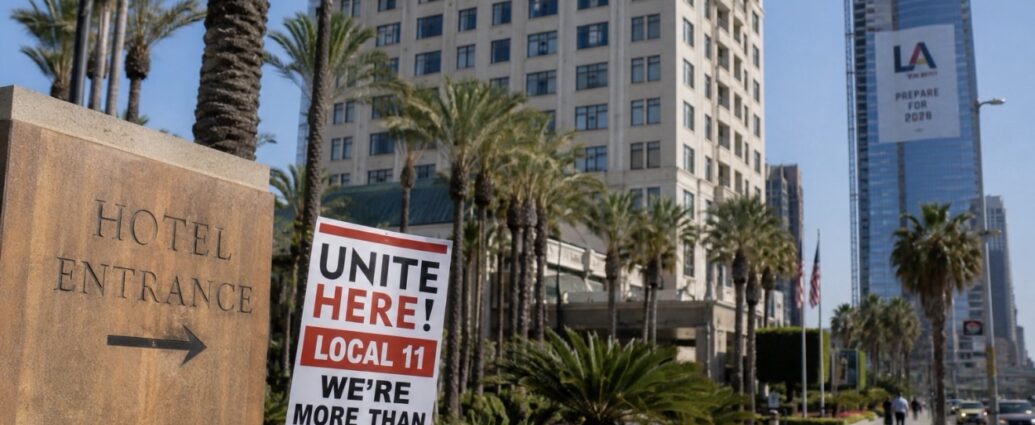
The Los Angeles City Council voted to delay its plan to raise the minimum wage for hotel and airport workers to $30 an hour, pushing the deadline from 2028 to 2030 after the hospitality industry warned the increase was already causing layoffs, hiring freezes, and canceled investment.
The proposal, often called the “Olympic Wage,” was designed to raise pay ahead of the 2028 Summer Olympics. Under the revised schedule, hotel and airport workers will still receive raises beginning July 1, when the minimum wage rises to $25 an hour, followed by $27.50 in 2027. The final increase to $30 an hour will now take effect in 2030 instead of 2028.
Hotel workers currently earn roughly $22.50 an hour, meaning the proposal still delivers substantial pay increases over the coming years, though on a slower timetable.
Hotel operators argued the original schedule was becoming financially unsustainable. Industry organizations including the American Hotel & Lodging Association and the Asian American Hotel Owners Association warned that rapidly rising labor costs had already forced hotels to reduce staffing, freeze hiring, and postpone development projects even as Los Angeles prepares for the 2026 FIFA World Cup and the 2028 Olympic Games.
An industry report released this spring found hotel construction in Los Angeles had slowed, investment was shifting to competing markets, and operators were reducing payroll expenses as wage growth outpaced revenue.
Smaller independent hotels told city officials they face the greatest pressure. One Venice Beach hotel owner testified that family-operated properties often work with thin profit margins, making higher payroll costs difficult to absorb without reducing employee hours, cutting services, or closing hotel restaurants altogether. Hotel restaurants also compete directly with nearby independent restaurants that are not required to pay the higher hotel wage.
The debate intensified when business groups successfully gathered enough signatures to place a separate measure on the November ballot repealing Los Angeles’ gross receipts tax, one of the city’s largest revenue sources.
City officials warned repealing the tax could cost approximately $860 million annually, threatening funding for public safety, homelessness programs, and other city services. Business groups indicated they would withdraw the ballot initiative if the city delayed implementation of the $30 wage.
Following the council’s vote, organizers agreed to suspend the repeal effort.
Labor unions strongly criticized the decision.
UNITE HERE Local 11 accused business organizations of using the tax repeal effort to pressure city leaders into delaying promised wage increases. Union leaders described the strategy as economic intimidation, while dozens of hotel and airport employees packed City Hall, arguing the raises had already helped workers pay medical bills, avoid eviction, and reduce the need for multiple jobs.
Four council members voted against the delay.
The dispute reflects a broader national debate over rapidly increasing service-sector wages. Cities across the country have approved significant minimum wage increases to help workers keep pace with rising housing and living costs, while employers argue that steep labor cost increases ultimately lead to higher prices, automation, reduced hiring, and fewer jobs.
Los Angeles has become one of the country’s highest-profile test cases for how aggressively cities can raise wages while remaining competitive as a tourism destination.
City leaders emphasized the vote represents a delay rather than a cancellation. Council President Marqueece Harris-Dawson called the action a “placeholder” intended to create additional time for negotiations between labor unions, hotel operators, and city officials.
Workers will still receive raises beginning this summer, while the highest wage level arrives two years later than originally planned.
For now, both sides leave with partial victories. Employees continue receiving scheduled pay increases, while hotel operators gain additional time to adjust before the full $30-an-hour mandate takes effect.
The larger question remains whether Los Angeles can successfully deliver some of the nation’s highest hospitality wages while maintaining a thriving tourism industry ahead of the World Cup and the Olympic Games.
JBizNews Desk
© JBizNews.com All Rights Reserved. Reproduction or distribution without written permission is prohibited.