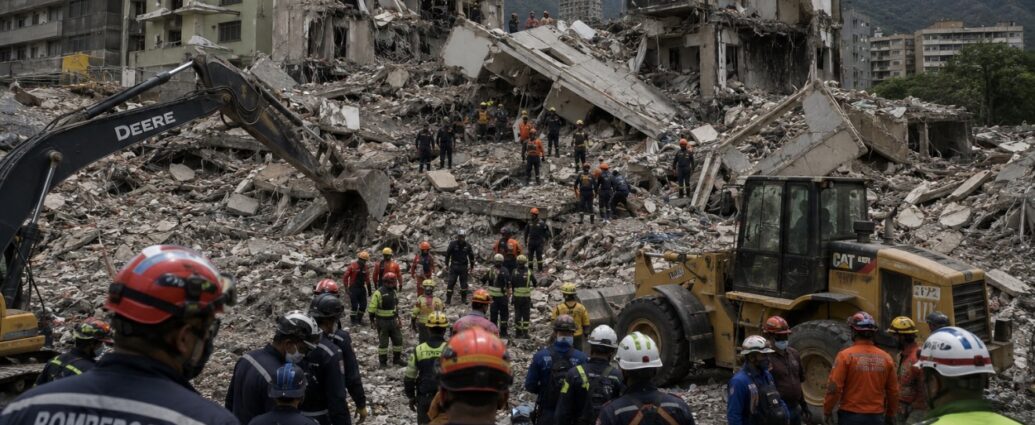
The death toll from the powerful earthquakes that struck Venezuela has climbed above 1,700, as emergency crews continue searching collapsed buildings while thousands remain injured and missing.
Officials said at least 1,719 people have died and more than 5,000 have been injured following the twin earthquakes that struck the country’s northern coast. Thousands of additional people remain unaccounted for as rescue operations continue around the clock.
The disaster began when a magnitude 7.2 earthquake struck on June 24, followed just 39 seconds later by a more powerful magnitude 7.5 quake—the strongest to hit Venezuela in more than a century.
The coastal state of La Guaira, just north of Caracas, suffered some of the worst destruction and remains under emergency military control as rescue efforts continue.
Authorities estimate nearly 800 buildings collapsed across the affected region.
Because June 24 was a national holiday, many residents were inside homes rather than office buildings when the earthquakes struck, contributing to the high casualty count.
Despite rescue crews now working beyond the critical 72-hour survival window, isolated rescues continue. One survivor was pulled alive from the rubble after more than 106 hours, offering hope that additional people may still be found.
The disaster has further strained an economy already facing years of financial hardship.
Although Venezuela possesses some of the world’s largest oil reserves, the country has endured prolonged economic decline, widespread emigration, chronic power shortages, and deteriorating infrastructure.
Frequent electrical outages have complicated rescue operations by limiting communications, transportation, and access to heavy equipment.
The country’s primary international gateway, Simón Bolívar International Airport, also sustained significant damage, forcing flight cancellations and disrupting humanitarian aid deliveries along with business travel and commercial shipments.
International assistance has begun arriving.
The U.S. Treasury Department temporarily eased certain sanctions to allow financial transactions supporting earthquake relief efforts through October 23.
Secretary of State Marco Rubio said the United States is sending search-and-rescue teams, medical supplies, and humanitarian assistance. U.S. officials also reported that three Americans were killed while 12 others remain missing.
More than 1,600 international rescue workers have joined recovery operations, with assistance arriving from countries including Brazil, Chile, Mexico, and China.
Engineers believe rebuilding will require years.
Many of the collapsed buildings are believed to have failed because of outdated construction standards, aging infrastructure, or building codes that were poorly enforced.
The disaster also carries major financial consequences for Venezuelans living abroad.
Communities across the United States—including large Venezuelan populations in places such as Union City, New Jersey—have begun raising money to support relatives affected by the disaster.
Remittances sent home from family members working overseas are expected to become an increasingly important source of financial support as rebuilding begins.
For now, rescue operations remain the priority.
Crews continue searching damaged neighborhoods throughout La Guaira and Caracas while families wait for news of missing loved ones.
The full economic cost will likely take months to calculate, but the earthquakes have already added another enormous burden to one of Latin America’s most fragile economies.
JBizNews Desk
© JBizNews.com All Rights Reserved. Reproduction or distribution without written permission is prohibited.