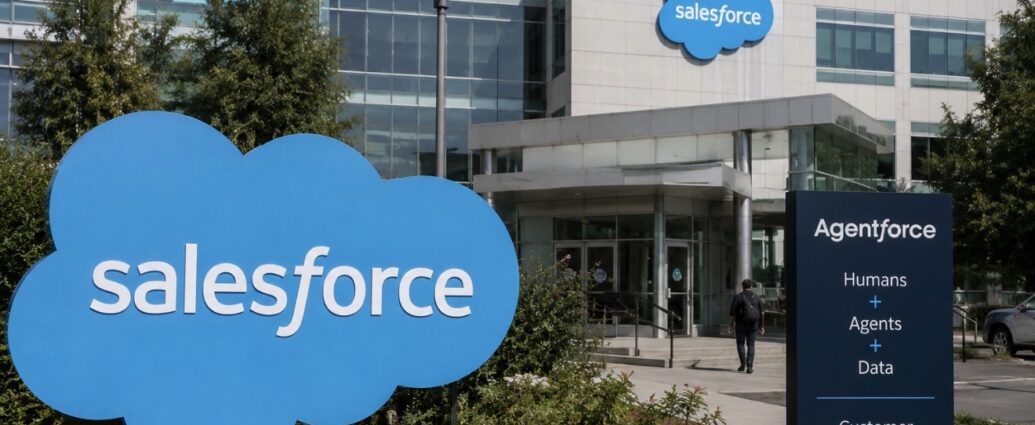
Salesforce is buying artificial-intelligence companies at a rapid pace, acquiring more than a dozen AI and data firms over roughly the past year and a half. While the strategy is designed to strengthen its AI platform, investors are increasingly questioning whether the company is moving too fast.
A Salesforce spokesperson said the company’s acquisition strategy remains “highly selective and focused on strategic fit, integration discipline, margin and cash flow parameters, and advancing our agentic AI roadmap to drive customer value,” even as the stock has struggled throughout 2026.
The largest purchase was Informatica, a data-management company acquired in a deal valued at about $8 billion.
Since then, Salesforce has continued adding companies including Fin, an AI customer-service platform formerly known as Intercom, for approximately $3.6 billion, along with Contentful, m3ter, Qualified, and several other AI- and data-focused businesses.
Altogether, Salesforce has completed more than a dozen acquisitions centered on artificial intelligence and enterprise data.
Nearly every purchase supports one objective: strengthening Agentforce, Salesforce’s AI platform introduced in September 2024.
Agentforce was designed to move beyond AI assistants by allowing autonomous AI agents to complete business tasks independently. Early customers, however, encountered challenges involving data quality, inconsistent AI performance, and a pricing model many found difficult to understand.
Rather than building every missing capability internally, Salesforce has chosen to acquire companies that solve those problems.
Informatica strengthens data management, Fin expands customer-service capabilities, Contentful improves content management, and m3ter provides usage-based billing technology.
There are signs the strategy is producing results.
Agentforce reached approximately $1.2 billion in annual recurring revenue during the first quarter, representing 205% year-over-year growth.
Salesforce also reported quarterly revenue of approximately $11.13 billion, up 13% from the previous year, demonstrating continued momentum despite its size.
Investors, however, remain cautious.
Salesforce shares have fallen roughly 33% to 37% during 2026, marking one of the company’s longest periods of sustained weakness.
RBC Capital Markets analyst Rishi Jaluria, who downgraded the stock following the Informatica acquisition, warned that the pace of acquisitions increases operational risk.
His concern centers on Salesforce’s ability to integrate numerous companies, technologies, and employees simultaneously while continuing to operate one of the world’s largest enterprise software businesses.
Investors are also watching capital allocation.
Alongside its acquisition campaign, Salesforce has authorized a $50 billion share repurchase program, raising questions about whether the company can simultaneously finance major acquisitions, reward shareholders, invest heavily in research and development, and maintain financial flexibility.
Underlying the strategy is an even larger business challenge.
Salesforce built its software empire by charging customers subscription fees based largely on the number of employees using its products.
Autonomous AI agents could eventually reduce the number of human users, forcing the company to rethink how it generates revenue.
That helps explain acquisitions such as m3ter, whose technology enables companies to bill customers based on actual AI usage rather than traditional per-user subscriptions.
Instead of charging for software seats, Salesforce is preparing to charge for the work AI agents perform.
For businesses that rely on Salesforce to manage sales, marketing, and customer service, the outcome could significantly influence both pricing models and AI capabilities over the next several years.
Chief Executive Officer Marc Benioff is betting that acquiring the industry’s strongest AI technologies will prove faster than developing them internally and ultimately position Agentforce as the leading enterprise AI platform.
Wall Street’s question is whether Salesforce can successfully integrate all of those acquisitions while maintaining profitability and staying ahead of an increasingly competitive AI market.
The answer may determine whether the company’s difficult 2026 becomes a temporary setback—or an early warning sign.
JBizNews Desk
© JBizNews.com All Rights Reserved. Reproduction or distribution without written permission is prohibited.