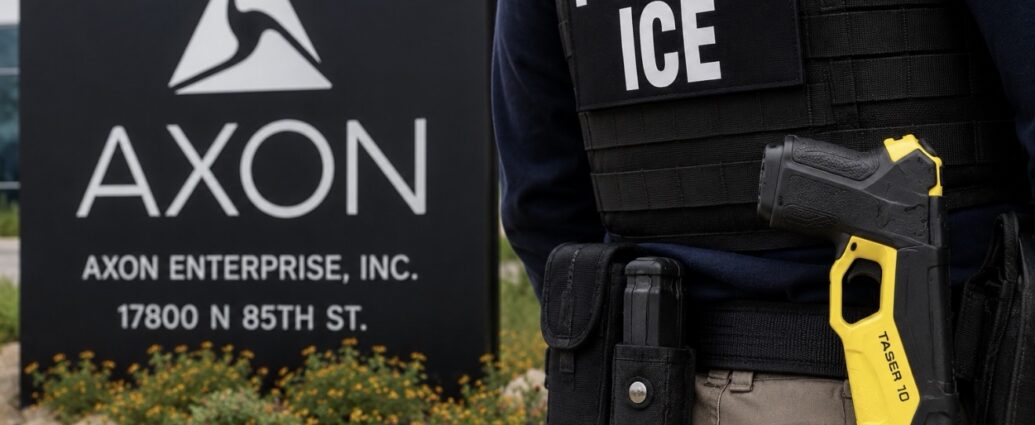
Federal financial disclosures show that President Donald Trump purchased between $1 million and $5 million of stock in Axon Enterprise—the maker of Tasers, body cameras, and policing software—on Feb. 10, roughly two weeks before U.S. Immigration and Customs Enforcement (ICE) moved to solicit a five-year, $220 million Taser contract. The timing, first reported Monday by CNBC, has drawn scrutiny from government watchdogs, though there is no evidence the president was involved in or aware of the procurement.
According to the disclosures, which Trump filed May 14 and which report value ranges rather than exact amounts, the Axon purchase was part of much broader trading activity—more than 3,700 transactions during the first quarter of 2026, including investments in Nvidia, Microsoft, Amazon, and Palantir, with an estimated total value between $220 million and $750 million.
On Feb. 24, ICE posted a solicitation seeking approximately 17,800 new Tasers, along with unlimited cartridges and training, in a procurement valued at roughly $220 million over five years. The purchase would expand ICE’s Taser inventory from about 4,300 units to nearly 18,000.
The solicitation never specifically names Axon, but its technical specifications—including a 45-foot effective range and 10 individually deployable probes—closely match the company’s TASER 10 model. Experts who reviewed the solicitation told CNBC those requirements would effectively exclude competing products. Axon currently controls roughly 90% of the U.S. Taser market, and ICE already purchases its conducted-energy weapons from the company. The contract has not yet been awarded.
Several important caveats remain.
There is no evidence that Trump participated in or knew about the procurement process, that ICE contracting officials were aware of his investment, or that Axon knew Trump had become a shareholder.
The White House has said Trump’s assets are held in a trust managed by his children and that investment decisions are handled by independent third-party financial managers rather than by Trump or his family.
For Axon, the potential contract arrives during a period of strong growth.
The company reported record quarterly revenue of $796.7 million in the fourth quarter of 2025, followed by $807.3 million during the first quarter of 2026, driven by strong Taser demand and expanding artificial-intelligence products.
Executives have described Department of Homeland Security business as a significant growth opportunity, and Axon has expanded its federal-sales operation, including hiring a longtime Palantir executive to strengthen government contracting efforts.
The broader backdrop is the expansion of federal immigration enforcement.
ICE detention levels climbed to more than 60,000 detainees by April 2026, up from just over 37,000 at the end of fiscal year 2024. A larger detention system creates increased demand for conducted-energy weapons, body cameras, and the digital evidence platforms Axon sells alongside them.
The company also spent nearly $2.5 million on federal lobbying during 2025, even as its stock declined more than 25% during 2026.
Ethics experts say the situation highlights recurring questions surrounding presidents who actively own or trade individual stocks. Even without evidence connecting personal investments to government actions, they argue that overlap between private financial holdings and federal contracting can create the appearance of potential conflicts of interest.
Supporters counter that the trust structure and independent investment management are specifically designed to separate the president from day-to-day trading decisions.
For now, the publicly established facts remain limited.
Trump purchased shares of the country’s dominant Taser manufacturer. Weeks later, a federal agency within his administration sought a major Taser procurement whose specifications closely matched Axon’s flagship product.
Whether that sequence reflects coincidence, ordinary investment management, or circumstances warranting additional scrutiny remains a subject of debate—and one likely to continue as questions surrounding presidential financial disclosures and government contracting evolve.
JBizNews Desk
© JBizNews.com All Rights Reserved. Reproduction or distribution without written permission is prohibited.