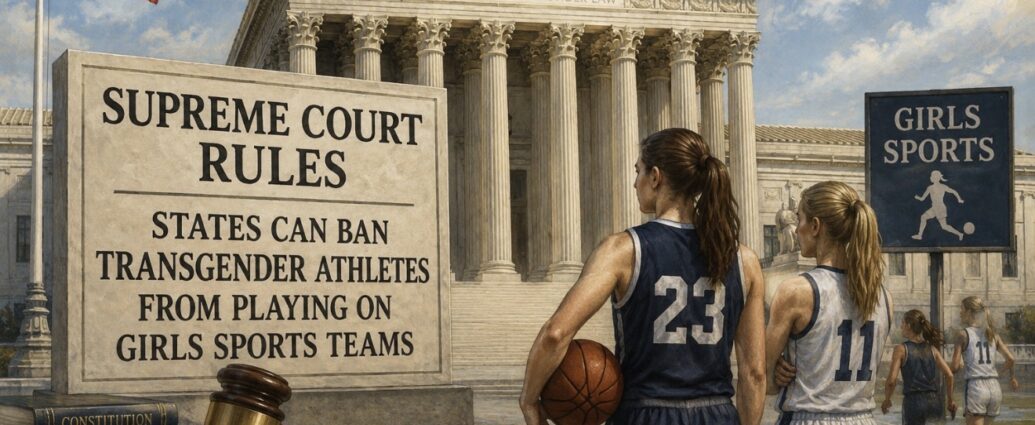
The Supreme Court on Tuesday ruled that states may keep transgender girls off girls’ and women’s sports teams at public schools, a decision that gives athletic departments long-sought legal clarity while leaving workplace discrimination law unchanged. Writing for the majority in West Virginia v. B.P.J. and Little v. Hecox, Justice Brett Kavanaugh said that under Title IX and the Constitution’s Equal Protection Clause, states may maintain women’s and girls’ sports for biological females.
The ruling upholds laws in West Virginia and Idaho—West Virginia’s 2021 Save Women’s Sports Act and Idaho’s 2020 measure—that tie athletic eligibility to sex assigned at birth. Both cases were brought by transgender athletes: Becky Pepper-Jackson, a West Virginia student who competes in cross-country and track, and Lindsay Hecox, who sought to compete at Boise State University. Lower courts had reached conflicting conclusions, leaving schools across more than 20 states uncertain about which policies would ultimately survive.
Kavanaugh emphasized the limited scope of the decision. He wrote that the Court was not deciding broader questions about transgender participation in athletics beyond the issues before it. He also drew a clear distinction between school athletics and employment law, explaining that the Court’s 2020 decision in Bostock v. Clayton County, which held that firing an employee because they are transgender constitutes unlawful sex discrimination under Title VII, does not control cases arising under Title IX involving school sports.
For employers, that distinction is the key takeaway. The ruling does not alter federal workplace protections for transgender employees. Hiring, firing, benefits, and anti-discrimination obligations established under Bostock remain unchanged, meaning most businesses do not need to revise their employment policies as a result of Tuesday’s decision.
The largest operational impact falls on schools, colleges, and athletic organizations. Title IX compliance is tied to federal funding, and for the approximately 1,100 colleges competing in the National Collegiate Athletic Association, representing more than 530,000 student-athletes, the ruling reinforces policies the NCAA has already adopted. Following an executive order issued by President Donald Trump in February 2025, the NCAA limited women’s competition to athletes assigned female at birth. NCAA President Charlie Baker had previously urged a single nationwide standard rather than what he described as a patchwork of conflicting state laws and court rulings. Tuesday’s decision removes much of that uncertainty for schools operating in states with similar laws.
For athletic directors, compliance officers, insurers, and the law firms advising educational institutions, the decision settles an issue that had generated years of litigation and uncertainty. Schools in states with participation restrictions now have stronger legal footing for maintaining those policies, while colleges dependent on federal education funding gain additional clarity regarding compliance expectations.
The national landscape, however, remains divided. Since 2020, more than 20 states have enacted laws restricting transgender participation in school sports, while other states continue allowing participation under different standards. Tuesday’s ruling permits states with restrictions to enforce them but does not require states with different policies to change their laws, leaving varying rules across the country.
The decision follows a series of recent Supreme Court rulings involving transgender rights. Last year, in United States v. Skrmetti, the Court upheld a Tennessee law restricting certain medical treatments for transgender minors. Attorneys representing Pepper-Jackson argued that she was the only transgender athlete competing in West Virginia and maintained that puberty-blocking treatment eliminated any competitive advantage. The Court ultimately concluded that states may draw participation lines based on biological sex.
For the business community, the practical message is straightforward. Schools and athletic organizations in states with these laws now have clearer legal guidance for compliance. Employers, however, should expect no change in their obligations toward transgender employees under existing federal workplace discrimination laws.
JBizNews Desk | New York
© JBizNews.com All Rights Reserved. Reproduction or distribution without written permission is prohibited.