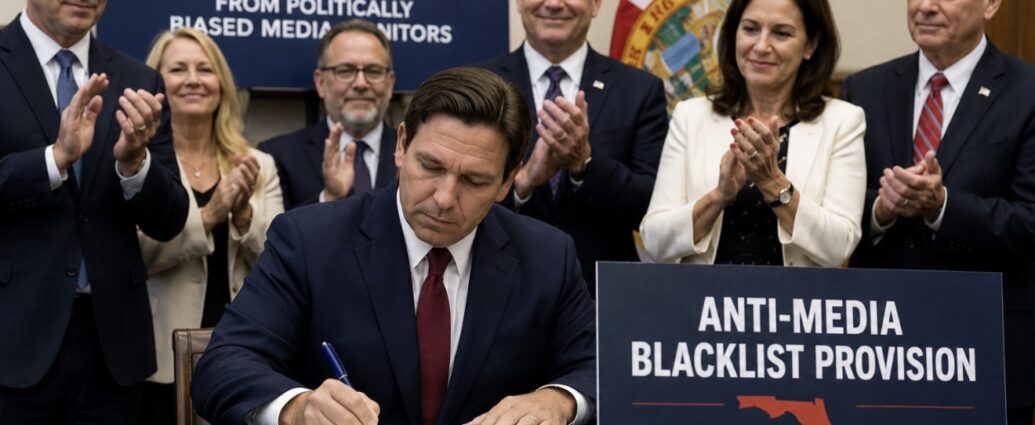
Florida Continues to Lead the Nation in Protecting Taxpayer Dollars from Politically Biased Media Monitors
Florida Gov. Ron DeSantis signed the state’s $117.6 billion budget for the 2026–2027 fiscal year on Monday, and buried inside the spending plan is a rule that decides which companies can and cannot get paid with Florida tax dollars. For the second year in a row, the budget blocks state agencies from hiring advertising or marketing firms that rate news outlets for bias or reliability.
The target is a small but growing industry. Companies like NewsGuard, Ad Fontes Media and the Global Disinformation Index score news sites on how trustworthy they judge those sites to be. Big advertisers and ad agencies often use those scores to decide where to place ads, steering money toward outlets that rate well and away from ones that rate poorly.
Florida’s new rule says state agencies can no longer do business with any advertising agency or contractor that acts as or uses the services of media reliability and bias monitors. In plain English, if an ad firm wants Florida’s advertising business, it cannot rely on those rating systems to determine where the state’s ads are placed.
The Independent Media Council, a coalition of conservative and independent news organizations, praised the move. Spokesperson Christine Czernejewski said taxpayer-funded advertising should reach as many people as possible rather than being filtered through what she called ideological gatekeepers. The council also credited House Speaker Daniel Perez and state Sen. Ed Hooper for championing the measure.
Supporters argue the rating firms are not the neutral referees they claim to be. They point to studies, including research from the Media Research Center, which reported that NewsGuard awarded higher average ratings to left-leaning publications than to right-leaning outlets. Critics contend that a poor rating can quietly reduce a news organization’s advertising revenue without any law ever being passed.
There is significant money behind the debate. NewsGuard developed its “Misinformation Fingerprints” tool with assistance from a $750,000 grant from the U.S. Department of Defense, then marketed the technology to social media platforms, artificial intelligence developers and technology companies. That federal relationship later drew scrutiny when the U.S. House Oversight Committee opened an investigation in 2024, citing concerns about potential impacts on protected First Amendment speech.
The companies affected by the measure see the issue differently. Vanessa Otero, founder and chief executive of Ad Fontes Media, has argued that laws like Florida’s may infringe upon the free-speech rights of private businesses by discouraging constitutionally protected business practices and chilling the speech of advertising agencies. She has said Ad Fontes will continue operating under its existing model.
At its core, the dispute centers on how billions of dollars in advertising are directed. Advertising agencies have long relied on “brand safety” tools to keep clients’ advertisements away from content they consider risky, and media-rating firms have increasingly become part of that process. Florida is now removing state advertising dollars from that system, and it is not the only state moving in that direction.
West Virginia enacted a similar measure this year through its First Amendment Preservation Act, and Congress has also considered similar restrictions in recent National Defense Authorization Act legislation, reflecting growing scrutiny in Washington over the government’s relationship with media-rating firms. The private sector has shifted as well. Advertising giant Omnicom Group agreed, as part of its merger with IPG, not to engage in unlawful collusion to direct advertising away from publishers based on political or ideological viewpoints.
The Florida provision did not emerge in a vacuum. According to reporting by Florida Politics and Jason Garcia of Seeking Rents, the original proposal followed lobbying efforts by Newsmax, which receives relatively low scores from rating organizations such as NewsGuard. A low rating can discourage advertisers from placing ads with a news outlet, and Newsmax last year paid more than $100 million to settle two separate defamation lawsuits. Supporters of the Florida measure argue those issues are separate from the state’s policy, maintaining that the law is about ensuring taxpayer dollars are not allocated using ideological media-rating systems.
The provision is narrowly written. It does not apply to audience measurement companies or organizations that compile readership and viewership data. Instead, it applies only to contractors whose primary function is evaluating the factual accuracy, political bias or alleged misinformation of news organizations. Like last year’s language, the provision is included in the annual budget and must be renewed in future budgets to remain in effect.
For now, Florida’s message is clear: companies that rate the news will not receive state advertising dollars, and businesses seeking Florida’s advertising contracts will have to decide whether to continue relying on those rating services. Whether other states adopt similar policies—or whether the restrictions are ultimately challenged in court—could shape how government advertising dollars are spent for years to come.
JBizNews Desk
© JBizNews.com All Rights Reserved. Reproduction or distribution without written permission is prohibited.