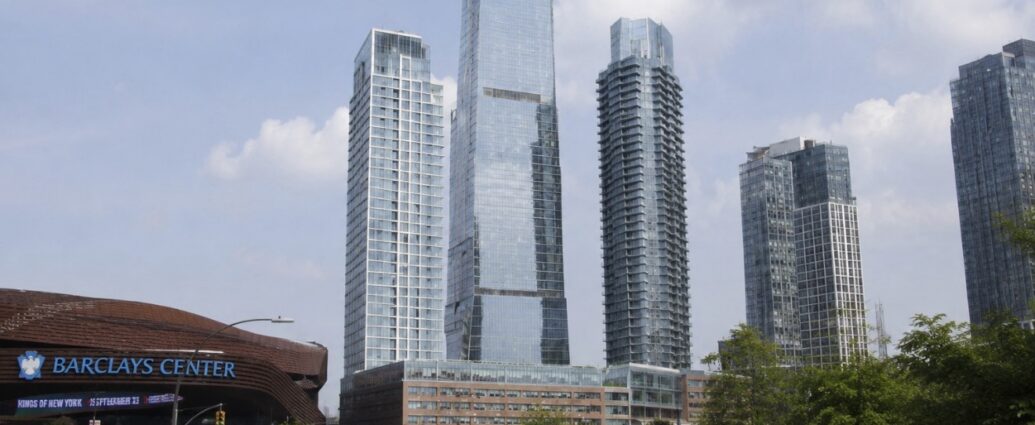
Brooklyn’s most notorious unfinished megaproject may finally be getting a last chapter. On Monday, June 29, Empire State Development, the state’s economic-development agency, along with developers Cirrus Workforce Housing and LCOR, unveiled a $5 billion plan to complete the long-stalled Atlantic Yards project, now known as Pacific Park, more than two decades after it was first announced. Governor Kathy Hochul called it one of New York’s most significant unfinished affordable-housing developments and said the state is finally moving it toward completion.
The plan calls for six new high-rise towers holding about 5,600 apartments and condos, including roughly 1,242 units, or about 21%, set aside as affordable for low- and moderate-income households. It would add about five and a half acres of public open space and feature a nearly 800-foot skyscraper connected to a 570-foot tower at the corner of Flatbush Avenue and Pacific Street, in the Prospect Heights neighborhood next to the Barclays Center.
To understand why this matters, it helps to know why the project stalled for so long. Atlantic Yards was first announced in 2003 by developer Forest City Ratner, with star architect Frank Gehry and Brooklyn’s own Jay-Z attached, and the Barclays Center opened in 2012. But the housing kept getting delayed. The project later passed to Greenland USA, which defaulted on roughly $350 million in loans. Cirrus and LCOR acquired the development rights at a foreclosure auction last October, becoming the third development team to take on the project.
The hardest and most expensive part is literally building on air. Six of the planned towers must sit on platforms constructed above the MTA’s Vanderbilt Rail Yard, where Long Island Rail Road trains continue to operate. Building those decks is a complex engineering challenge that adds an estimated $700 million to the cost and has been one of the biggest reasons the project has dragged on for more than two decades. New York State has now pledged about $700 million toward the platforms, including $175 million already approved in the latest state budget.
Here is where the business story becomes especially important for Brooklyn’s economy. Much of the construction will be financed by union pension funds, which will provide financing to the developers rather than relying primarily on traditional bank loans. Cirrus has committed to using union labor, creating the potential for years of well-paying construction jobs throughout the borough. Cirrus Chief Executive Joseph McDonnell said construction could begin by 2028, with the first affordable apartments welcoming residents as early as 2031 and full completion expected by the late 2030s.
For Brooklyn renters, the affordable housing is the centerpiece of the proposal. Housing costs throughout the borough have surged, with Prospect Heights home prices topping $1 million years ago. Adding more than 1,200 income-restricted apartments could provide meaningful relief. Critics, however, argue that too many of those units are aimed at moderate-income households instead of the lowest-income families originally promised when the state used eminent domain to assemble the site. Assemblymember Jo Anne Simon and local housing advocates say the revised plan still falls short of earlier affordability commitments.
The economic benefits extend well beyond housing. The development also includes retail and office space, along with community facilities such as an intergenerational center in the first residential building. Thousands of new residents would bring additional customers to local restaurants, retailers, and neighborhood businesses along Atlantic and Flatbush avenues, helping support an area that has lived alongside construction for years. New public open space is also intended to better connect the development with the surrounding community.
The project still has significant hurdles before construction begins. It must complete an environmental review expected to take about two years before receiving final approval from the Empire State Development board, a vote that may not occur until 2028. A memorandum of understanding between the developers and the state is due by July 31, 2026. If an agreement is not reached, the state could pursue penalties tied to previously unbuilt affordable housing commitments.
Still, the announcement represents the most meaningful progress in years on a project that became synonymous with delays. If completed, Pacific Park would deliver thousands of new homes, years of union construction jobs, expanded retail and office space, and new public parks. After more than two decades of missed deadlines, Brooklyn will now be watching to see whether Cirrus and LCOR can finally deliver what previous developers could not.
JBizNews Desk
© JBizNews.com All Rights Reserved. Reproduction or distribution without written permission is prohibited.