For more than a century, PEF Israel Endowment Funds has channeled American donations to Israeli charities without drawing much attention to itself. Its president had never sat for an interview. Then Congress accused the fund of helping finance a campaign to bring down the Israeli government.
Founded in 1922 as the Palestine Endowment Fund by early American Zionists including Louis Brandeis and Rabbi Stephen Wise, PEF is a tax-exempt pass-through: it lets American donors give to Israeli charities and take the deduction. It charges no fees, runs on the income from roughly $150 million in endowments, and answers to volunteer trustees. Since October 7, the volume of giving has doubled, president Geoffrey Stern says, while overhead has stayed under 1%. Most Israelis have never heard of it.
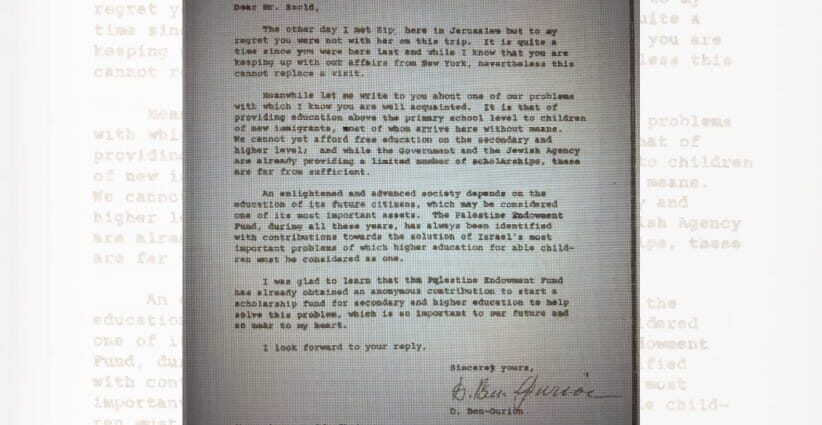
One was David Ben-Gurion. PEF gave The Jerusalem Post a letter the prime minister sent on February 11, 1962, to Robert Szold, then the fund’s chairman, at its offices on Broad Street in New York. Israel could not yet afford free secondary or higher education, Ben-Gurion wrote, and the children of new immigrants were arriving without means and going no further than primary school. He pressed PEF to help, called the education of the country’s future citizens one of its most important assets, and said he was glad the fund had already found an anonymous donor to start a scholarship program he cared about.
Sixty-three years later, a very different letter reached PEF, this one from two Republican-led House committees.
“No good deed goes unpunished,” Stern told me, in what PEF says is its first interview. “When you live it, it still hurts.”
Congress questions PEF’s role in protest funding
In March 2025, the House Judiciary and Foreign Affairs Committees, chaired by Jim Jordan and Brian Mast, sent document requests to six US and Israeli nonprofits. PEF was one of them. A July 2025 memo and a second installment released on May 29 of this year laid out the theory: that under the Biden administration, US taxpayer money flowed through a chain of American foundations to Israeli groups that organized the 2023 protests against the government’s judicial reform.
PEF sits in the middle of that chain. The committee says that between 2021 and 2024, PEF moved more than $884 million to over 1,000 Israeli organizations, “including groups involved in the judicial reform protests,” and that in 2023 it sent roughly $18 million to Blue and White Future, the NGO the memo describes as the protest coalition’s headquarters. The May memo itemizes smaller grants PEF passed along from Jewish Communal Fund money: $525,000 to Women Wage Peace, $462,000 to Darkenu, $110,000 to Sikkuy-Aufoq, and $30,000 to Standing Together, the grassroots movement it credits with the first demonstrations.
The committee never alleges that PEF knowingly handled government money. Its case rests on what it calls the fungibility of money: PEF received $187,000 from Rockefeller Philanthropy Advisors, which had taken in tens of millions in federal grants, and once dollars mix, the memo argues, you can no longer say which ones paid for what. On that reasoning, the committee says PEF’s grantmaking “may constitute a violation” of its tax-exempt status, since US charities cannot intervene in political campaigns at home or abroad.
No finding has been issued. Both memos summarize an open inquiry and end with the same line: the committee’s oversight will continue.
PEF disputes allegations of political involvement
Stern starts with the numbers. The only government-traceable money the committee found reaching PEF is $187,000, and the total of all federal grants it lists across all organizations comes to under $600,000. Set that against the roughly $1 billion the committee itself credits PEF with moving to Israel, and the protest-linked sums, in his telling, are a rounding error.
“We have not received any funds from US AID,” he said. “There’s no reason the government would ever send money through PEF.” Congress controls its own purse, he noted; it does not need a tax-deductible charity to spend abroad. What PEF offers is the deduction, and the vetting that makes it legal: every recipient must be a registered amuta (an Israeli nonprofit association) with a valid management certificate, and must qualify as the equivalent of a US 501(c)(3). “Every charity we support has already been approved by the State of Israel.”
That, he argues, is also why the political reading collapses. PEF supports Ariel University and the New Israel Fund, settlement institutions and Arab-Israeli ones, “every demographic, every ethnic group, no matter what side of the so-called Green Line they’re on.” It does not screen donors by ideology. “We are not the local cop,” he said. “We are not a gatekeeper.” Building one, he added, would cost more than the organization spends on everything else combined and would betray the only mandate it has, which is to have no politics at all.
He will not name the donors behind the protest-linked grants, calling donor confidentiality “sacrosanct,” though he allowed himself one tease: the people who funded the right to protest would surprise you, and the left-right labels rarely hold up against the actual list of donors.
The allegations predate the committee by years, and they began in the press. The earliest version came in February 2023, in a column by Caroline Glick, now an adviser to Netanyahu, arguing that the Biden administration was subverting Israeli democracy. The Washington Free Beacon followed weeks later with a report on US taxpayer money reaching a group it said was bankrolling the protests. In February 2025, an Israel Hayom investigation drawn from Makor Rishon described what it called the money machine behind the 2023 demonstrations. The committee’s memos cite all three.
Jewish Insider broke the news of the letters in March 2025. When the first memo landed that July, the coverage split along the usual lines.
Outlets aligned with the government reported the allegations as settled fact. Channel 14 told viewers a congressional report had determined that Biden money reached the Kaplan Street protests. A commentator on Walla wrote that the road to dismantling Israel’s “deep state” ran through Washington. JNS, the Algemeiner, the Jewish Chronicle, and Fox News carried the headline figure of some $900 million.
Other outlets questioned the numbers. The Post reported that the government money traceable to the protest groups was a small fraction of the sum ministers were quoting. eJewishPhilanthropy said the report leaned on implication and unproven allegations and flagged a plain error: the high school civics grant the memo blamed on the Biden administration had been issued under the first Trump administration. Jewish Currents cast the campaign as an attack on liberal Zionism.
The named organizations rejected the premise outright. Blue and White Future said the letter rested on false assumptions and called the surrounding claims the work of a “toxic propaganda machine,” insisting no government money had reached it directly or indirectly. The Jewish Communal Fund told Fox News it had cooperated but considered the questions not relevant to the use of federal funds.
When I read Stern those headlines off a single search, the billion dollars, the terror-financing angle, the charge that Washington had tried to bring down an Israeli government, he pushed back line by line. The billion-dollar figure was a banner, he said; the fine print underneath put the protest-linked money in the millions. He called the rest politically driven, an effort to divide people who should be on the same side. “All we can do is tell the truth and respond,” he said, “and we have responded with reams and reams of paper.”
Stern says PEF’s mission remains unchanged
Stern seems less troubled by Jordan and Mast than by what happened next in Israel. Prime Minister Benjamin Netanyahu and Finance Minister Bezalel Smotrich seized on the first memo to claim the previous US administration had funneled nearly $1 billion into toppling the government, a figure the underlying documents do not support. For a man who says he wakes up every morning asking how to help Israel, hearing his own work described that way by Israel’s friends “boggles my imagination.”
His real audience is two groups he says the noise has frightened: the donors, and the amutot that depend on them. Israeli civil society is squeezed from every direction, with shrinking state support, rising need, and a strong shekel that makes every donated dollar worth less. “When a donor who has dedicated considerable resources starts to worry that the ability might be curtailed, that is problematic,” he said. He wants both sides to hear that PEF has done nothing wrong, has cooperated fully, and is not going anywhere.
Pressed on what changes, Stern conceded the era of operating under the radar is over. “We don’t have the luxury to remain under the radar,” he said. The job now is to explain something most people never had to think about: how diaspora money reaches Israel, and what happens if that stops.
Stern makes the point without the spreadsheets. He talks about the tzedakah box (the charity tin) in his grandfather’s kitchen, and how the answer to where the coins went was always the same: to the State of Israel. Regulate that, he said, and you are reaching into something much older than any nonprofit statute. It is the same channel Ben-Gurion turned to when Israel could not yet afford to educate its immigrant children.
“Tell our story,” he said as we finished. “Let people in Israel know they have friends in the US who wake up every morning trying to figure out what they can do for their brothers and sisters here.”
In a statement, PEF said its work “is, and has always been, charitable, not political,” and that it supports only organizations recognized under Israeli law and compliant with US and Israeli legal standards.