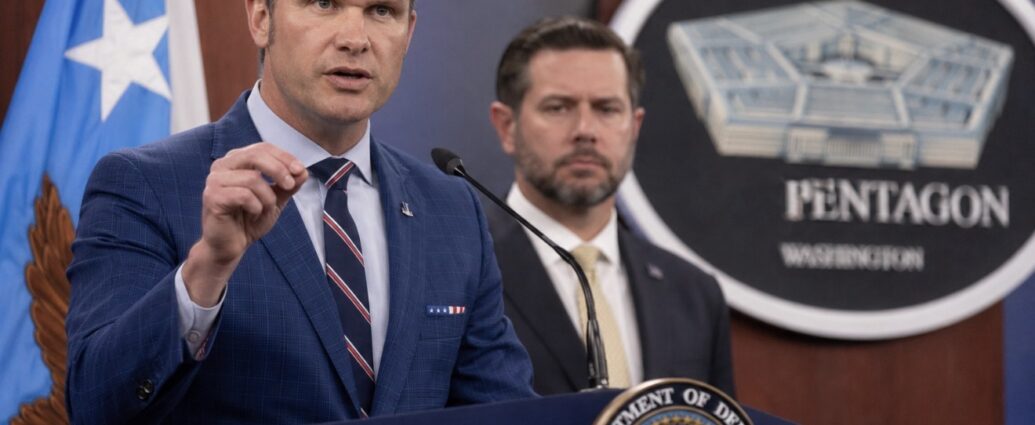
Defense Secretary Pete Hegseth built a plan last month to pull more American troops out of Europe, then dropped it before announcing it. The Pentagon’s chief spokesman, Sean Parnell, said Thursday that Hegseth made sure his message lined up with President Donald Trump‘s goals and did not want to crowd the president’s room to decide.
Hegseth had been planning to fly to Brussels in June to tell NATO’s top military chiefs that the United States was readying fresh troop cuts on the continent, according to people familiar with the matter cited by the Wall Street Journal. The cuts would have gone beyond two moves already made this year: the canceled deployment of an armored brigade to Poland and the earlier withdrawal of an infantry brigade from Romania.
That plan was scrapped after Hegseth shared it with Secretary of State Marco Rubio, who also serves as Trump’s national security adviser, and other senior officials. Instead of the bombshell, Hegseth used his June 18 speech in Brussels to announce a review of American forces in Europe that could take up to six months.
The episode shows the Trump administration has not settled on how fast or how deep it wants to cut in Europe. There are roughly 80,000 U.S. troops on the continent now.
The back-and-forth is familiar. In May, the Pentagon said it would withdraw about 5,000 troops from Germany after German Chancellor Friedrich Merz criticized Trump’s handling of the war with Iran. Weeks later, Hegseth canceled an armored brigade’s rotation to Poland — a move that caught even Trump off guard. Trump then reversed it on Truth Social, saying he would send 5,000 troops to Poland instead, citing his ties to Polish President Karol Nawrocki.
Congress has tried to slow the cuts. Under the 2026 defense budget law, the Pentagon cannot keep troop levels in Europe below 76,000 for more than 45 days without first notifying and certifying its plans to lawmakers. Republican and Democratic members of the armed services committees have complained they were not consulted on the earlier moves.
The direction, though, is set. A Pentagon defense strategy issued in January said the United States would trim its presence in Europe to focus more on the western Pacific and the Western Hemisphere, with the goal of handing European nations the main job of defending their own continent. On Thursday, Trump wrote on social media that the U.S. spends more on NATO than any other country and gets no benefit from it.
Troop levels and allied spending will be front and center next week when Trump meets NATO leaders in Ankara, Turkey. Alliance officials are hoping the summit shows unity and support for Ukraine, but they fear friction with Trump will steal the spotlight. Officials are also weighing whether to scrap a planned 2027 summit in Albania, according to Reuters.
For business, the story is about who pays and who builds. NATO members agreed in June 2025 to lift defense spending toward 5% of GDP by 2035, a huge jump from the old 2% target. Consulting firm McKinsey estimates European core defense spending could reach about €800 billion—roughly $912 billion—by 2030.
That money is lifting Europe’s arms makers. Shares of Germany’s Rheinmetall, Britain’s BAE Systems, Italy’s Leonardo, France’s Thales, and Sweden’s Saab have climbed sharply since Russia invaded Ukraine in 2022, driven by growing order books. The Stoxx Europe Aerospace & Defence index cooled somewhat this year as investors questioned whether prices had run too far ahead of actual deliveries.
There is a catch for American firms. Much of Europe’s new spending is being steered toward European factories. Under the European Union’s SAFE loan program, the bloc wants 55% of weapons purchases coming from European or Ukrainian makers by 2030. That threatens to shut out U.S. contractors that have long dominated European sales, even as Washington pushes allies to spend more.
At home, Hegseth has said the United States will invest $1.5 trillion in defense in its 2027 budget. But the uncertainty over troop levels—plans floated, then pulled—has unsettled allies and some leading Republicans, who worry the stop-and-start approach will damage the alliance and encourage Russia.
For now, the pace of any pullback is on hold pending the six-month review. The Ankara summit will offer the next signal of where Trump wants it to go.
JBizNews Desk | Washington
© JBizNews.com All Rights Reserved. Reproduction or distribution without written permission is prohibited.