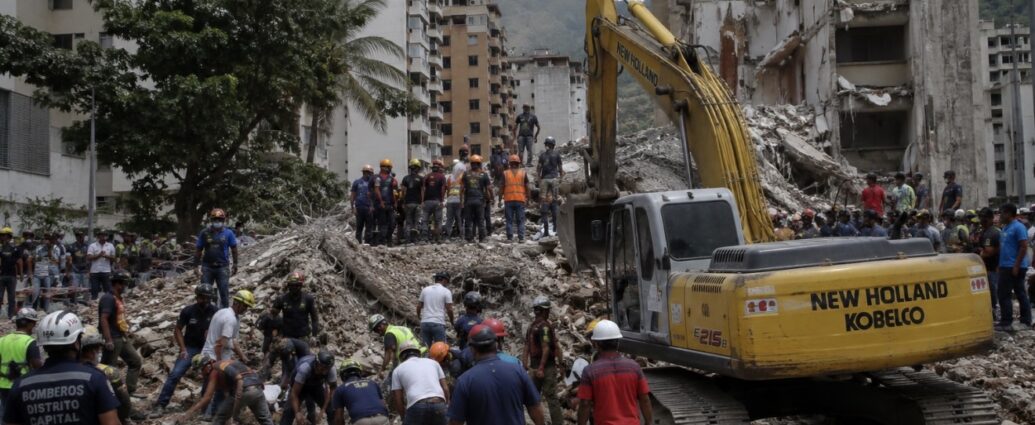
Nearly a week after two powerful earthquakes devastated Venezuela’s northern coast, rescue crews are still struggling to reach victims—not because of a lack of equipment, but because many of the cranes, excavators, and heavy machines needed to clear debris have run out of fuel.
According to Venezuela’s National Assembly, the death toll climbed to 3,000, with more than 11,200 people injured and tens of thousands still unaccounted for. Rescue operations remain concentrated in La Guaira, one of the hardest-hit regions.
The fuel shortages have added a painful irony to the disaster.
Despite possessing the world’s largest reported oil reserves, Venezuela has been unable to keep enough gasoline flowing to support emergency recovery efforts. Government machinery has reportedly sat idle while families and volunteers searched collapsed buildings by hand.
The two earthquakes struck within seconds of one another on June 24, measuring 7.2 and 7.5 in magnitude, with epicenters in Yaracuy state west of Caracas. The second and stronger quake released roughly three times the energy of the first, bringing down aging apartment buildings and damaging communities across the northern coast.
Satellite imagery indicates nearly 60,000 buildings were damaged or destroyed.
The United Nations estimates the disaster caused between $4.7 billion and $8.7 billion in physical damage—equal to roughly 4% to 8% of Venezuela’s economy. UN agencies also estimate that as many as 6.8 million people could require shelter, medical care, food, or clean water.
Ironically, the country’s oil infrastructure largely survived.
State-owned energy company PDVSA said major refineries, including El Palito, Amuay, and Cardón, escaped significant earthquake damage, while crude production in the Orinoco Belt continued operating.
Instead, officials say the fuel shortages stem from years of underinvestment that left Venezuela unable to refine enough gasoline for domestic demand, forcing the country to depend on imports and fuel rationing. Once the earthquakes struck, that fragile supply chain quickly broke down.
Public frustration has continued to grow.
Many survivors accused the government of responding too slowly, forcing neighbors to rescue victims before heavy equipment arrived. PDVSA and private distributor Domegas said they are also inspecting natural gas systems serving roughly 600,000 households around Caracas to identify leaks caused by the earthquakes.
The emergency response is unfolding under Venezuela’s new political leadership.
Following the capture of former President Nicolás Maduro in January, the United States has backed the country’s new government while overseeing much of Venezuela’s oil revenue.
About 2,000 U.S. service members are assisting with search-and-rescue operations, according to U.S. Southern Command commander Gen. Francis Donovan. President Donald Trump has also pledged American assistance, describing the earthquakes as catastrophic.
International rescue teams from Ecuador, Spain, the Netherlands, Jordan, and Argentina joined local crews during the early days of the response. While many foreign teams have begun winding down operations, rescuers continue searching for survivors.
A three-year-old boy was pulled alive from the rubble in La Guaira on June 30, while crews continue efforts to rescue a 44-year-old man trapped beneath the parking garage of a shopping mall, supplying him with food, water, and medicine.
For businesses, the disaster strikes at a critical moment.
Since Maduro’s removal, the United States has eased sanctions on PDVSA, Venezuela has adopted a new oil law, and crude production has begun recovering. The country produced approximately 1.16 million barrels of oil per day in May, with PDVSA targeting 1.37 million barrels per day by the end of 2026.
Now, billions of dollars needed to rebuild homes, highways, ports, power systems, and public infrastructure may compete directly with efforts to expand oil production and revive the broader economy.
The World Food Programme has requested $50 million to feed up to 500,000 people during the next three months, while the World Health Organization warns that already strained hospitals face growing risks of disease outbreaks.
For now, one of the world’s largest oil-producing nations continues confronting a basic obstacle to recovery: getting enough fuel to power the machines needed to save lives. Until fuel supplies improve, much of the work in La Guaira will continue one shovel at a time.
JBizNews Desk | Caracas
© JBizNews.com All Rights Reserved. Reproduction or distribution without written permission is prohibited.