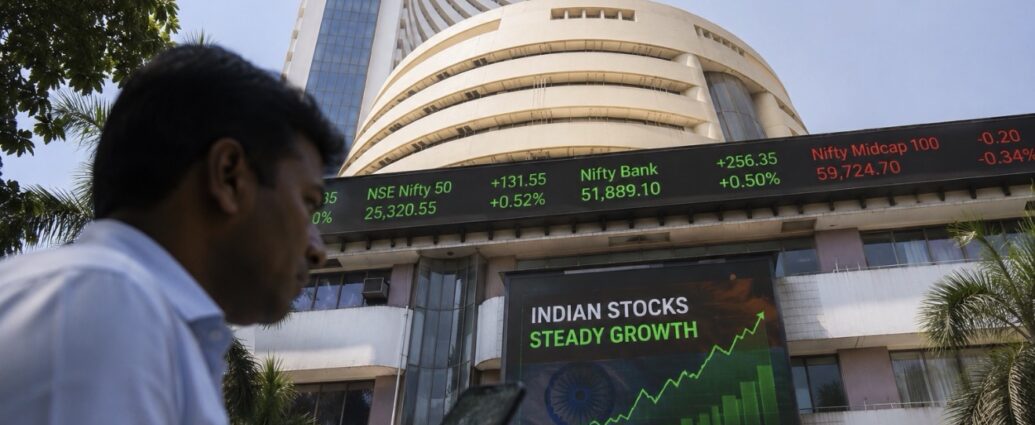
India has emerged as a shelter for global investors rattled by sharp swings in artificial-intelligence stocks, with the NSE Nifty 50 posting steadier returns than most emerging-market rivals through the first half of 2026 and foreign money beginning to flow back. Through June, the Nifty 50 outpaced the MSCI Emerging Markets Index by its widest margin since November, while foreign investor outflows slowed to their lowest level in four months—a shift that has prompted several strategists to rethink a market they had largely written off earlier in the year.
The irony is that India’s recent strength stems largely from what it lacks. For much of 2026, the country’s limited exposure to major AI companies weighed on investor interest as global capital poured into technology-heavy markets such as South Korea and Taiwan, home to many of the semiconductor manufacturers driving the artificial intelligence boom. Now, with those same AI-related investments swinging sharply on every headline about spending, valuations and earnings, India’s relative lack of exposure has become an advantage rather than a weakness. During the first half of the year, the Nifty 50 experienced daily moves of 1% or more far less frequently than most major emerging-market indexes, offering investors a level of stability that has become increasingly valuable.
The broader economic backdrop has improved as well. A stronger Indian rupee, declining oil prices and lower commodity costs have eased inflation concerns while improving the country’s growth outlook. That combination of more stable prices, resilient economic growth and lower market volatility has strengthened the investment case for India and helped distinguish it from many other emerging markets.
Oil prices remain an important part of the story. India imports most of its crude oil, making the economy particularly sensitive to fluctuations in global energy prices. The recent decline in oil prices following earlier spikes tied to geopolitical tensions in the Middle East has provided meaningful relief by reducing inflationary pressures, improving corporate profit margins and giving policymakers greater flexibility.
Monetary policy remains an important variable. The Reserve Bank of India (RBI) kept its benchmark interest rate unchanged at 5.25% in early June while lowering its growth forecast and modestly raising its inflation outlook. The cautious stance suggests policymakers remain unwilling to declare victory over inflation despite improving economic conditions. Investors positioning India as a relatively safe destination are effectively betting that the RBI can continue controlling inflation without significantly slowing economic growth.
Corporate earnings now become the next major test. Investors are closely watching results from Tata Consultancy Services (TCS), India’s largest information-technology services company, scheduled to report later this week. Analysts will be looking to see whether lower operating costs and steady domestic demand translate into stronger earnings. As one of India’s largest technology companies, TCS could also offer important clues about how artificial intelligence may affect the country’s massive outsourcing industry, where automation presents both opportunities and long-term competitive challenges.
For business leaders and investors, the appeal of India increasingly comes down to diversification. The renewed interest is not based on expectations that India will dominate the artificial intelligence revolution. Instead, investors are seeking exposure to one of the world’s largest equity markets whose performance is less dependent on the handful of mega-cap AI companies that have increasingly driven—and disrupted—global stock markets. At a time when a single earnings report from a technology giant can move markets worldwide, an economy supported more by domestic consumption than by semiconductor manufacturing offers a different risk profile.
That does not make India immune from global uncertainty. The rupee could weaken, oil prices could climb again if geopolitical tensions escalate, and a severe downturn in global technology stocks would almost certainly spill into emerging markets as well. Even so, the investment case has become increasingly clear. In a year dominated by both the excitement and volatility surrounding artificial intelligence, India is offering investors something increasingly difficult to find: stability.
JBizNews Desk | Mumbai
© JBizNews.com All Rights Reserved. Reproduction or distribution without written permission is prohibited.