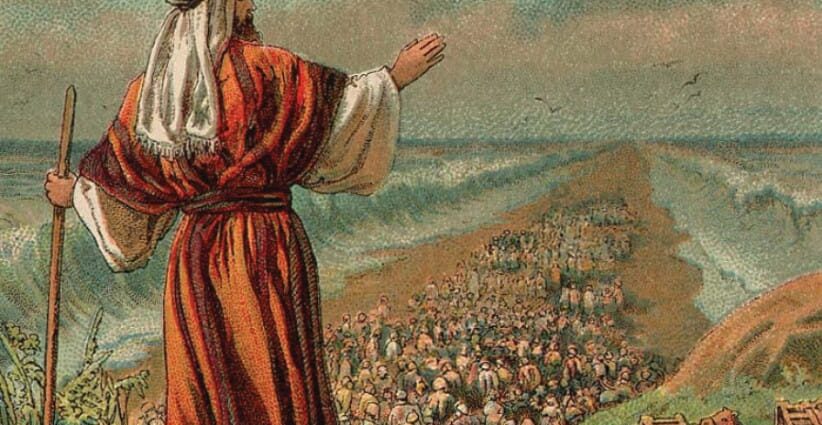
Moses had already been told that he would not lead the people into the Land of Israel. Yet perhaps there was still hope that the decree might be rescinded. Moses had successfully overturned previous heavenly decrees. Perhaps, with enough prayer and enough faith, even this decree could be rescinded.
He conducted a final census, counting the people he had guided so carefully and lovingly through the harsh desert for 40 years. Despite the divine decree, he continued to lead the nation. Despite the loss of his brother and sister, he remained at the helm.
The Torah then turned to the laws of inheritance. This may be the final sign that Moses’ fate had been sealed. As the Torah outlined how children inherit the legacy of their ancestors, Moses realized that he, too, must prepare to pass his own legacy to the next generation.
In a heroic moment of selflessness, his first thoughts turned to the question of who would lead the people after him. He did not dwell on his own disappointment or plead once more for his own future. Instead, he asked God to appoint a worthy successor. To ensure a smooth transition and avoid any crisis of leadership, he wanted that successor appointed during his own lifetime.
In asking God to appoint a successor, Moses used an intriguing description of God. He addressed Him as Elokei haruhot – the God who knows every human spirit. In doing so, he hinted at what he considered the primary qualification for the leader who would guide the people into the Land of Israel.
Moses sought someone who understood the differences in the human spirit and the diversity of human experience. He wanted a leader who appreciated those differences and cultivated them rather than trying to homogenize people and their lives. He realized that God alone fully understands the uniqueness of every individual. God created us with different temperaments, different strengths and weaknesses, different perspectives, and different missions.
No human being can see people as God does. Yet Moses sought someone who would come as close as possible.
Moses knew that our deepest convictions often narrow our perspective. Our passions convince us that our way is the only way. We become emotionally attached to our own viewpoints and find it difficult to step outside ourselves and see the world through someone else’s eyes. Over time, we become so committed to our own ideas that we struggle to recognize truth beyond them.
Different paths of serving God
Moses was different. He possessed the breadth to appreciate the full range of human experience. Partly, this grew from his prophetic vision, which lifted him beyond the narrowness of ordinary human perspective. Partly, it stemmed from his unique life experience. He was raised in an Egyptian palace, married a Midianite woman, and spent decades away from Egypt before returning to liberate us. Above all, Moses loved the Jewish people so deeply that he could look beyond their flaws and appreciate the richness of different personalities and different paths in serving God.
Moses realized that his successor would need to embody these same qualities, especially as we prepared to settle the Land of Israel and live as separate tribes. In the desert, tribal identity had been less pronounced. Although each tribe camped in its own section, everyone shared the same desert and the same experience. Life in Israel would be different. As the people spread across the land, regional and cultural differences would become more pronounced. Their leader would need to appreciate those differences rather than force conformity.
Moses did not seek an influencer. He was not looking for a larger-than-life personality or a charismatic leader who could overwhelm people and persuade them to follow a single path. Nor was he searching for the sharpest intellect. He wanted someone who respected other people and appreciated the complexity of the human condition.
I encountered this same outlook in my rebbe, Rav Aharon Lichtenstein.
In 1978, Shimon Peres, then opposition leader and chairman of the Labor Party, visited my yeshiva. He asked Rav Lichtenstein what the political credo of our yeshiva was. I was proud of Rav Lichtenstein’s response. Politics had never been part of his educational agenda. His goal was to shape human souls and deepen religious commitment. Political convictions were left to each individual student.
Rav Lichtenstein replied that he hoped to instill three values in his students: a sense of responsibility for the broader community even while immersed in Torah study, the discipline to think deeply rather than simplistically about public issues, and the ability to respect those who hold different views even when convinced that your own position is correct.
He taught us to respect differing opinions without surrendering our own convictions.
We are living through a period of deep division. We have formed staunch ideological camps and have become passionately committed to our own way of life. In Israel, we are enduring a painful period of social discord that has at times erupted into near violence.
Have we lost the ability to understand those who see the world differently and appreciate their values even when we disagree with them? Have we become too narrow in our outlook? Do we possess enough humility and enough breadth of vision to see beyond our own assumptions?
Where we live also shapes how we see one another. For good reason, Orthodox Jews tend to cluster in homogeneous communities. This is a healthy and effective way to cultivate shared values that are reinforced by communal norms and expectations. I live in a fully Orthodox yishuv, where Shabbat is built into the fabric of the community because the gates are closed.
Yet by closing those gates, I also limit my exposure to other types of Jews whose lives and experiences I need to better understand.
This demographic isolation has become characteristic of many Orthodox communities, both in Israel and, to a large extent, abroad. While it strengthens communal identity, it also makes it more difficult to appreciate the depth and complexity of Jewish lives beyond our own circles.
In Israel, one important point of common ground remains the army, where people from very different backgrounds serve together and learn to better understand one another despite their differences. By its very nature, military service is a leveling experience. Social distinctions fade, and people earn one another’s respect through shared experience. That shared experience allows people from very different walks of life to develop genuine respect for one another.
Because most haredim currently do not serve in the army, this interaction is largely absent. It becomes more difficult for each side to understand the experiences and assumptions of the other. As tensions continue to mount, it is increasingly apparent that the different sides in this debate are operating with very different narratives, and neither fully understands how the other sees the issue.
A society cannot remain united if its different communities rarely encounter one another.
This is why Moses addressed God as Elokei haruhot. He knew that no leader could understand every person as God does. But he hoped for a leader who would strive to see beyond his own perspective.
The first step toward healing our divisions is to broaden our own perspective before trying to change someone else’s. That is a better path to leadership than simply speaking louder than everyone else.
The writer is a rabbi and educator at Yeshivat Har Etzion (Gush) in Israel. His latest book, Reclaiming Redemption, Vol. II: Faith, Identity, Peoplehood, and the Storms of War, is available at mtaraginbooks.com