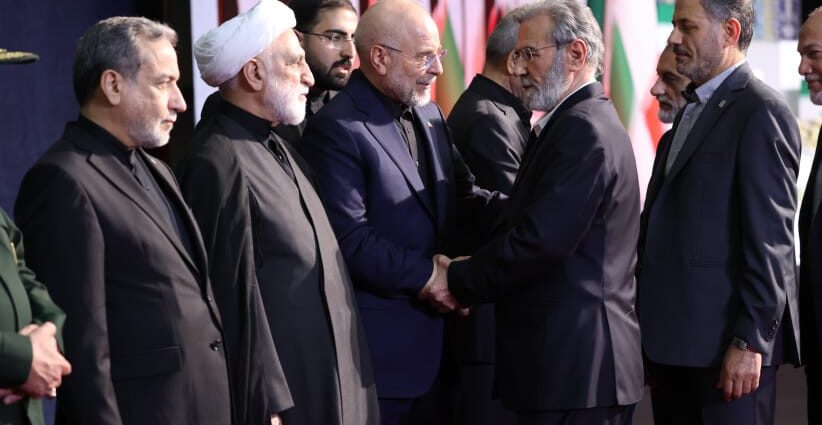
Iran’s Supreme Leader Mojtaba Khamenei reappointed Chief Justice Gholam-Hossein Mohseni-Eje’i to his post, he announced in a post on X/Twitter Sunday evening, despite anti-regime London-based outlet Iran International reporting last week that the chief justice was expected to be replaced, citing several sources.
“Imam Sayyid Mojtaba Khamenei, the Leader of the Islamic Revolution, has issued a decree reappointing Hujjat al-Islam wal-Muslimin Mohseni Eje’i to be the Head of the Judiciary,” read Khamenei’s post.
Iran International’s sources said the now-refuted decision not to reappoint the chief justice would not have been a part of judicial reform, but rather part of a broader power restructuring following the recent war; with the new supreme leader reportedly seeking to align Iran’s various power centers more closely with his personal vision.
Iran International reported that that decision would have “[come] amid growing criticism of Mohseni-Eje’i from hardline figures,” who saw him as being “at odds with Khamenei’s stated position,” especially in regard to the Memorandum of Understanding between the United States and Iran.
During Iran’s Judiciary Week, an annual national observance dedicated to the country’s judiciary, Khamenei issued a message calling for the implementation of the Judicial Transformation Document, which, according to Iran International, is a strategic roadmap and long-term plan for guiding the Iranian judiciary. It aims to modernize, digitize, improve efficiency, and implement anti-corruption and public rights measures.
“The comprehensive expectations laid out by our martyred Leader, along with the points I raised in my message of June 28, 2026, provide the framework for the transformation, growth, and realization of a Judiciary as it should be,” said Khamenei in another post on X Sunday evening.
Chief Justice Mohseni-Eje’i defends his performance
According to Iran International, Mohseni-Eje’i published a letter in response to Khamenei’s message, defending the judiciary’s performance and committing to maintain the path of “judicial transformation.”
He wrote, “I and all components of the judiciary consider ourselves obliged to carry out Your Excellency’s binding commands precisely, swiftly and without any reduction.”
Various factions within the Iranian regime have mounted attacks on Mohseni-Eje’i, who, according to Iran International, has only stated his loyalty to Khamenei’s goals in this recent letter, after the security of his position came under fire.
Mohseni-Eje’i’s supporters defend him by pointing to reduced imprisonment, shorter trials, as well as the implementation of anti-corruption efforts and the use of electronic court proceedings as falling in line with the Judicial Transformation Document and the regime’s stated goals.
‘Judge of Death’ oversees array of human rights violations
Human rights organizations, on the other hand, such as Iran Human Rights Monitor, call out Mohseni-Eje’i as a key figure in the Islamic Republic’s repressive regime, with some naming him the “Judge of Death” because of his extensive record of orchestrating mass executions, torturing dissidents, and shutting down civil liberties.
Amnesty International said that during the January 2026 clampdowns on anti-government protests, Mohseni-Eje’i “ordered rapid prosecutions and ‘deterrent’ punishments,” publicly boasting about “ordering harsher charges against arrested protesters than those leveled by prosecutors,” as well as ordering the interrogation of protesters “without lawyers present in coerced ‘confessions’ broadcast on state media.”
Amnesty International also revealed that those sentenced to death or facing imminent execution under Mohseni-Eje’i’s directives included individuals who were under the age of 18 at the time of their alleged offenses, in direct violation of international law.
Iran International said that rights groups believe that a potential Mohseni-Eje’i’s replacement would do little to bring meaningful change, so long as deep structural reform does not follow.
To them, his replacement would have amounted to little more than a cosmetic change.