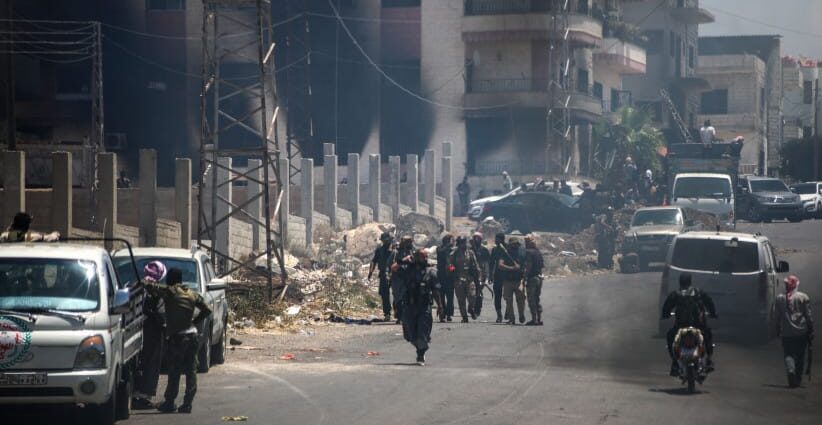
Judicial proceedings have been launched against individuals accused of being involved in the sectarian violence in Sweida last year, National Investigation Committee into the Sweida events spokesperson Ammar Ezzedin confirmed to Syrian state media on Saturday.
Ezzedin told SANA the Military Public Prosecution referred multiple suspects to an investigating judge over alleged offenses linked to the violence and that those cases have now been transferred to the Military Criminal Court in Damascus.
The attacks in July were among the worst outbreaks of sectarian violence since Ahmed al-Sharaa seized power following the fall of the Assad regime in 2024. More than 2,000 people were killed, including 789 Druze civilians, according to the Syrian Observatory for Human Rights monitor, though the Syrian government has said that it confirmed the killings of 1760 people.
The first public hearing was held on Wednesday, and the next hearing is scheduled for July 13, Ezzedin confirmed.
“The referral of these cases to the competent judiciary and the commencement of public trials represent the transition from fact-finding to judicial accountability,” Ezzedin said.
The proceedings aim to ‘establish the facts and hold anyone proven responsible accountable’
Hatem al-Naasan, who leads Syria’s national committee investigating the events in Sweida, said the proceedings aim to “establish the facts and hold accountable anyone proven responsible for any violations … regardless of their position or the side to which the acts are attributed.”
A UN investigation in March confirmed that Syrian government forces, in addition to Bedouin militias and individuals affiliated with Islamic State, attacked Druze communities, leading to the deaths of 1707 people across all factions and the displacement of up to 155,000 people.
A United Nations official warned on Monday that efforts to repair divisions and stabilize southern Syria have stalled nearly a year after deadly sectarian violence in a Druze-majority province shook the country.
A respected Syrian human rights activist, speaking to The Jerusalem Post anonymously, said that in a normal country, the legal process was part of a necessary reconciliation process but that the issue in Syria is that it relied on a non-elected culpable party being both judge and defendant.
Reuters contributed to this report.