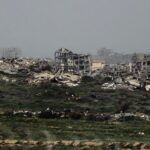
A Lidl supermarket and a refrigerated storage and logistics facility are set to be built on the remains of Austria’s second-largest women’s concentration camp.
The Hirtenberg subcamp was a World War II women’s labor concentration camp established in September 1944 as part of the wider Mauthausen concentration camp network. Most of the prisoners were Jewish women from Auschwitz who were sent to the women’s camp to manufacture munitions. The camp was evacuated in April 1945. It is situated near the town of Leobersdorf.
The Wiener Zeitung was the first to report that the Mayor of Leobersdorf and real estate entrepreneur Andreas Ramharter profited from the sale of the site. His company sold it to businessman Thomas Rattensperger for more than €15 million, and Ramharter received an extra €1.34 million through rezoning.
The site will be turned into a refrigerated storage and logistics facility with multiple loading docks, freezer sections, and shipping areas. It will also include a branch of the German discount retailer Lidl, Wiener Zeitung added.
When the plans were first hinted at in 2024, they caused significant controversy.
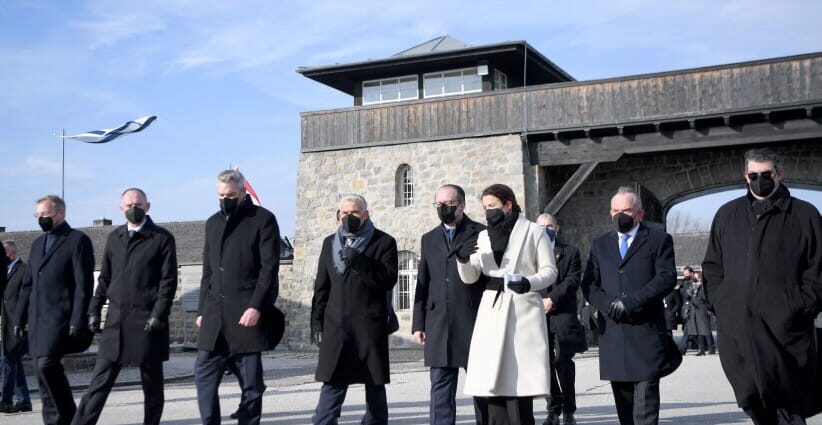
Barbara Glück, director of the Mauthausen Memorial, called the demolition of the concentration camp remains “a disgrace.” Oskar Deutsch, president of the Israelitische Kultusgemeinde Wien, said the site should have been preserved to commemorate “this dark chapter of our history” and “must not be covered over by a shopping center.”
“That profit was made here at the expense of the memory of tortured and murdered women,” said Deutsch.
Federal Monuments Office approves supermarket plans
Nevertheless, the Federal Monuments Office decided that the remains of the camp were “not sufficient to warrant protected monument status” and therefore permitted the building to go ahead.
According to the Mauthausen Guides, around 400 women were interned in the camp. The first transport with 391 women arrived in Hirtenberg from Auschwitz Concentration Camp on September 28, 1944.
The second one arrived on November 27, 1944, with another 11 female prisoners, three of whom came from Auschwitz Concentration and Extermination Camp, and eight came from Ravensbrück Concentration Camp for Women.
Most prisoners were Russian women
194 of the women were Russian protective-custody prisoners, thus forming the largest group. 101 Italians, most of whom were from the border region with Slovenia, which was then occupied by Italy, formed the second largest group of prisoners.
Moreover, 95 women from Poland, five from Yugoslavia, three from Hungary, two from Croatia, and one each from Germany and from Slovakia arrived at Hirtenberg Subcamp. The youngest was 16; the oldest was a 58-year-old woman from Poland.
The Jerusalem Post reached out to the Federal Monuments Office for comment.