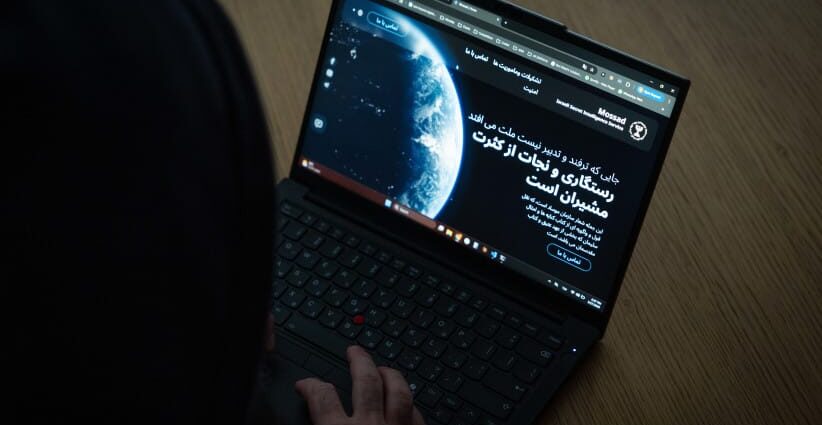
Israel still has no national policy or designated government body to coordinate its response to foreign influence campaigns online, nine years after the threat was first identified, outgoing State Comptroller Matanyahu Englman said on Tuesday.
The finding comes as Israel enters an election year, which the report described as a particularly vulnerable period for attempts to manipulate public debate, shape perceptions and undermine trust in election results.
“The threat of foreign influence in the digital sphere is worrying,” Englman said. “Hostile actors, including Iran, exploit social media covertly and systematically to deepen divisions, sow panic and engineer the Israeli public’s perception of reality.”
The comptroller’s audit, conducted between July 2024 and January 2026, found that repeated attempts since 2017 to create an interagency response were never translated into a functioning national framework.
According to the report, the National Security Council, the National Cyber Directorate, the now-defunct Intelligence Ministry, the Shin Bet (Israel Security Agency) and other bodies each identified the danger at different points. Yet initiatives to coordinate their work were abandoned, a national policy was never approved, and responsibility for the issue was left unassigned.
National security action plan submitted, not examined by PM Netanyahu
A 2023 national-security assessment that included recommendations to improve the monitoring and disruption of foreign influence campaigns on social media was not presented to the cabinet, the report said.
The Cyber Directorate presented Prime Minister Benjamin Netanyahu with a proposed national action plan in August 2024 and submitted it the following month. However, as of mid-July 2025, the plan had not been examined by the Prime Minister’s Office, according to the comptroller. It was transferred to the NSC only after the State Comptroller’s Office raised the issue.
By August 2025, both the NSC and Cyber Directorate had largely stepped back from broader work on the issue. The Cyber Directorate decided to focus only on cases in which foreign influence stemmed from cyberattacks used to achieve influence-related goals.
The report warned that the resulting gaps have left Israel with only a partial picture of foreign activity online.
The Shin Bet monitors suspected foreign influence operations, but the audit found that some technological and operational difficulties remained unresolved. A pilot intended to improve monitoring capabilities was still being examined in July 2025, before the Cyber Directorate stopped working on the broader issue.
The report also found that there is no formal channel through which civil-society organizations or members of the public can report suspected foreign influence activity to the authorities.
That gap is serious given the role online platforms now play in Israeli public life. According to a survey cited in the report, some 58% of Israelis said they regularly get news through social media.
Report points to several examples of influence activity, election interference
The report pointed to several examples of influence activity. One was a campaign known as ISNAD, which a 2024 study described as seeking to influence Israeli public opinion over the war. The report said the campaign produced thousands of messages between December 2023 and August 2024 and operated between 300 and 1,000 fake accounts on X alone.
It also cited a campaign identified by Israeli company Next Dim that sought, in the first days of the Gaza war, to promote the “GazaGenocide” narrative online. Visualizations included in the report showed the campaign’s initial activity and the subsequent spread of the term into a broader anti-Israel online conversation.
The report further noted that approximately five million alarming SMS messages, falsely warning recipients to immediately enter protected spaces, were sent to Israelis in September 2024 in a campaign attributed by the National Cyber Directorate to Iran and Hezbollah.
Efforts to remove harmful material have also been difficult to assess. Requests sent by security bodies and government ministries to the Cyber Department of the State Attorney’s Office for voluntary platform removals rose from about 8,600 in 2021 to more than 106,000 in 2024. Between 15% and 25% of requests forwarded to platforms in those years were not answered, the report said.
But the department does not separately track requests involving foreign influence operations, meaning the government cannot determine how platforms responded specifically in that area.
The comptroller also criticized the lack of preparation in schools and ahead of elections. Educational materials on disinformation and critical thinking remain optional, despite the risks posed by manipulated content and artificial intelligence-generated material. A “Fake or Not” initiative run by the Education Ministry recorded only about 9,000 site visits and 45,000 content views over roughly a year and a half.
The report said the Central Elections Committee had gaps in its threat assessment, while Justice Ministry guidelines drafted in 2019 for responding to online election interference had not been updated despite major advances in artificial intelligence.
Englman recommended that the NSC submit to the prime minister a framework for a government decision establishing a dedicated, budgeted coordinating body. He also called for stronger Shin Bet monitoring, a formal reporting channel for civil society, better data on platform-removal requests, mandatory digital-literacy education, and more structured election preparations.
“I want to raise a red flag,” Englman said. “Leaving the gaps in the field of foreign influence in the digital sphere unanswered leaves the Israeli public exposed and requires decisive national action.”