The High Court of Justice gave the state until the end of Tuesday to respond to Tzohar Kashrut’s newly issued license as an official kashrut-certifying body, after senior officials in the Chief Rabbinate and Religious Services Ministry challenged the way it was granted.
Justice Gila Canfy-Steinitz also gave Tzohar until Thursday to submit a short reply. By press time, the state had not submitted its response.
The dispute began last week, when Chief Rabbinate director-general Yehuda Cohen granted Tzohar Food Supervision a license to operate as a “body granting kashrut certification,” ending a years-long fight over the organization’s request to enter the official certification market.
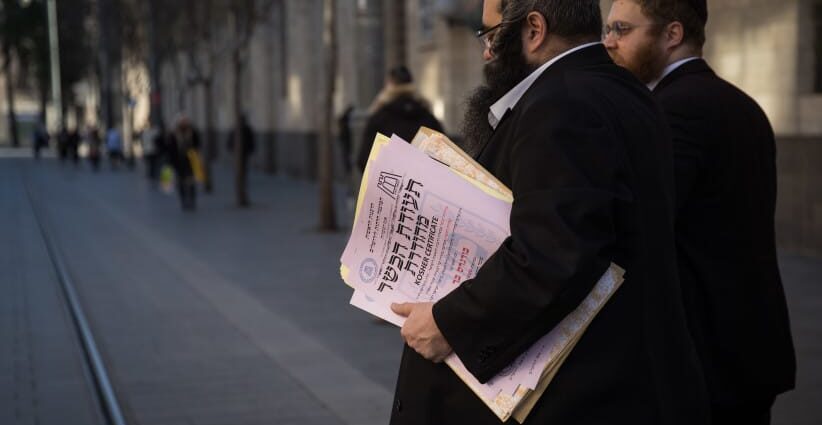
Tzohar then notified the court of the license and began replacing its existing certificates with those that could formally use the word “kosher.”
But the approval was quickly challenged from within the state bodies involved in the case.
‘Significant questions’ arise over Tzohar’s licensing
Chief Rabbinate legal adviser Yaakov Ofer wrote to Tzohar that “significant questions” had arisen over the administrative process that led to the license. He said the matter was under review and reliance on the license, or action taken under it, “may raise a difficulty” at this stage.
The letter did not itself revoke or suspend Tzohar’s license.
Religious Services Ministry director-general Yehuda Avidan went further, arguing that the authorization had no legal validity because it lacked the approval of the Chief Rabbinate Council, which he said was required by law.
The council took a somewhat different position. Its secretary, Rafael Frank, said it had not been informed in advance, had not received Cohen’s reasoned decision or the underlying material, and therefore was not approving the license at that stage.
Frank said the council had 30 days under the law to provide its halachic position once it received the relevant material.
Tzohar answered the following day through its lawyers, arguing that it had received a license from the official it said is legally empowered to issue it, after years of delay, despite High Court rulings.
The organization said it had already relied on the license, invested in preparing for the shift, and issued updated certificates to businesses under its supervision.
“It requires no small degree of audacity” for the rabbinate’s legal adviser to send such a warning, Tzohar’s counsel wrote, accusing the rabbinate of years of foot-dragging and noncompliance with the law and court rulings.
The lawyers said that any attempt to cancel the license would have to be made through the proper legal procedure, rather than through a letter cautioning Tzohar against relying on it.
At the center of the case is a dispute over who had authority to approve Tzohar. Tzohar says Cohen, as the designated licensing authority, could issue the certificate. Avidan and the council maintain that the council had to be involved before the authorization could take effect.
Tzohar maintains that Cohen, as the official appointed under the law to grant licenses to kashrut-certifying bodies, was empowered to issue the authorization. Avidan and the council maintain that the council had to be involved before it could take effect.
But the case is also about whether the 2021 kashrut reform will ever be implemented as intended.
Implementation of 2021 kashrut reform questioned
The reform was designed to move Israel away from a system in which local rabbinates effectively held geographic monopolies over official kashrut certification. It allowed private kashrut corporations to seek licenses to issue official certificates, while shifting the Chief Rabbinate toward a regulatory and supervisory role.
One of its central aims was to address the long-standing mashgiach-mushgach problem: the conflict created when a kashrut supervisor is paid directly by the business he is meant to supervise.
Under the reform’s intended model, the licensed kashrut body would employ the supervisor rather than the restaurant, hotel, caterer, or other business receiving certification.
The economic stakes were also significant. The Competition Authority has warned that the local rabbinate model can burden businesses, especially chains that must deal with separate local rabbinates and standards, while limiting competition in the certification market.
Tzohar applied for a license in 2023, after the reform entered into force. When no decision was made, it petitioned the High Court. In November 2025, the court ordered the rabbinate to examine whether Tzohar qualified under the law then in force and, if it did, issue it a license.
The ruling rejected the state’s argument that implementation could be delayed because the government intended to amend or repeal the law.
Tzohar said that its own supervision system reflects the reform’s model.
Tzohar kashrut division head denies conflict of interest
Rabbi Emmanuel Guedj, who heads Tzohar’s kashrut division, said every business certified by the organization has an on-site mashgiach, as well as a further supervisor above him.
“The mashgiach is not employed by the business,” Guedj told The Jerusalem Post. “He is employed by us, so there is no conflict of interest.”
Tzohar also tracks supervisors’ attendance through GPS, Guedj said, allowing it to know when a supervisor was at a business and for how long.
He said Tzohar follows halacha (Jewish Law) and does not certify businesses open on Shabbat, apart from hotels and assisted-living facilities. He added that its standards generally follow Chief Rabbinate procedures, while its model differs on questions such as the employment and oversight of supervisors.
Until now, Tzohar had operated under certificates that could not use the word “kosher.” Guedj said the license allowed the organization to replace them with official certificates bearing the word.
For businesses, that carries a practical commercial consequence.
“Once we have the ability to use the word ‘kosher,’ a business owner can bid for government tenders that require kosher certification,” Tzohar chairman Rabbi David Stav told the Post. “The state cannot say, ‘This is not kosher; you do not meet the tender conditions.’”
Guedj said businesses that had left Tzohar for local rabbinate certification in the hope of attracting more customers had already contacted the organization about returning.
“We are moving gradually, so that we give good kashrut and do not grow exponentially at the expense of quality,” he said.
Stav said Tzohar would continue operating under the license it received.
“The court is with us, the law is with us,” he said. “As long as the Knesset does not legislate a different law.”
Tzohar said on Tuesday that any procedural questions should be examined through the appropriate legal channels, but should not be used to undermine its ability to operate.
“The people of Israel deserve kashrut that they can trust and that is accessible and professional,” it said. “They should not have to contend with judicial and bureaucratic stall tactics.”
For now, Tzohar says it will continue operating while the High Court awaits the parties’ submissions.