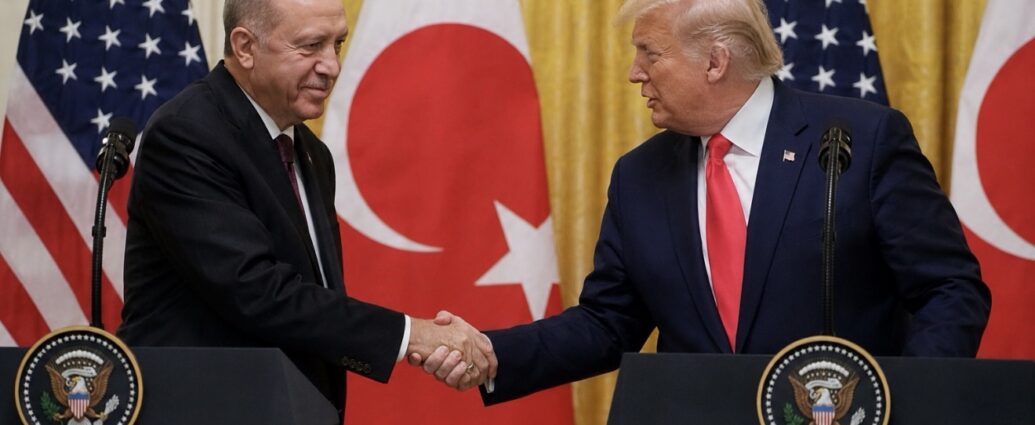
According to remarks made Tuesday, July 7, by President Donald Trump during a meeting with Turkish President Recep Tayyip Erdoğan, the United States is prepared to consider selling F-35 fighter jets to Turkey and revisiting sanctions that have blocked such a transaction for years. Trump said the administration would “certainly consider” the sale, describing Turkey as an important NATO ally while indicating the issue is now under active review.
The comments marked a significant shift in Washington’s posture toward Ankara. Rather than treating Turkey’s removal from the F-35 program as a settled matter, Trump suggested the issue could be revisited as part of broader efforts to strengthen U.S.-Turkish relations.
The dispute dates back to 2019, when the United States removed Turkey from the F-35 program after Ankara purchased Russia’s S-400 air-defense system. American officials argued that operating the Russian-made system alongside the fifth-generation stealth fighter could compromise highly sensitive military technology. Congress later reinforced that position through the Countering America’s Adversaries Through Sanctions Act (CAATSA) and subsequent defense legislation, effectively blocking future F-35 transfers while Turkey continues to possess the S-400 system.
Turkey previously invested approximately $1.7 billion in the F-35 program and had expected to receive aircraft before its participation was suspended. Several completed aircraft intended for Turkey have remained in storage in the United States since the program was halted.
Any reversal would face major political hurdles. While the White House can shape foreign policy, Congress continues to play a central role in approving major arms sales. Lawmakers from both parties have repeatedly opposed restoring Turkey’s access to the F-35 program unless Ankara permanently removes or relinquishes the Russian missile system. Several members of Congress have also raised concerns about Turkey’s regional policies, including tensions involving Greece and Cyprus.
One proposal that has circulated among policymakers would involve relocating the S-400 system to a third country, potentially creating a path toward resolving the dispute. No agreement has been reached, however, and significant diplomatic and legal questions remain.
The debate extends beyond the fighter aircraft themselves. The administration recently advanced plans for additional military sales involving F110 jet engines used in Turkey’s domestically developed KAAN fighter program, a move that also drew criticism from several lawmakers who questioned the strategic implications.
The financial stakes are substantial. The F-35 is manufactured by Lockheed Martin, while its engines are produced by Pratt & Whitney, a division of RTX. A Turkish return to the program would represent billions of dollars in potential orders for American aerospace manufacturers and thousands of companies throughout the defense supply chain. Turkey was previously both a customer and a manufacturing partner, supplying components used throughout the global F-35 production program.
For investors, the outcome could influence future revenue expectations across the U.S. defense sector. For NATO, the decision carries broader strategic implications, balancing alliance unity against longstanding security concerns surrounding Russian military technology.
For now, Trump’s remarks have reopened one of the alliance’s most contentious defense questions. Whether the proposal ultimately advances will depend not only on the White House but also on Congress, allied governments and Turkey’s willingness to address the issues that led to its removal from the F-35 program in the first place.
JBizNews Desk | Ankara
© JBizNews.com All Rights Reserved. Reproduction or distribution without written permission is prohibited.