President Emmanuel Macron of France and Syrian President Ahmed al-Sharaa announced a sweeping package of economic and infrastructure agreements on Tuesday, July 7, at a reconstruction forum in Damascus — hours after two bombs tore through a nearby street, wounding at least 18 people and laying bare the security risk hanging over Syria’s push to rebuild. The Élysée Palace said Macron was already at the presidential palace when the explosions hit and was unharmed. The visit went ahead as planned.
The economic message was the whole point of the trip. Macron arrived Monday night with a delegation of French business leaders, the first French president to visit Syria in 18 years and the first Western leader since Bashar al-Assad was ousted in December 2024. He came to sign deals — and to signal that France wants a front-row seat in a rebuild that could run into the hundreds of billions of dollars.
At the center of the package was a framework declaration for comprehensive cooperation and a major maritime, air transport and logistics agreement with French shipping giant CMA CGM, whose chairman and CEO Rodolphe Saadé joined the trip. CMA CGM already holds a 30-year contract to develop the Port of Latakia, signed in 2025 for €230 million, and later committed another €200 million to expand the port’s handling capacity. The new deal pushes the company into air cargo handling at Damascus airport.
Macron also put France’s name on Syria’s financial plumbing. He said France would provide technical assistance directly to the Central Bank of Syria and help restructure a banking sector shattered by 14 years of war. “We want to continue working on the restructuring of the banking sector,” Macron said. Additional protocols covered water treatment and energy projects in Homs province, civil aviation, and a memorandum with the French Development Agency to rebuild state institutions. The two countries also agreed to restore full diplomatic ties and reappoint ambassadors.
For al-Sharaa, the pitch to investors was geography. He framed Syria as a future transit hub linking the Mediterranean, the Gulf and Iraq — and tied it directly to the disruption in global shipping. “Syria has a strategic location linking the Mediterranean with the Gulf and Iraq, and is only a few hours by sea from Marseille,” he said. “After the Strait of Hormuz crisis, the world realized the value of safe and stable corridors here.”
That line matters well beyond Damascus. With traffic through the Strait of Hormuz still choked, companies and governments are hunting for alternative routes to move oil and goods between Europe and the Middle East. Syria is betting its coastline can become one of them.
Al-Sharaa laid out a long shopping list for foreign capital: modernized airports and air-navigation systems, offshore energy exploration, upgraded electricity and water networks, university hospitals, food processing, digital infrastructure and a rebuilt civil registry. “Our industrial cities are ready to become a platform for your investments,” he told the room. “We are building a modern investment environment governed by the rule of law and strong institutions.”
Energy is already drawing interest. Syria has signed a memorandum with TotalEnergies, U.S.-based ConocoPhillips and QatarEnergy to explore for oil and gas in its territorial waters. TotalEnergies chief Patrick Pouyanné was also part of Macron’s delegation.
The groundwork was laid over the past year. Macron pushed Europe and the United States to drop most sanctions on Syria, and the European Union lifted its economic penalties in May 2025. Clearing those barriers is what lets French and other Western firms sign contracts at all.
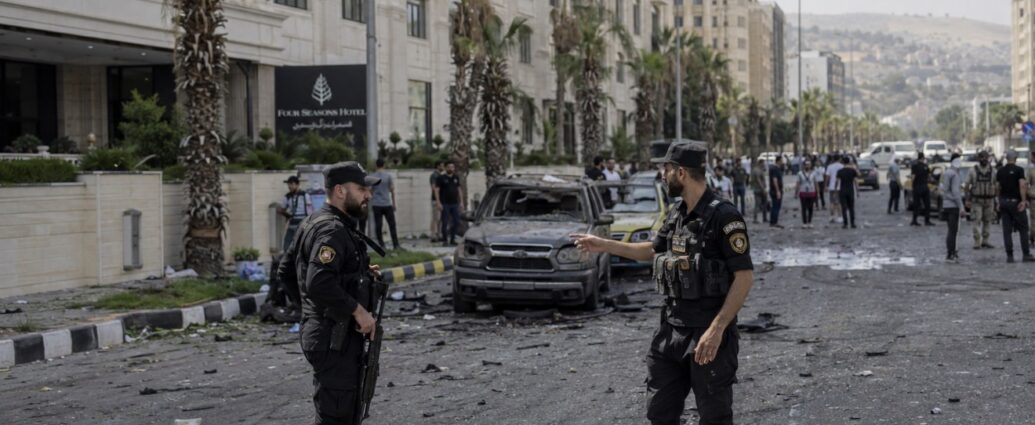
But Tuesday’s blasts underscored why many companies are still holding back. The two explosions — caused by devices planted in a garbage bin and a parked car, according to Syria’s Interior Ministry — went off near the Four Seasons Hotel, where Macron had spent the night. They came less than a week after a café bombing killed around 10 people in the same city. No group claimed responsibility for either attack.
That is the hard math for investors. Syria needs hundreds of billions of dollars, and it has already signed memorandums with several countries and companies — but many of those pledges have yet to become actual projects. Reconstruction money tends to wait for stability, and stability is exactly what Tuesday’s bombs called into question.
Macron tried to keep the focus on the opportunity. He said France would set up expanded joint economic committees, working alongside Gulf countries, to support the rebuild. “There are also many opportunities for our partnership,” he said. Whether Western capital follows the handshakes will depend less on the deals signed inside the palace than on the streets outside it.
JBizNews Desk | Damascus
© JBizNews.com All Rights Reserved. Reproduction or distribution without written permission is prohibited.