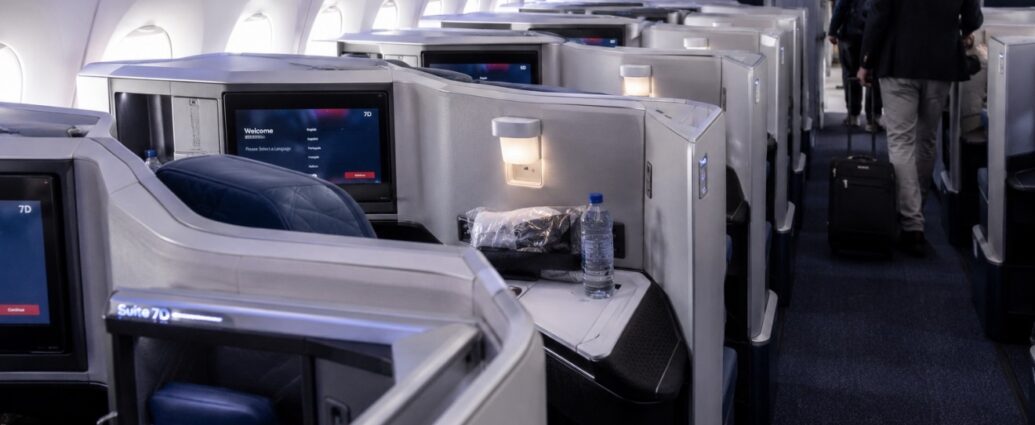
America’s largest airlines are redesigning air travel around their highest-paying passengers, pouring money into first-class cabins, private lounges and luxury perks while the experience for ordinary coach flyers grows tighter and pricier — a divide that industry executives and analysts spelled out this week.
The split is now impossible to miss. At Delta’s newest first-class lounges, open kitchens plate dishes like hamachi crudo, cocktail bars mix drinks to order, and travelers unwind in soundproof pods or on outdoor decks overlooking the tarmac. American Airlines has teamed with the James Beard Foundation to upgrade its lounge menus and redesigned its newest Boeing 787-9 Dreamliners around private business-class suites with sliding doors, lie-flat seats longer than a twin mattress, and amenity kits stocked with premium skincare.
For everyone else, the trip looks different: a line at every step, a café selling $16 sandwiches, a late boarding group, and a cramped middle seat once the overhead bins fill up.
The reason is money. Premium cabins have become the airlines’ most valuable real estate, throwing off outsized revenue from a small share of seats. That has pushed carriers to keep expanding the front of the plane while packing more travelers into the back. The shift didn’t happen overnight. Delta rewrote the industry’s playbook in the early 2010s, using sophisticated pricing tools to sell first-class seats to coach passengers willing to pay a bit more, rather than simply handing them out as free upgrades, said Henry Harteveldt, president of travel advisory firm Atmosphere Research Group.
Not every airline chief accepts the idea that the industry has abandoned regular flyers. United Airlines CEO Scott Kirby pushed back on the notion that carriers chase only big spenders, saying the company is “investing nose to tail for all customers.” He pointed to upgrades such as seatback entertainment and a better mobile app as improvements that reach every traveler, not just those up front.
Still, the direction is clear, and it reshapes what flying costs for families and budget travelers. As airlines devote more space and investment to premium seats, the cheapest fares increasingly arrive stripped of what used to be standard — seat selection, carry-on baggage, the ability to change or refund a ticket — through basic economy fares. The gap between a comfortable trip and a bare-bones one has widened dramatically, and closing it increasingly means paying more.
For the New York region, the trend hits close to home. Newark Liberty International Airport, a major United hub, along with JFK and LaGuardia, funnels millions of travelers into exactly this two-tier system every year. The business traveler who can expense a lounge pass and a lie-flat seat glides through; the family watching every dollar often pays extra just to sit together or bring a roller bag onboard.
The bigger question is where premiumization stops. Airlines have discovered that affluent travelers are willing to pay substantially more for comfort, convenience and exclusivity, and that finding is steadily reshaping aircraft cabins themselves. More premium suites, larger business-class cabins and expanded lounges are becoming the industry’s growth strategy, while economy passengers are asked to pay separately for services that were once included in the ticket price.
For most travelers, the skies remain open. They simply cost more to navigate comfortably than they did just a few years ago.
JBizNews Desk | Chicago
© JBizNews.com All Rights Reserved. Reproduction or distribution without written permission is prohibited.