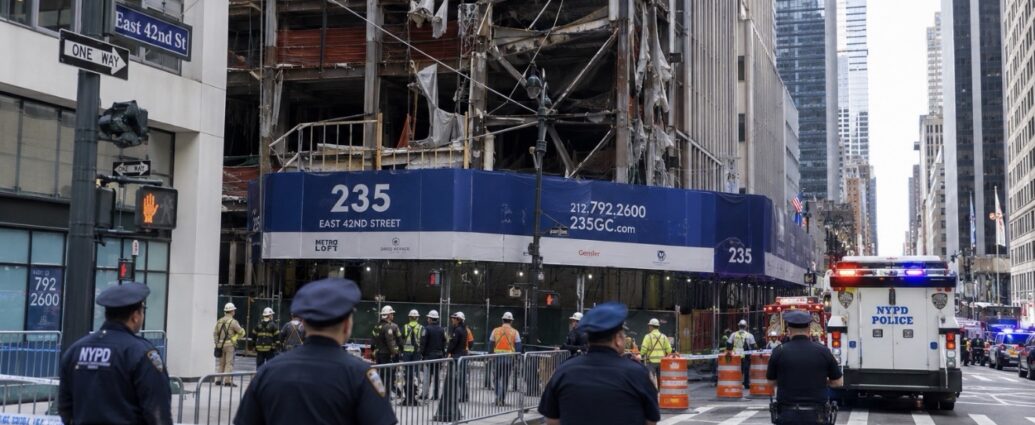
Hundreds Evacuated as Buckling Columns Trigger Massive Midtown ‘Frozen Zone’ at Mamdani’s Signature Housing Project
Construction workers converting the former Pfizer headquarters into apartments called 911 at roughly 8 a.m. on Tuesday, July 7, after they watched steel support columns begin to buckle on the 21st floor, the New York Police Department said. The workers evacuated the building on their own. Within hours, the city had emptied the tower and shut down a wide stretch of Midtown East, bringing one of New York City’s most ambitious housing redevelopment projects to a standstill.
The building at 235 East 42nd Street, at the corner of Second Avenue, is a 1960s office tower being transformed into housing as part of one of the city’s largest office-to-residential conversion projects. At a Tuesday afternoon briefing, Mayor Zohran Mamdani said two structural columns had buckled, several upper floors were sagging, and cracks had opened on the 21st floor. He described the situation as extremely serious and said the building continued shifting after city inspectors arrived.
Fire Chief John Esposito said the steel columns had begun to bend and deflect and that the structure was still moving while emergency crews remained on scene. While officials said a full collapse into surrounding streets appeared unlikely, they warned that a localized internal collapse remained possible. Fire Commissioner Lillian Bonsignore said the FDNY deployed approximately 150 firefighters and EMS personnel along with more than 50 emergency units to stabilize the situation.
The NYPD established what officials called a frozen zone, closing streets from 40th through 45th Streets between First and Third Avenues to both pedestrians and vehicles. Seven nearby buildings were evacuated as a precaution, including the Hampton Inn Manhattan Grand Central at 231 East 43rd Street, where hotel guests were removed from their rooms, and the Kennedy International School at 225 East 43rd Street, which was operating a summer camp serving approximately 400 children. The Israeli Consulate at 800 Second Avenue was also evacuated.
Authorities confirmed that no injuries were reported and that every construction worker had safely exited the building.
The implications extend far beyond a single Midtown block.
The former Pfizer headquarters is the centerpiece of 235 GC LLC’s redevelopment plan to create approximately 1,600 apartments, including more than 400 affordable housing units, in what developers and project architect Gensler have described as the largest office-to-residential conversion in New York City history. The development has become a centerpiece of the city’s effort to convert aging office towers into desperately needed housing as remote work reshapes Manhattan’s commercial real estate market.
The project is being developed by Metro Loft, led by veteran conversion developer Nathan Berman, together with David Werner Real Estate Investments. GACE Consulting Engineers serves as the project’s structural engineer. Financing totals hundreds of millions of dollars, including a $720 million construction loan provided by Madison Realty Capital in May 2025, in addition to earlier financing arranged through the Northwind Group. Any prolonged shutdown or major redesign could delay completion beyond the current 2027 target and increase project costs.
In a statement, a Metro Loft spokesperson thanked first responders, emphasized that public safety remains the company’s highest priority, and said the structural issues are confined to a limited section of one of the project’s two buildings. The company also stated that the overall structure is not believed to be at risk of complete collapse, consistent with the assessment provided by FDNY officials.
City officials offered a preliminary explanation for the failure. The building had been expanded to 37 stories, and as additional weight was added above the 21st floor, load-bearing columns experienced increased structural stress. A union tradesman at the scene, Cliff Johnson of Steamfitters Local 638, alleged that foundation work supporting the additional height had not been performed properly, though city officials have not reached any conclusions regarding the cause.
The development also carries an existing regulatory history. According to Department of Buildings records, the construction entity associated with the project received seven safety violations during 2025 totaling more than $32,000 in penalties. One citation issued in December carried a $10,000 fine for allegedly failing to notify the department of an incident involving serious injury or death.
By Tuesday evening, officials reported cautious progress. The Department of Buildings said inspectors had completed an initial assessment of the damaged area and authorized contractors to begin installing temporary shoring to stabilize the affected columns. Officials said the damaged structural members had shown no additional movement since the morning inspection. Deputy Mayor for Housing and Development Leila Bozorg told reporters around 4 p.m. that the building had remained stable for several hours, describing that development as encouraging. Residents of one evacuated building, located at 222 East 44th Street, were later allowed to return home.
Officials cautioned that stabilization work would continue overnight and that there was no timetable for reopening surrounding streets or allowing displaced residents, hotel guests and businesses to return. Governor Kathy Hochul said she remained in contact with city officials and confirmed that state building inspectors had joined the response.
For now, the Midtown project that was expected to showcase New York City’s effort to transform vacant office towers into housing has instead become a costly reminder of the engineering, financial and construction risks that accompany some of the largest redevelopment projects in the country.
JBizNews Desk | New York
© JBizNews.com All Rights Reserved. Reproduction or distribution without written permission is prohibited.