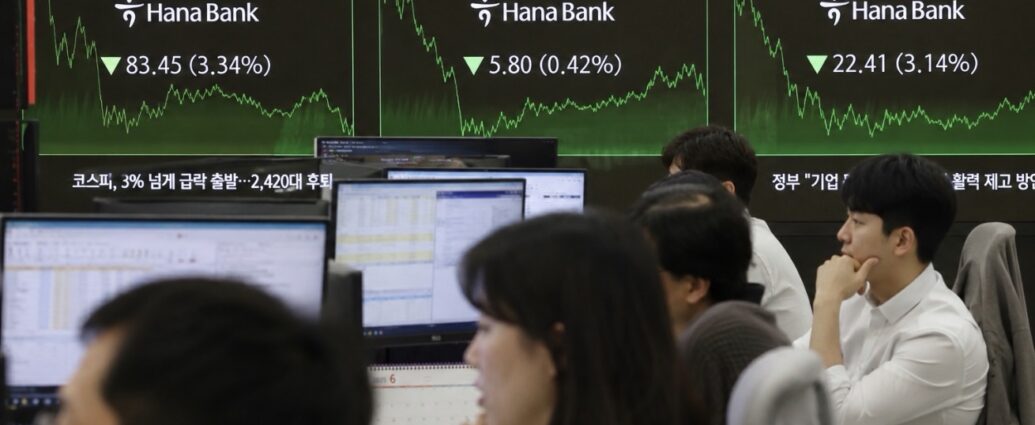
Asian markets opened sharply lower on Wednesday, hit by a fresh wave of selling in semiconductor stocks and a jump in oil prices after the United States struck Iran overnight. The twin blows landed within hours of each other. Late Tuesday in Washington, the U.S. Treasury Department revoked the license that had allowed Iran to sell its oil on world markets, and U.S. Central Command followed with a new round of military strikes inside Iran. Together they sent crude prices up roughly 6% and rattled a region already nervous about chips.
South Korea took the hardest hit. The Kospi index plunged 3.34% to 7,400.24 shortly after the open, its lowest level since late May. Japan’s Nikkei 225 fell 1.34% to 67,341.86, sliding to a level last seen in mid-June.
The pain was concentrated in the same memory-chip giants that had led the region’s blistering 2026 rally. Samsung Electronics dropped 4.32%, extending a slide that began a day earlier when the company’s record earnings guidance failed to satisfy investors who had bet on even bigger numbers. Rival SK Hynix fell 4.77%, slipping toward the 2 million won mark. In Japan, tech-investment heavyweight SoftBank Group eased 1.18%.
One name bucked the trend. Kioxia, the Japanese memory maker, rose 1.16% at the open, a rare spot of green in an otherwise red screen.
The selloff was a second act. On Tuesday, Samsung’s “sell the news” drop was severe enough to trigger a rare circuit breaker in South Korean trading, a mechanism that briefly pauses activity when moves get too violent. Wednesday’s open picked up where that left off.
What’s driving the chip slide
The immediate trigger came from Wall Street. Overnight, the Philadelphia Semiconductor Index — the main gauge of U.S. chip stocks — fell sharply again, and the Nasdaq Composite dropped 1.16% to close at 25,818.69. The Dow Jones Industrial Average slipped 0.25% to 52,925.15 after touching a record high earlier in the day, while the S&P 500 lost 0.45% to 7,503.85.
Underneath the numbers is a bigger worry. Investors are starting to question whether the enormous sums Big Tech is pouring into artificial intelligence can keep justifying the sky-high prices of the chips that power it. Samsung’s results made the point in miniature: profit soared nearly 19-fold from a year earlier to a company record, yet the stock still fell because expectations had climbed even higher. When a record isn’t good enough, nervous investors sell.
Oil and the Iran shock
The energy story added a second layer of stress. On July 7, the U.S. Treasury Department’s Office of Foreign Assets Control scrapped a waiver issued only weeks ago that had let Iran sell crude oil internationally, replacing it with a far narrower authorization. The move came after a string of attacks on tankers in the Strait of Hormuz, the narrow waterway through which a large share of the world’s oil passes.
Hours later, U.S. Central Command said it had carried out strikes inside Iran, targeting air-defense systems, command networks, coastal radar and anti-ship missile sites, and destroying several Iranian Revolutionary Guard patrol boats.
Oil markets reacted fast. West Texas Intermediate crude, the U.S. benchmark, climbed about 5.25% to roughly $72.15 a barrel, while international standard Brent crude rose about 5.7% to near $76.14. For a region that imports almost all of its energy, higher oil prices are a direct threat — they raise costs for manufacturers, squeeze household budgets, and feed inflation just as central banks had hoped to ease off.
Why it matters beyond the trading floor
For everyday consumers across Asia, the two stories connect at the wallet. Pricier oil means costlier fuel and shipping, which eventually shows up in the price of goods. And the memory chips made by Samsung, SK Hynix and Kioxia sit inside the phones, laptops, cars and data centers that people and businesses buy every day. When these companies stumble, the effects ripple through supply chains, jobs and investment plans well outside the stock market.
The bigger question now is whether Wednesday’s drop is a healthy pause after a red-hot run or the start of something deeper. South Korea’s Kospi and Japan’s Nikkei are both still up strongly for 2026, powered by the AI-driven chip boom. But with oil climbing and the U.S.-Iran conflict flaring again, the mood has turned cautious. Traders across the region will be watching two things above all in the days ahead: whether chip stocks find their footing, and how far oil runs if the standoff with Iran gets worse.
JBizNews Desk
© JBizNews.com All Rights Reserved. Reproduction or distribution without written permission is prohibited.