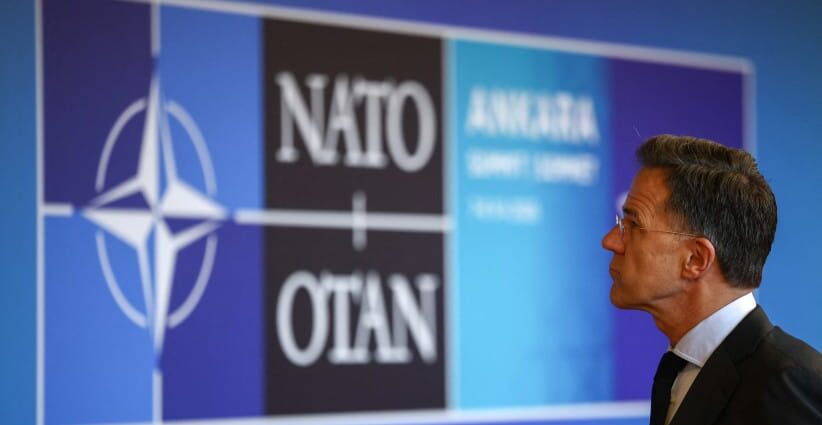
US President Donald Trump said Wednesday that he felt that the Memorandum of Understanding (MoU) with Iran was nullified following overnight strikes between the US and Iran in the Strait of Hormuz.
“To me, I think it’s over,” he said at the NATO summit in Ankara, Turkey, in comments to the press.
Trump also stated he felt the US had “wasted a lot of time” negotiating with Iran, and he did not wish to continue talks.
“I don’t want to deal with them [Iran] anymore. They’re scum. They’re sick people.”
BREAKING: Trump says Iran ceasefire is over for him.
He adds that he doesn’t want to deal with the Iranians anymore. pic.twitter.com/mXyzbDJuJa
— Clash Report (@clashreport) July 8, 2026
“I’m with you [on Iran],” responded NATO Secretary General Mark Rutte.
Earlier, Rutte had insisted the US strikes were “absolutely necessary,” noting that Iran had violated the ceasefire, which was signed three weeks ago.
“When you have a ceasefire and Iran is basically violating the ceasefire, I think it is totally crucial that the US forcefully react,” Rutte told reporters.
US-IRGC trade strikes once again, MoU collapsing
On Tuesday night, US forces began “a series of powerful strikes against Iran to impose heavy costs for targeting and attacking commercial shipping crewed by innocent civilians in an international waterway,” according to US Central Command (CENTCOM).
In response, Iran’s Revolutionary Guards (IRGC) confirmed it targeted US military sites in Bahrain and Kuwait in response to the US strikes in southern Iran that targeted air defense systems, coastal surveillance, and missile and drone launch sites.
When asked about the strikes, Dutch Prime Minister Rob Jetten stressed the importance of showing Iran that breaches of the “fragile” ceasefire in the Middle East will not be accepted.
“At the same time, you must apply maximum diplomatic pressure to make sure talks continue, and a solution is reached,” he said.
Breaches of ceasefire must be met with force until diplomatic pressures prevail
Senior diplomatic advisor to the president of the UAE, Dr. Anwar Gargash, said in a statement on X/Twitter that he believed Iran was unable to commit to peace.
“The Iranian attacks on Qatari and Saudi commercial tankers in the Strait of Hormuz, and the repeated aggression against the two sisterly nations of Bahrain and Kuwait, are a clear indication that Tehran is still unable to commit to the requirements of de-escalation and turning the page on war,” he wrote.
“The Arab Gulf states cannot remain a target for Iran’s hesitation between the logic of escalation and the path of rationality, stability, and peace.”
Kuwait’s Ministry of Foreign Affairs released a statement on X, condemning Iran’s actions with its “strongest denunciation of the repeated heinous Iranian aggressions against the State of Kuwait.”
The ministry affirmed that “continuation of these brazen aggressions, at a time when regional and international efforts aimed at de-escalation are underway, constitutes a systematic undermining of efforts to reduce tensions and strikes at the supporting international will for this path.”
It also emphasized that Kuwait maintains the right to take all necessary measures to preserve its sovereignty and security.
Oman also condemned attacks on Kuwait, calling for restraint and diplomacy to contain the escalation and promote peace, according to Iran International, an independent news agency.
Reuters and Esther Davis contributed to this report.