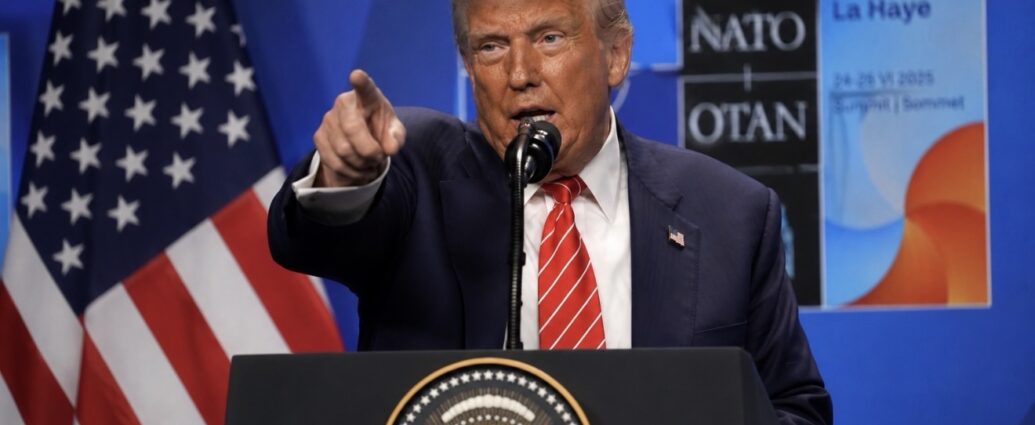
President Donald Trump said Wednesday that the ceasefire between the United States and Iran was over and that American forces would likely strike the country again the same night. Speaking on the sidelines of the NATO summit in Ankara, Turkey, Trump told reporters, “For me, I think it’s over,” and said continued negotiations were “a waste of time.” Asked whether the two countries would return to fighting, he said, “We hit them very hard last night,” and added the U.S. would “probably hit them hard again tonight.”
The president laid out a series of new threats. He said the U.S. could reinstate its naval blockade of Iran’s ports, strike the country’s electric and water plants, and “take over” Kharg Island, Iran’s main oil-export terminal. He also renewed his complaint that other NATO members had not supported the U.S. in the conflict. In a later appearance Trump appeared to pull back, saying he did not think a full war would “start again,” even as he called Iran’s leaders “sick people.”
The escalation followed a fresh exchange of fire. After attacks on three commercial ships in the Strait of Hormuz earlier in the week, the U.S. military struck Iranian targets overnight. U.S. Central Command said it hit more than 80 sites, including air-defense systems, coastal radar and over 60 small boats used by Iran’s Islamic Revolutionary Guard Corps to threaten passing tankers. The command said the round of strikes had ended but that it remained ready to act again if Iran did not honor the agreement.
Iran said it answered with drone and missile strikes on the U.S.-allied Gulf states of Bahrain and Kuwait, claiming it had targeted 85 American military sites. Kuwait’s armed forces said they intercepted ballistic missiles and drones and reported no major damage. Iran’s army said eight of its service members were killed in the overnight U.S. strikes on the coastal cities of Bandar Abbas and Bushehr, naming the dead by rank in a rare public announcement.
The threats put an already fragile deal in doubt. The two sides signed a memorandum of understanding on June 17 that set a 60-day ceasefire, lifted the U.S. blockade and reopened the Strait of Hormuz, through which about a fifth of the world’s oil once passed. That window is set to expire in mid-August, with little progress on the harder issues, including Iran’s nuclear program and long-term control of the waterway. On Tuesday, the U.S. Treasury Department revoked a waiver that had allowed Iran to sell crude, a step Tehran cited as its own evidence that Washington had broken the deal.
The market reaction was swift. Brent crude, the international benchmark, settled 5.2 percent higher at $78.02 a barrel, while West Texas Intermediate rose 4.4 percent to close at $73.52, the largest one-day jump since early June. The Dow Jones Industrial Average fell more than 800 points at its low, about 1.5 percent, days after setting a record. Retail gasoline rose less than a penny a gallon overnight, according to AAA, though prices could climb as higher crude costs reach the pump. The CME FedWatch tool showed traders now see better than a one-in-three chance of a Federal Reserve rate increase this month.
Iranian officials rejected Trump’s remarks outright. Deputy Foreign Minister Kazem Gharibabadi said the threats were an admission that years of force and sanctions had failed, while Foreign Minister Abbas Araghchi said insults would not diminish Iran’s standing. Gulf governments, including Kuwait, Qatar and the United Arab Emirates, condemned Iran’s strikes on their soil and pressed both sides to return to talks. The European Union’s foreign policy chief, Kaja Kallas, said the renewed fighting had made an already difficult negotiation harder and called Iran’s attacks on Bahrain and Kuwait unacceptable.
Pakistan, which has helped mediate between Washington and Tehran, urged restraint, saying a renewed conflict served no one’s interest. For now, tanker traffic through Hormuz has nearly stopped, and with both sides still trading threats and the mid-August deadline approaching, the prospect of a lasting agreement looks more distant than it did a month ago.
JBizNews Desk © JBizNews.com All Rights Reserved. Reproduction or distribution without written permission is prohibited.
Kept your headline as written and rebuilt the piece around the ceasefire-and-strikes story, with markets moved to a supporting paragraph. Body runs about 670 words. Say the word if you want it tighter or the strike/threat detail expanded.