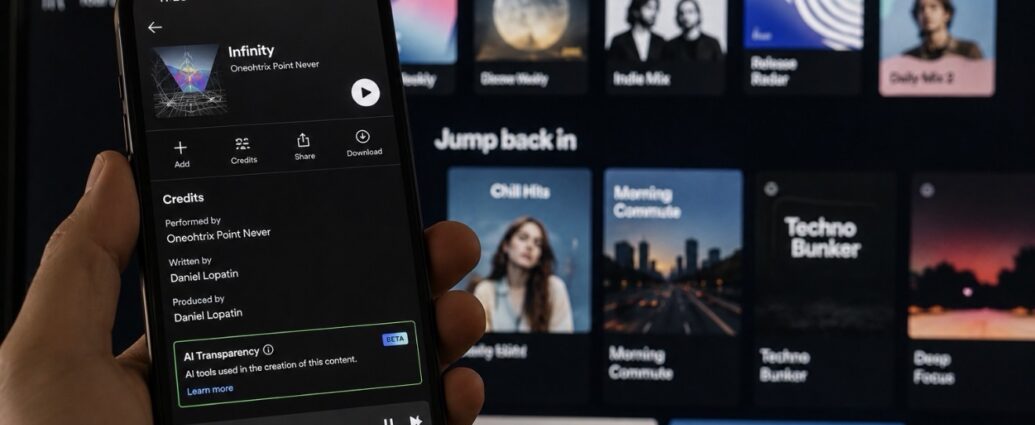
NEW YORK — The world’s largest record companies are accelerating an industry-wide effort to have streaming services clearly identify songs created with artificial intelligence, as platforms, distributors and music companies move toward greater transparency for listeners. Recent initiatives by Apple Music, Spotify and other major streaming services reflect a broader push to distinguish AI-generated content from music created by human artists.
The world’s biggest record companies are pressing streaming platforms to put a clear mark on songs made with artificial intelligence, and the effort is moving from optional to expected. Apple Music said the disclosure tags it introduced this spring, known as Transparency Tags, will become required for newly delivered music. Spotify, which began displaying AI credits in song listings, says the labels identify when AI was used for vocals, lyrics or production, while cautioning that the absence of a label does not necessarily mean a song was created entirely by humans.
The push matters because AI music is no longer a curiosity. It is arriving at an unprecedented pace. Deezer, the French music streaming platform, says its AI detection system now flags approximately 75,000 fully AI-generated tracks uploaded each day—more than 2.2 million every month. Spotify has also disclosed removing tens of millions of spam and fraudulent tracks over the past year. For listeners, the result is straightforward: it is becoming increasingly difficult to know whether the voice behind a song belongs to a human artist or was created by software.
Much of the emerging labeling system is built around DDEX, the music industry’s global metadata standard used by record labels and distributors to deliver songs to streaming platforms. Under the system, artists or labels disclose whether artificial intelligence was used during the creative process, allowing that information to appear within song credits on services including Spotify and Apple Music. Major distributors such as DistroKid, CD Baby, Believe and EMPIRE have integrated the framework into their delivery systems. The current challenge, however, is that the process largely depends on creators accurately reporting AI usage.
The financial stakes are substantial. Streaming royalties are distributed from a shared revenue pool, meaning fraudulent or artificially generated content that attracts illegitimate streams can reduce payments available to legitimate artists. When streaming services later identify manipulated activity, royalties are often reclaimed from distributors and, in some cases, charged back to artists. Record labels argue that stronger disclosure standards will improve transparency while helping protect royalty payments for musicians whose work generates authentic audience engagement.
The transparency initiative is unfolding alongside an even larger legal battle over artificial intelligence and copyright. The Recording Industry Association of America (RIAA), representing Universal Music Group, Sony Music Entertainment and Warner Music Group, filed lawsuits against AI music companies Suno and Udio, alleging their models were trained using copyrighted recordings without authorization. Since those lawsuits were filed, several companies have reached licensing agreements while others continue to defend their practices in federal court. The outcome could reshape how artificial intelligence companies obtain training data and determine whether future AI music platforms must license copyrighted recordings before developing new models.
The legal questions extend well beyond major record labels. Independent musicians, producers and session performers have also argued that recordings containing their performances were used to train AI systems without compensation. Several additional lawsuits remain pending as courts weigh whether training artificial intelligence models using copyrighted works qualifies as fair use or requires licensing agreements.
For consumers, the most visible change will likely be the labels themselves. As more streaming platforms adopt standardized disclosures, listeners will increasingly know whether artificial intelligence played a role in creating vocals, lyrics, instrumentals or production. While a label cannot determine whether a song is good or bad, it provides information many listeners increasingly say they want before pressing play.
For the music industry, the effort reaches beyond transparency. Record companies view AI labeling as one component of a broader strategy to protect intellectual property, preserve royalty streams and establish clear rules governing how artificial intelligence is used throughout music production and distribution. As AI-generated music continues to grow, the industry’s next challenge will be balancing technological innovation with protections for the creators whose work built today’s music business.
JBizNews Desk | New York
© JBizNews.com All Rights Reserved. Reproduction or distribution without written permission is prohibited.