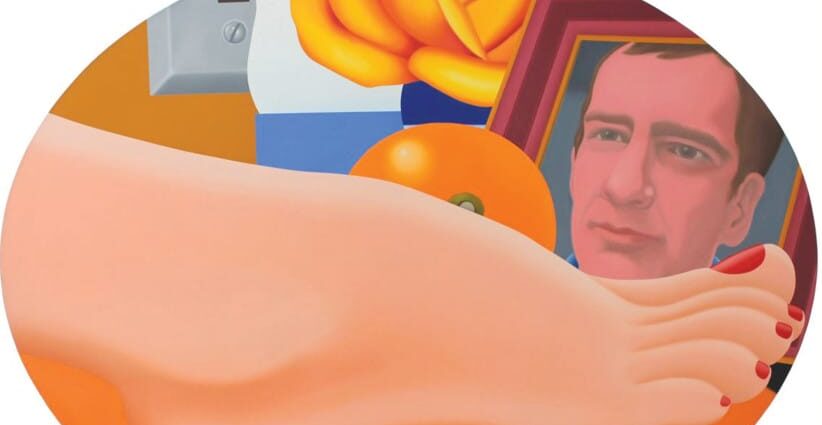
As the United States marks its 250th anniversary, a burst of American pop art lands in Israel, colliding with questions of how imagery from that era reads in today’s social and political climate.
At a moment when local realities feel increasingly complex, the Tel Aviv Museum of Art (TAMA) turns to Tom Wesselmann and the visual grammar of American consumer culture.
Tom Wesselmann: All Out, on view through December 26, is the first comprehensive exhibition in Israel dedicated to the late American artist (1931-2004).
The show brings together over 40 works from the 1960s and 1970s, including key pieces from his Great American Nude, Still Life, and Bedroom Paintings series, drawn entirely from the private collection of Marie and Jose Mugrabi.
“Presenting a comprehensive exhibition in Israel at this particular moment dedicated to Tom Wesselmann, one of the most important and influential artists to emerge in the United States during the 20th century, is a significant achievement for the Tel Aviv Museum of Art,” TAMA director Tania Coen-Uzzielli said.
“Wesselmann’s work continues to resonate today, inspiring generations of artists working within an image-saturated culture.”
Yet bringing Wesselmann’s landscapes of American abundance to the Middle East right now is not simply an exercise in colorful escapism.
For curator Shahar Molcho, the show demands a confrontational, albeit liberating, interaction with the audience, using Wesselmann as a tool for examining how we look at images today.
Stripping away the modern gaze
Wesselmann’s work emerged in the 1960s, at the height of the sexual revolution and the rise of mass advertising culture. His canvases isolate body parts, lips, breasts, and legs, transforming the classical nude into a flat, hyper-pigmented pop icon.
Today, however, these direct, unapologetic images collide with modern sensibilities. Molcho explicitly invites visitors to leave their 21st-century lens at the door.
“There is so much critical observation today when we approach an image,” Molcho explained, pointing to the influence of political correctness, the #MeToo movement, and heightened awareness of objectification.
“I ask people who enter the exhibition to remove these things and put themselves 60 years back,” she continued.
“We are already accustomed to jumping to critical and judgmental observations, which often do not put things in their correct and appropriate context.”
She pointed to shifting social codes, using the era’s ubiquitous cigarette as an example. “It is thrilling to see how we look today at an image of a smoking woman, at a pack of cigarettes,” Molcho noted.
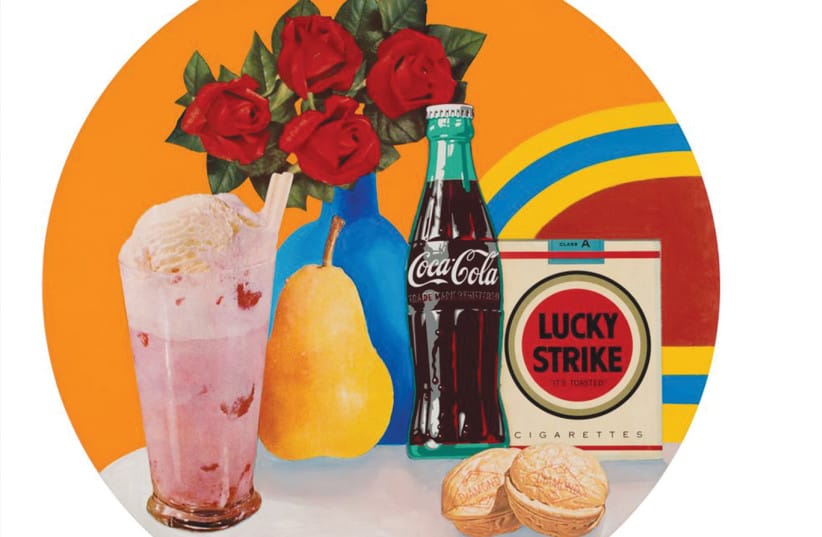
“What in the 1960s was the sexiest thing and the most Hollywood … today we look at the fact that it’s forbidden to advertise cigarette packs,” she went on to say.
This tension extends to how we view the human body.
“We live in a society that highly regulates physical space,” Molcho said, “yet the space of the screen is extremely exposed. Look how p***ographic the space of the screen is.”
That contrast becomes central to how the Bedroom Paintings and Great American Nude series are read today. “Today, you have channels like OnlyFans where the body has become an economic platform,” Molcho noted.
“If today we have the concept of d*** pics, that people take photos and send, then look at artworks from 60 years ago that dealt with freedom and this sexual celebration in such a direct and liberated way.”
For a readership with deep American roots, the exhibition’s themes hit particularly close to home. Wesselmann’s most famous series, Great American Nude, plays on a concept that is impossible to detach from today’s political climate.
Works that once reflected the optimism of postwar America now sit within a different global reading of American power and imagery.
A portrait of John F. Kennedy, created two years prior to his assassination, captured the bright promise of a new era. Today, that cultural dominance has shifted into a different kind of global presence.
“We wake up in the morning and want to know what [US President Donald] Trump decided, and what our day will look like,” Molcho observed.
A dialogue across centuries
Despite the bold colors and advertising aesthetics, Wesselmann’s engagement with art history runs deep. Behind the pop art surfaces lies a sustained dialogue with European painting traditions.
“He takes classical subjects, like still life, and puts them into an American bedroom with everyday items,” Molcho explained.
Wesselmann pushed the boundaries of his medium, using shaped canvases like the iconic Mouth #14 (Marilyn) and incorporating physical, real-world objects directly into his art, such as the painted plastic orange in Still Life #49 or the actual radiator, telephone, and door built into Great American Nude #44.
The effect is not decorative; it produces friction between tradition and consumer culture, painting and advertising, intimacy and display. To highlight this intergenerational dialogue, the exhibition expands beyond Wesselmann himself.
Molcho has positioned his work alongside pieces from TAMA’s collection by historical masters like Henri Matisse and Pablo Picasso, as well as contemporary voices like Mickalene Thomas and Doron Solomons.
Perhaps the most compelling story behind All Out is the fact that it is hanging on the walls of TAMA at all. Molcho was candid about the difficulties of bringing international art to Israel right now.
“In light of the growing boycott, there is a very great difficulty in bringing international art to Israel,” she admitted. “This is an objective difficulty even before we get into politics at all.”
Beyond the political climate, the logistics of insurance and shipping for priceless works are significant.
“You think about insurance, and you think about shipping, and you think about the desire of artists, of lenders, and of institutions to send works of art to Israel during this period – it is a very big challenge. Many projects were postponed and canceled in the last three years.”
Against that backdrop, the Mugrabi collection has become a crucial partner. “These are the places we turn to also to present exhibitions,” Molcho said of the Mugrabi family. “They do not compromise in any way. This is first-rate quality.”
Ultimately, All Out is not a nostalgic return to pop art, but a test of perception. Wesselmann’s images remain immediate, seductive, and disarmingly direct, but they now arrive in a world where looking is unstable, constantly shaped by context, memory, and critique.
The question the exhibition quietly poses is simple: What happens when images that once defined visual clarity meet a present that no longer trusts what it sees? For visitors, the answer unfolds not in explanation, but in looking.