I have a love affair with Israel’s North. Ask me any day, any time, if I want to go north and I will say, “When do we leave?”
Once the Carmel mountains appear on the left and Mount Tabor can be seen in the distance on the right (when it’s not hazy), I’m already relaxing. My breathing is slower, my mind clearer, and my head is out the window.
Before the wars, I went multiple times a year – usually with Laura Ben-David, my soul sister and best friend. I breathed. She photographed. I zenned by the flowing streams; she captured the moments.
But the wars have made travel there difficult, and Laura’s death left me without my “Let’s go!” partner – and I have missed it terribly.
So when Yael Levontin of Jewish National Fund-USA texted me, “Would you be interested in joining me tomorrow in the North to cover a story? We are opening our GCI by JNF building for a cooking therapy session for kids in the region,” my answer was “OMG [oh my God] yes.”
I’ll be honest. I didn’t have much expectation (and I didn’t know what GCI was). I figured we would see some kids, talk about processing trauma through activities, and I would be in my beloved North for a few hours.
I also did not realize how close we would be to the border and thus the Hezbollah rocket fire. The last time I had been so far north was in 2024 to pay respects to the Druze community of Majdal Shams after the horrific tragedy at the soccer field in which a Hezbollah rocket killed 12 children.
Off we went. And while I did fall in love all over again at my landmarks, I also increasingly thought, My family is going to kill me for driving happily into a war zone.
The quiet roads were both magical and mournful. The glorious North is empty, devoid of the thousands who would be wading through its streams; bereft of hikers climbing its hills, the normally well-tread trails overgrown and obscured.
But the wild beauty of the Galilee beside the fields tended with love even under fire is where my heart finds its home.
By the time we pulled into Kibbutz Gonen, nestled between the Hula Valley and the Golan slopes, my neck hurt from craning to catch every sight I could.
But the best was yet to come. We were greeted with a huge smile by Anna, director of sales, business development and marketing of CGI, which I now know stands for Galilee Culinary Institute.
As she opened the doors to a stunning, incredible, state-of-the-art building, I fumbled for words. No joke – it felt like walking into another world. A spectacular restaurant opened before us, with views that make you want to plant (or at least frolic in) the open fields. Romantic dinners, friends night out – this place is Instagram-worthy.
Anna took us through kitchens with cutting-edge equipment and top standards, pastry-making rooms, and a manual flour mill (so that students learn what makes wheat into flour, how it functions and tastes at different stages).
The institute isn’t just where one learns to cook; one also learns about food, nutrition, agriculture, taste, aesthetics, and more.
A recipe for rebuilding the North
Every room elicited a gasp, and I could not believe that such a glorious institute sits in the midst of a kibbutz.
The institute is intended to turn the Galilee into a global food and culinary capital while strengthening the region itself. The school will include a restaurant, brewery, winery, chocolatier, bakery, and farm, bringing jobs and economic growth, attracting students, tourists, and professionals, and supporting local farmers, producers, and small businesses.
Directed by renowned chef and spice master Lior Lev Sercarz, the JNF-USA Galilee Culinary Institute will bring the entire greater Kiryat Shmona region to life through food, agriculture, employment, education, and tourism.
As the first-of-its-kind, accredited, multiyear cooking school in the Middle East, the academy aims to become a center of professional excellence not just in cooking, baking, food science, food technology, and agriculture, but also in restaurant and hospitality management and the business of food security.
The first cohort was supposed to already have students from around the world, but… wars. So, the JNF-USA did what Israelis do best and pivoted. The innovative kitchens would be used for cooking workshops for northern families – to get them out of the house and away from the fears of war for a few hours.
The participants filed in. Normal Israeli teens – and their parents, actually mainly dads (one even in uniform). Most of those who joined were there with their fathers (I imagine the mothers were happy to get them out of the house for a few hours!).
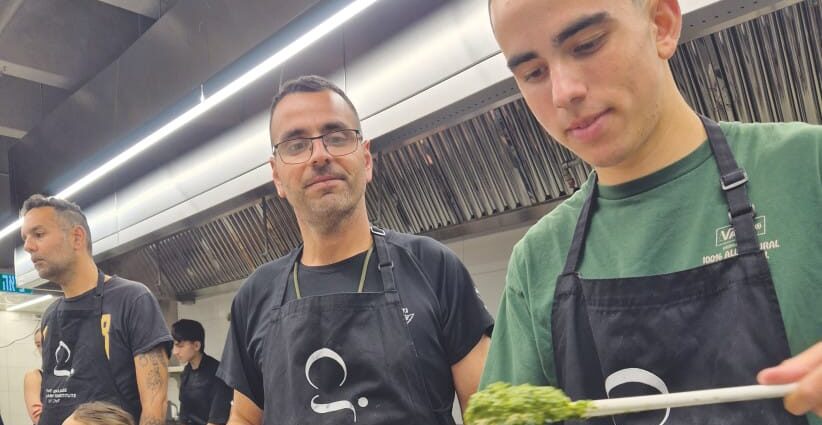
Paired up in the incredible kitchens (think MasterChef but better), they heard about the food they would be making (empanadas, salad, apple tarts, and chimichurri).
They learned a bit about the institute itself and, of course, where the safe room is. We practiced filing out of the kitchen and into the reinforced room next door – important when you have 15 seconds or less from the time you hear the siren.
These families would be the first people to ever use the kitchens. Nervous, or a bit wary at first, the participants loosened up, smiled, chatted, and divvied up the work among themselves.
Smiles abounded, and I asked a few people whether I could interview them. Friends, I was humbled.
“What is it like living where you have 15 seconds to find shelter – for years under fire?”
“Don’t feel bad for us,” said one father. “We have 15 seconds. The people on the border have none. No time. We have to be next to a protective space; they can’t leave one.”
His son enjoyed the opportunity to do something with his dad that wasn’t work or war-related, something that enabled them to work with their hands and be together.
Other parents I spoke with loved having the one-on-one time with their children – not on a screen – and the kids loved getting out of the house to learn something new. Schools in the North have been closed since mid-February.
Eli Ovadya, 40, lives in Kibbutz Amir and came with his daughter. “We came to get some time off from this crazy routine. There aren’t any after-school activities, and we have time to be together, taking a break from the uncertainty. You don’t know what you can or cannot do, should do or shouldn’t. Missiles and sirens.
“You get used to it after a month and a half; it’s been very hard. We miss our home the way it used to be and the way it should be.
“My daughter is 16. It was great cooking with her. When I was cooking with her, she was focused on that – not worried about sirens or potential sirens or what-ifs. She just had a beautiful activity.”
Shiri is 18, from Kibbutz Gonen. “We learned to cook different things.
“It was really fun and important for us to come here today with all our friends. I had a break from the past two weeks that were really hard in the kibbutz; the war and the noise. It was a really good break for us to get away from everything”.
Shalev, 19 years old, is doing a year of service in Gonen before the army. “I wanted to come here because I wanted to expand my knowledge of how to cook.
“Having a break from the war freed my mind. It gave me the opportunity to not focus on everything around us. The cooking quieted my brain. It gave me quiet in my head.”
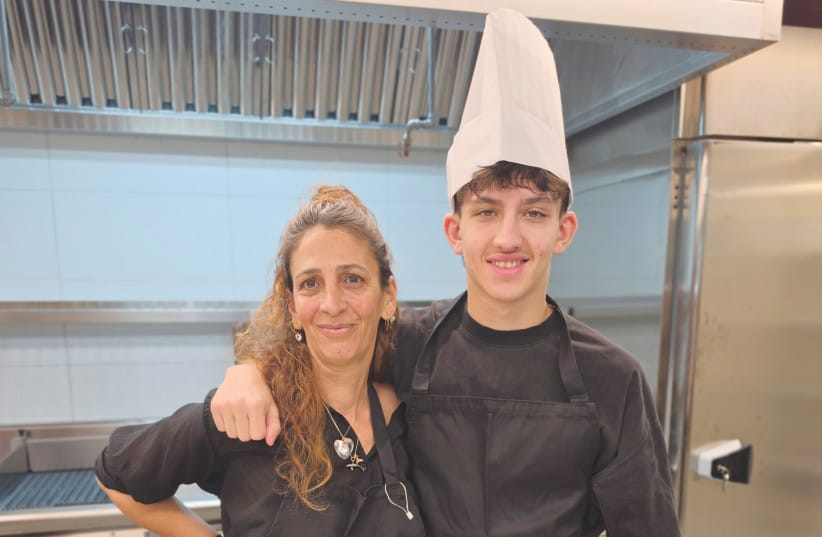
Steve Dabrow, chairman of GCI by JNF, says of the program, “Our mission has always been to stand with our communities not only in times of strength, but in moments of profound challenge.
“We had the privilege of welcoming families from Kibbutz Gonen to GCI by JNF for a simple yet deeply meaningful experience – cooking together.
“In the midst of war and daily uncertainty, this workshop offered something essential: a chance for parents and children to slow down, reconnect, and find comfort in one another.
“Watching families knead dough, share laughter, and briefly set aside the weight of sirens and stress was a powerful reminder that resilience is built in these small, human moments. What may seem like an ordinary activity became, in this context, an extraordinary source of relief, grounding, and hope.
“JNF-USA intends to continue these resilience workshops, ensuring that more families have access to spaces where they can heal, connect, and simply feel like themselves again. Even in the most difficult times, creating moments of normalcy and togetherness is not just meaningful – it is essential.”
I left the experience entirely uplifted, impressed with the people of the North, who are living the reality that I worried about experiencing for a day; astounded by JNF-USA’s ingenuity and farsightedness, to create an entire food ecosystem of the highest quality – not just “good enough” but cutting-edge standard with heart and soul, detail and imagination befitting the glory of the North and its people.
In my work, I often deal with the worst humanity has to offer: the pain people can inflict on one another, the selfish impulses that cause people to harm one another.
This project, the people behind it, the desire for positive change for all involved, Jews and non-Jews, is something healing for the soul and, honestly, the stuff that dreams are made of.■