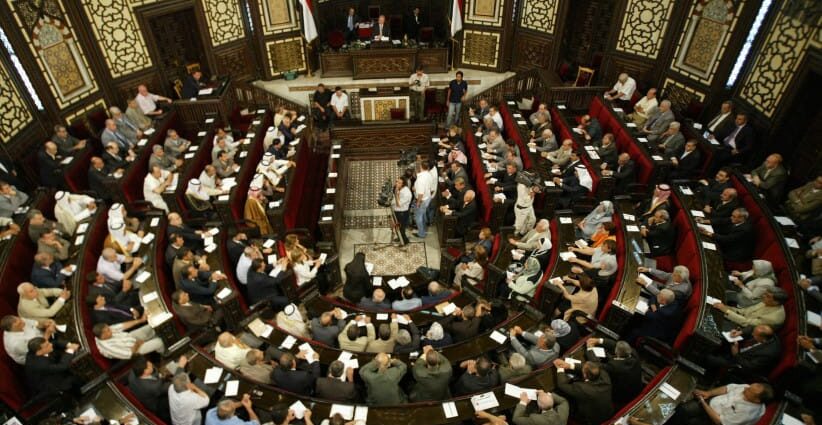
Syrian President Ahmed al-Sharaa spoke at the opening of the newly formed People’s Assembly on Sunday, in a historic event for Syria.
Bashar al-Assad‘s regime fell in December 2024.
In 2025, Syria spent the year trying to unite the country and begin its complex process of appointing members of the new parliament. The final members were recently chosen by the president after a vote last year. The voting was done by electors, so the parliament still does not reflect a widespread vote.
Nevertheless, this is a major step for Syria.
New Syrian parliament is more diverse, including many female, minority representatives
Many commentators online noted that, unlike in the Assad era when he would receive a dictator’s round of applause, with sycophants in the rubber-stamp parliament applauding him, now there is no cheering for Sharaa.
Instead, the new Syria has a more diverse parliament, with, for instance, one Kurdish woman representative wearing traditional Kurdish clothes.
The woman in Kurdish clothes was Fasla Yousef, a senior member of the Kurdish National Council (ENKS). She is one of five Kurds who won elections held in Kobane, Hasaka, Qamishli, and Derik, bringing the total number of Kurdish representatives in the interim parliament to at least eight, including three elected in Afrin in October 2025, Rudaw noted. She represents Hasakah along with Ibrahim Mustafa al-Ali and Omar Issa Hais.
Commentators also pointed to the fact that one woman appeared in a full veil and the presence of a Syrian actress who was appointed.
Actress Rozina Lazkani, 36, was selected as one of President Sharaa’s 70 appointees earlier this month. It was not clear who the woman in the full veil was.
Men in the new parliament also come from a variety of backgrounds. There are Alawites, Druze, Kurds, Christians, Sunnis, and others represented in the new parliament. It is believed that there are six Christians, five Alawites, and three Ismailis in the new parliament.
An article at New Lines Magazine by Abdullah al-Ghadhawi, “I went through the resumes of all 210 members, starting with the 140 whose backgrounds show how the parliament was born of the 13-year war, not of party life. The overwhelming majority of members come largely from no declared party and ran on no institutional platform.”
He noted that “instead, they rose through the social and political networks that Syrians built after 2011, including the opposition movement and its local armed factions, Sharia councils and local councils, relief organizations and field hospitals, free professional unions, civil defense groups, reconciliation committees, town notables and Kurdish parties.”
Syrian state media SANA noted that Sharaa “called on members of Syria’s newly formed People’s Assembly to make the legislature a model of responsibility, competence and institutional governance, urging lawmakers to promote dialogue, uphold the rule of law and help build a modern Syrian state.” He spoke at the first session, which had been postponed last week.
“President al-Sharaa said humanity had long sought the best way to govern public affairs, stressing that consultation and consensus remained the most effective means of achieving the common good.” He added, “there is no better path than consultation and consensus,” he said, adding that “mutual acceptance is essential to overcoming division, resolving differences and reaching sound judgment.” Syria is entering a new chapter, he said. Last week he hosted the French president in Damascus and also met US President Donald Trump in Ankara on the sidelines of a NATO summit.
The Syrian People’s Assembly elected Member of Parliament Abdul Hamid Akil al-Awak as the Speaker of the new council. He secured a majority of 99 votes during the parliamentary session, SANA noted. It also noted that Moayad Hayel al-Qablawi and Mohammad Ramez Koraj had sought the position. Awak was born in 1966 and earned a Bachelor’s degree in Law from the University of Aleppo in 1990. Awak is considered a legal expert from Hasakah Governorate.
140 members were chosen through elections to the new parliament
A total of 140 members of the new parliament were elected by a limited number of electors in each area of Syria. The president appointed 70 members of the new parliament.
Only the Sweida area did not participate in the process, as it is governed by a Druze leadership seeking autonomy or independence and does not recognize the new government in Damascus. Nevertheless, a pro-government Druze figure, Laith al-Balous, was appointed to the new parliament.
Rudaw Kurdish media network noted that the “new parliament will serve a 30-month term and is expected to review previous decrees, pass legislation and begin drafting a new constitution. The assembly’s composition has drawn criticism from some Kurdish politicians, who argue that Kurdish representation falls well below the community’s share of Syria’s population. Only a handful of Kurds are among the presidential appointees, while nine Kurdish lawmakers were elected from northeast Syria, known as Rojava.”
Several Kurdish members from the ENKS or KNC parties were appointed.
Rudaw noted that “senior Kurdish National Council (ENKS) official Sulaiman Oso previously said he hoped Kurdish lawmakers would effectively represent their constituents.” Oso said, “We wish them success, and I hope that they are the voices of our people in the Syrian parliament and obtain Kurdish rights in the new constitution and work to make Kurdish the official language in Kurdish areas,” Rudaw noted.
Turkey’s Special Envoy to Syria Nuh Yilmaz noted, “The Syrian People’s Assembly opens today. I congratulate all the Syrian people. Syria waited for decades to regain its popular sovereignty, gave hundreds of thousands of lives, and hundreds of thousands of people wasted away their lives in prisons. Syria has more than earned this.”
The Syria in Transition magazine noted that a poll of Syrians about the new assembly found that only 14 percent believed it was representative, and only 10 percent felt it would influence decisions.
Many said they didn’t know what would come next. It shows that many Syrians are either skeptical or taking a wait-and-see approach. Having lived under Assad regime rule since the 1970s and then in 13 years of civil war where much of the country was destroyed, and millions had to flee abroad, it is no surprise people are skeptical.
Levant24 noted that Sharaa said, “Since the beginning of humanity, people have searched for the best way to manage their interests. Acceptance and consensus are a means to overcome disagreements.” He also said “we are partners in building responsibility, and the council today is a platform for truth and justice…I call on you to make this council a model of responsibility and competence, and to contribute to strengthening the culture of dialogue, the rule of law and respect for institutions.”