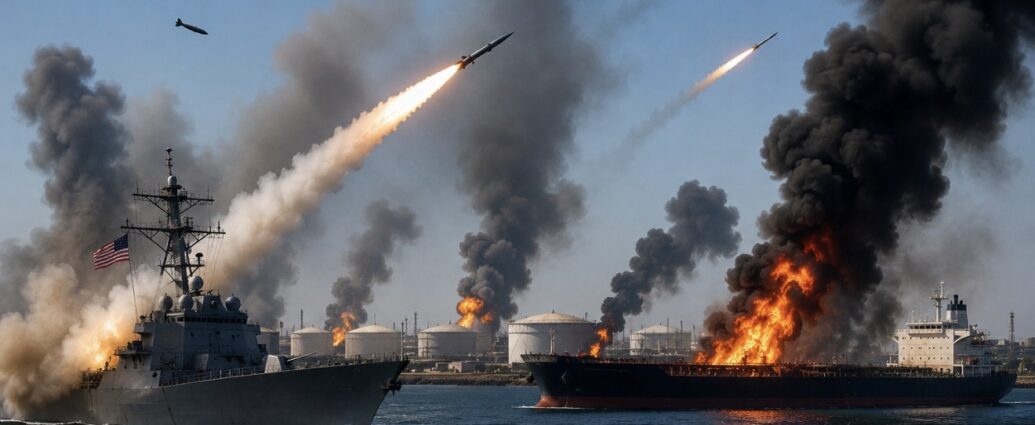
U.S. Central Command said Sunday, July 12, that American forces struck about 140 Iranian military targets over the weekend, the third round of strikes in a week, after Iran’s Islamic Revolutionary Guard Corps attacked a container ship in the Strait of Hormuz and again declared the waterway closed. The command said the operation, ordered by President Donald Trump on Saturday, lifted the three-night total to more than 300 targets and was meant to strip Tehran of the ability to fire on commercial shipping.
The targets included missile and drone positions, naval assets, ammunition depots, communications networks and coastal radar, CENTCOM said. The escalation followed the IRGC’s strike on the Cyprus-flagged GFS Galaxy, whose engine room was heavily damaged; one Indian crew member remained missing and ten others were rescued after the crew abandoned ship to a lifeboat. Iran answered by firing across the Gulf, claiming attacks on Jordan, where three missiles struck near the Prince Hassan Air Base; on Qatar, where shrapnel from an intercept injured three people, including a child, near the Al Udeid base; and on Kuwait, where a Kuwait Oil Company drilling platform was hit and a worker hurt. The United Arab Emirates, Oman and Bahrain reported intercepting missiles and drones.
The fighting runs straight through the price of oil. Brent crude, the international benchmark, has held near $76 a barrel and settled as high as $78.19 last week, while West Texas Intermediate climbed above $73, leaving Brent up more than 5% on the week. Roughly 20% of the world’s oil and liquefied natural gas — about 20 million barrels of crude a day — moved through Hormuz before Iran began choking the channel in late February. Equities have swung with each headline: the Dow Jones Industrial Average shed 577 points, or 1.1%, the day Trump told a NATO summit the ceasefire was “over,” while the energy-tracking XLE fund rose more than 2% as crude jumped. The S&P 500 and Nasdaq Composite have traded choppily since, and the yield on the 10-year Treasury note climbed toward 4.60%, up from 3.97% before the war, as bond investors priced in faster inflation.
Washington also tightened the financial screws. The U.S. Treasury moved to revoke the 60-day waiver that had allowed sales of Iranian oil through August 21, barring transactions after July 17 and cutting off revenue Tehran had counted on under the “Islamabad Memorandum” the two sides signed last month. That deal was meant to pause the war for 60 days, reopen Hormuz and buy time to negotiate Iran’s nuclear program; it has instead frayed with each attack.
The disruption reaches well beyond crude. Major carriers including Maersk, Hapag-Lloyd, CMA CGM and MSC have suspended or sharply limited Hormuz transits and rerouted Asia-Europe cargo around the Cape of Good Hope, adding 10 to 14 days and thousands of dollars per container in war-risk and emergency surcharges. War-risk insurance premiums have run near 0.5% of a vessel’s value per transit, about four times pre-crisis levels, with some underwriters pulling Gulf cover entirely. Maritime trackers said the number of ships waiting west of the strait had fallen below 700. Energy majors are feeling it too: Shell trimmed its second-quarter gas output guidance, citing lost Qatari volumes, and the International Monetary Fund cut its 2026 global growth forecast to 3%, blaming the energy shock even as booming AI investment cushioned the blow.
The political temperature matched the military one. Defense Secretary Pete Hegseth wrote on social media, “Iran made a poor choice. Now they pay.” Iran’s new Supreme Leader, Mojtaba Khamenei, who took over after his father was killed in the war’s opening strikes on February 28, vowed vengeance, and senior negotiator Mohammad Bagher Ghalibaf declared “the era of one-sided deals is OVER.” CENTCOM, disputing Tehran’s closure claim, insisted the corridor stays open: “Iran does not control the strait. Traffic is flowing,” it said, adding that U.S. forces had helped move more than 800 commercial vessels and 400 million barrels of crude since early May.
For businesses, the risk is a fresh energy and price shock at a delicate moment. Berenberg chief economist Holger Schmieding noted that Trump, facing November midterm elections, wants cheaper fuel, while Tehran’s Guard covets the cash that sanctions relief would bring — competing pressures pulling the strait in opposite directions. Verdence chief investment officer Megan Horneman called the standoff “highly inflationary and highly uncertain,” warning that markets may be growing numb to an on-again, off-again war. With Oman’s mediation stalling and both sides digging in, the crude that fuels the world economy remains hostage to a 21-mile channel.
JBizNews Desk | Washington © JBizNews.com All Rights Reserved. Reproduction or distribution without written permission is prohibited.