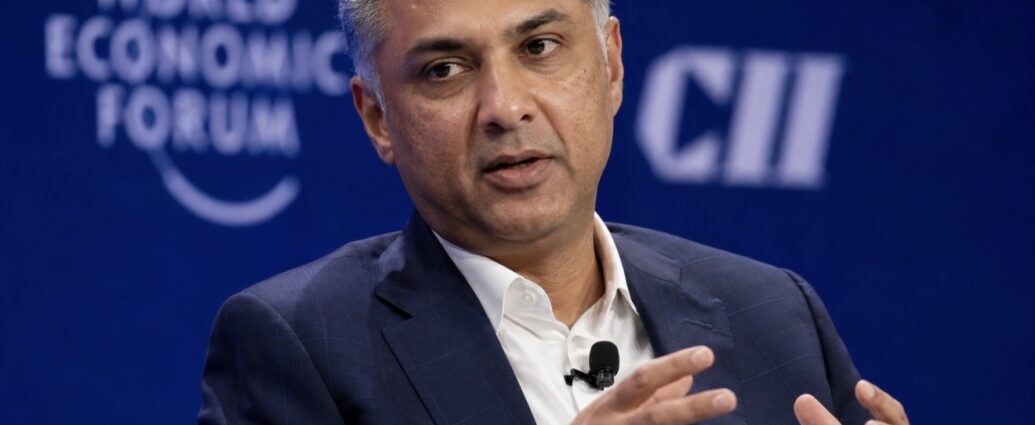
Artificial intelligence may be transforming nearly every industry, but one of the technology sector’s most influential cybersecurity executives says the economics still do not work for most businesses. Nikesh Arora, chairman and chief executive of Palo Alto Networks, told CNBC that the cost of running AI must fall by roughly 90 percent over the next two years before companies can afford to deploy it broadly across their organizations. While the technology itself continues to improve rapidly, Arora argued that today’s pricing remains the biggest obstacle preventing AI from moving beyond pilot projects and into everyday enterprise operations.
Speaking on CNBC’s Squawk on the Street, Arora focused on the cost of AI “tokens,” the units companies pay for every prompt submitted and every response generated by an AI model. Although token prices have fallen significantly over the past two years, he said they remain too expensive for organizations looking to deploy AI across thousands of employees and millions of daily interactions.
His comments came just moments after OpenAI Chief Executive Sam Altman appeared on the same program and said the company’s newest model delivers 54 percent greater efficiency on agentic coding tasks. Arora praised the improvement but made clear it is only an early step.
“I think 54% is a good start,” Arora said. “I think we probably need another turn at it.”
He estimated that AI costs need to decline dramatically again over the next two years before most chief information officers will feel comfortable approving company-wide deployments.
The challenge, according to Arora, is not a lack of demand.
“Demand continues to be infinite,” he said, noting that businesses are eager to adopt AI but continue to face two major constraints: limited computing capacity and high operating costs. Every AI request carries a measurable cost, making large-scale deployments difficult to justify under current budgets.
For business leaders, the issue is becoming increasingly important. While executives continue investing heavily in AI, many companies are placing limits on employee usage, steering workers toward lower-cost models, or testing open-source alternatives to control expenses. The conversation has shifted from whether AI works to whether organizations can afford to use it at scale.
Arora is not the only technology executive questioning today’s pricing model. Earlier this week, Palantir Technologies Chief Executive Alex Karp criticized the per-token pricing structure used by OpenAI and Anthropic, telling CNBC that “something has gone completely wrong.” Karp argued that open-weight AI models could eventually provide enterprises with a significantly more affordable alternative while reducing dependence on expensive proprietary systems.
The debate comes as AI providers continue competing aggressively on both performance and price.
The differences are already visible across the industry’s leading models. SpaceXAI’s Grok 4.5, introduced on July 8, is priced at $2 per million input tokens and $6 per million output tokens. OpenAI’s GPT-5.6 ranges from $1 to $10 per million input tokens and $6 to $45 per million output tokens, depending on the service tier. Anthropic’s Fable 5 is priced at $10 per million input tokens and $50 per million output tokens. For organizations processing millions of AI requests every day, those differences can quickly add up to millions of dollars in annual operating costs.
The discussion is particularly significant for Palo Alto Networks, whose future growth is increasingly tied to artificial intelligence. The cybersecurity company protects AI infrastructure, secures enterprise deployments, and embeds AI throughout its own product portfolio, meaning broader AI adoption would likely expand demand for its security offerings.
The company’s financial results reflect that momentum. In results reported June 2 for the quarter ended April 30, Palo Alto Networks generated $3.0 billion in revenue, up 31 percent from a year earlier, including $388 million from the recently acquired CyberArk and Chronosphere businesses. Next-generation security annual recurring revenue climbed 60 percent to $8.1 billion, while remaining performance obligations reached $18.4 billion, highlighting continued customer investment in AI security.
The rapid expansion has also increased expenses. Palo Alto Networks reported a GAAP net loss of $177 million, compared with a $262 million profit during the same period a year earlier, primarily due to acquisition-related costs and stock-based compensation. On a non-GAAP basis, however, net income increased to $684 million, or 85 cents per share. Chief Financial Officer Dipak Golechha said the company remains ahead of its integration plans and continues targeting a 40 percent adjusted free cash flow margin by fiscal 2028.
Despite the current pricing challenges, Arora remains optimistic that the economics will eventually improve.
“All these things will rationalize over time,” he told CNBC.
If that happens, enterprises are expected to accelerate AI adoption across virtually every business function—from customer service and software development to finance, legal, human resources, and cybersecurity. For Palo Alto Networks, cheaper AI would not represent a threat but an opportunity, creating more AI-powered systems that require protection and expanding the market for the security technologies it sells.
JBizNews Desk | New York
© JBizNews.com All Rights Reserved. Reproduction or distribution without written permission is prohibited.