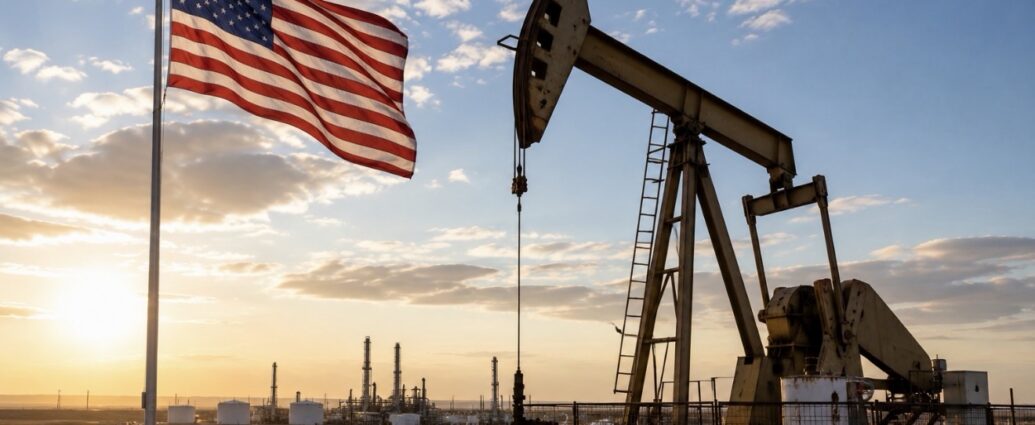
The United States strengthened its position as the world’s largest oil producer in 2025, pumping a record 13.6 million barrels of crude oil per day, according to a July 9 report from the U.S. Energy Information Administration (EIA). The production figure, which includes lease condensate, surpassed the previous U.S. and global record of 13.2 million barrels per day set in 2024 and extended America’s lead over every other oil-producing nation as advances in shale drilling continued to reshape global energy markets.
The milestone underscores how dramatically the United States has transformed from a major oil importer into the world’s dominant producer over the past decade. Since overtaking Russia in 2018, American producers have consistently increased output through improved drilling technology, longer horizontal wells, and greater operational efficiency, allowing companies to extract more oil while operating fewer drilling rigs.
The production gap over America’s closest competitors widened again last year.
According to the EIA, Russia remained the world’s second-largest producer at 9.9 million barrels per day, while Saudi Arabia ranked third at 9.6 million barrels per day, up from 9.2 million as OPEC+ gradually unwound voluntary production cuts. Canada held fourth place with approximately 5 million barrels per day.
The United States produced roughly 40 percent more crude oil than either Russia or Saudi Arabia.
Perhaps even more notable was how efficiently that production was achieved.
American crude output increased by roughly 350,000 barrels per day, or about 3 percent, despite a 5 percent decline in active drilling rigs and slightly fewer wells being completed. The EIA credited improvements in drilling productivity across major shale regions, particularly the Permian Basin, where operators continue extracting more oil from every new well.
The Permian Basin, spanning western Texas and southeastern New Mexico, remained the country’s largest producing region, accounting for approximately 48 percent of total U.S. crude production. Output there climbed 280,000 barrels per day to 6.6 million barrels daily, reinforcing its role as the engine of America’s energy expansion.
Despite lower oil prices, drilling remained profitable.
West Texas Intermediate (WTI) crude averaged $65 per barrel during 2025, down from $77 the previous year, but still comfortably above the estimated $61 to $62 per barrel breakeven levels reported by producers operating in the Permian Basin, according to the Federal Reserve Bank of Dallas.
Record production also translated into record exports.
In a separate July 8 report, the EIA said U.S. crude oil exports averaged 5.6 million barrels per day in April, setting another all-time high and exceeding the previous record established in December 2023 by 21 percent. Exports of refined petroleum products—including gasoline, diesel fuel, and jet fuel—also reached their highest level since December 2024.
The export surge came as conflict during the U.S.–Iran war disrupted shipping through the Strait of Hormuz, prompting many international buyers to seek additional supplies from the United States. During the height of the conflict, Brent crude briefly traded above $126 per barrel before retreating. It closed near $76 per barrel on July 10.
Looking ahead, the EIA expects U.S. oil production to remain near record territory.
The agency forecasts average output of approximately 13.7 million barrels per day in 2026 before climbing to 14.2 million barrels per day in 2027. It also projects WTI crude prices averaging roughly $88 per barrel this year as global markets tighten.
The production gains coincide with renewed efforts by the Trump administration to expand domestic energy development.
In November 2025, the administration approved additional offshore lease sales off Alaska, Florida, and California. In March, the Department of the Interior conducted the first lease sale in the National Petroleum Reserve–Alaska since 2019. Interior Secretary Doug Burgum said the auction demonstrated what responsible energy development can accomplish when aligned with America’s long-term national energy needs.
Most recently, on July 7, the Justice Department moved to reverse Biden-era leasing restrictions covering portions of the Arctic National Wildlife Refuge, with Deputy Attorney General Todd Blanche describing the previous limitations as unreasonable and unlawful.
Environmental groups remain opposed.
Mike Scott, oil and gas campaign manager for the Sierra Club, argued that expanded drilling in the Arctic would permanently damage one of America’s last untouched wilderness regions while doing little to address long-term energy needs.
For businesses and consumers, however, rising U.S. production provides a larger domestic energy supply, strengthens America’s position as one of the world’s most important exporters, and offers refiners greater access to competitively priced crude oil. As geopolitical tensions continue affecting global energy markets, the United States appears positioned to remain the world’s swing supplier while maintaining its lead in global oil production.
JBizNews Desk | Washington
© JBizNews.com All Rights Reserved. Reproduction or distribution without written permission is prohibited.