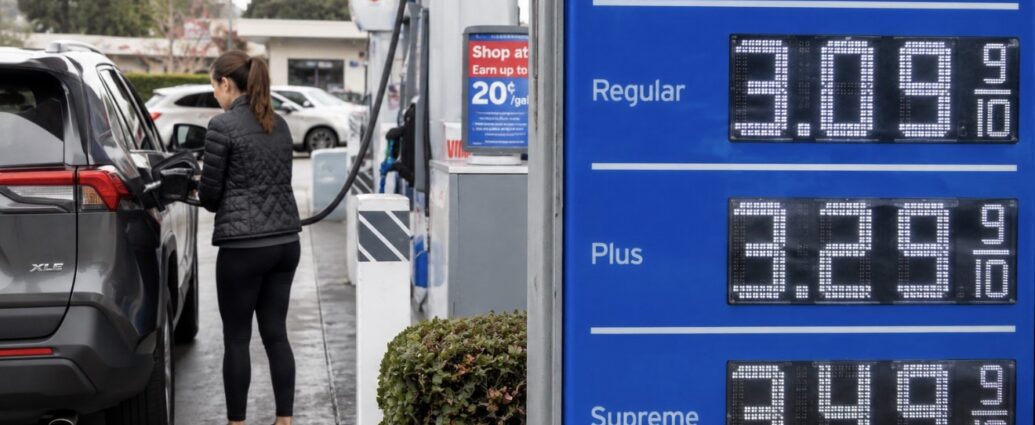
Drivers got a fresh jolt at the pump on Monday after President Donald Trump announced he was reinstating a naval blockade on Iranian shipping through the Strait of Hormuz, a move he laid out in a post on Truth Social that pushed oil and gasoline prices sharply higher just as the summer driving season peaks. Trump said the United States would now be known as “The Guardian of the Hormuz Strait” and would charge a 20% fee on all cargo passing through the waterway, reigniting fears of a supply squeeze that lands straight in household budgets.
U.S. gasoline futures rose above $3.10 a gallon on Monday, up more than 5% on the day, after briefly dipping toward $2.98 in the prior session. Crude did the heavy lifting. West Texas Intermediate jumped more than 8% to around $77 a barrel, its highest in about a month, while Brent crude climbed toward $79. At the retail level, the national average for regular unleaded sits near $3.86 a gallon, according to AAA — well off the $4.56 peak hit over Memorial Day weekend, but climbing again after weeks of relief.
That relief had come after Trump signed a memorandum of understanding with Iran on June 18 to end the conflict and reopen Hormuz, which sent Brent below $70 by July 1. The renewed fighting has reversed part of that drop. Adding to the pressure, Ukraine intensified drone attacks on Russia’s energy infrastructure over the weekend, and Moscow has banned gasoline exports after refinery outages cut its fuel output to roughly 65% of seasonal norms.
The terms Trump laid out carry real weight for the oil trade. At the prices he described, a 20% transit fee would run roughly $32 million for a single supertanker, far above the up-to-$2 million charges Iran previously imposed. For the roughly 20% of the world’s seaborne oil that moves through Hormuz, even the threat of disruption commands a premium. OPEC trimmed its 2026 oil demand growth forecast to 800,000 barrels a day, and tanker traffic through the strait has slowed sharply.
The consumer math is simple and unwelcome. Higher pump prices act like a tax on every household, leaving less to spend on groceries, dining, and back-to-school shopping. Analysts at the Stanford Institute for Economic Policy Research estimated earlier this year that a sustained spike could add hundreds of dollars in transportation costs to the average family’s annual budget. “Even if the war ends tomorrow, gasoline prices are not going down to where they were before the war, at least not in the short term,” said Ryan Cummings, the institute’s chief of staff, pointing to the collision with peak summer demand.
Diesel is the quieter threat. Because nearly everything Americans buy moves by truck, a rise in diesel filters into the price of food and consumer goods weeks later, keeping grocery and delivery costs elevated even after crude cools. Airlines, delivery firms, and rideshare drivers all feel the same pinch.
The U.S. Energy Information Administration still expects prices to ease later in the year. In its July Short-Term Energy Outlook, the agency forecast retail gasoline would average just under $3.80 a gallon in the third quarter, down about 41 cents from the spring, as global supply grows and refiners lift output. But that forecast rests on the assumption that Hormuz stays open and the conflict stays contained — assumptions Monday’s escalation called into question. The agency also noted that stubbornly low gasoline inventories are keeping wholesale margins high, which can offset some of the benefit consumers would otherwise see from cheaper crude.
The timing matters for the inflation picture, too. The Bureau of Labor Statistics reports June consumer prices on Tuesday, and economists expect the month to show a rare decline driven almost entirely by the earlier drop in gasoline. Monday’s rebound means that relief may prove short-lived when the July figures arrive.
Retailers are already bracing. Grocery chains squeezed by cautious shoppers now face customers with even less room in their budgets, and fuel-sensitive businesses from airlines to freight haulers watch every uptick in crude. For families planning late-summer road trips, the message from the market on Monday was clear: budget for more at the pump, and hope the self-declared guardians of the strait can keep the oil moving.
JBizNews Desk | New York
© JBizNews.com All Rights Reserved. Reproduction or distribution without written permission is prohibited.